Indietro
Viruses: Structure, Replication, and Impact
Guida di studio - Note intelligenti
 Appunti personalizzati basati sui tuoi materiali, ampliati con definizioni chiave, esempi e contesto.
Viruses
Introduction to Viruses
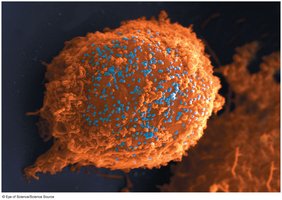
Viruses are infectious particles that exist at the boundary between living organisms and chemicals. They are much smaller than cells and can only replicate within a host cell. Viruses have had significant impacts on human health, agriculture, and the global economy, as seen with the COVID-19 pandemic caused by SARS-CoV-2.
Definition: A virus is a non-cellular infectious agent composed of nucleic acid (DNA or RNA) enclosed in a protein coat, and sometimes surrounded by a membranous envelope.
Size: Viruses range from about 20 nm to several hundred nanometers in diameter.
Examples: Human Immunodeficiency Virus (HIV), SARS-CoV-2, Influenza virus.
Viral Structure
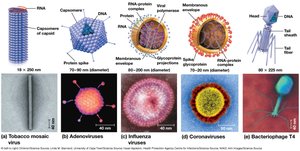
Viruses are structurally simple but diverse. Their main components include the viral genome, a protein coat called the capsid, and in some cases, a membranous envelope.
Viral Genome: May be double- or single-stranded DNA or RNA. Viruses are classified as DNA viruses or RNA viruses based on their genetic material.
Capsid: The protein shell that encloses the viral genome, built from protein subunits called capsomeres. Capsids can have various shapes (helical, icosahedral, complex).
Envelope: Some viruses have a lipid membrane derived from the host cell, containing both viral and host molecules. This envelope aids in infecting host cells.
Bacteriophages: Viruses that infect bacteria, often with complex structures including a head, tail, and tail fibers.
Viral Genomes
Viral genomes are highly variable and can be composed of DNA or RNA, which may be single- or double-stranded. This diversity influences how viruses replicate and express their genes.
DNA Viruses: Use DNA as their genetic material.
RNA Viruses: Use RNA as their genetic material; these often mutate rapidly.
Capsids and Envelopes
The capsid protects the viral genome and facilitates its delivery into host cells. Envelopes, when present, are derived from host membranes and contain viral proteins that help the virus attach to and enter host cells.
Capsomeres: Protein subunits that assemble to form the capsid.
Viral Envelopes: Aid in host cell recognition and entry, often containing glycoproteins.
Viral Replication
General Features of Viral Replicative Cycles
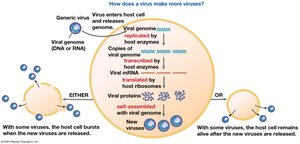
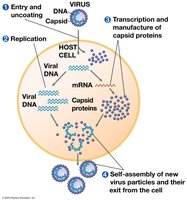
Viruses are obligate intracellular parasites, meaning they can only replicate inside host cells. The replication cycle involves several key steps:
Attachment: Virus binds to specific receptors on the host cell surface.
Entry: Viral genome enters the host cell, either by injection, endocytosis, or membrane fusion.
Replication and Expression: Host machinery is used to replicate viral nucleic acids and synthesize viral proteins.
Assembly: New viral particles self-assemble from the replicated genomes and proteins.
Release: New viruses exit the host cell, often destroying it in the process.
Phage Replicative Cycles
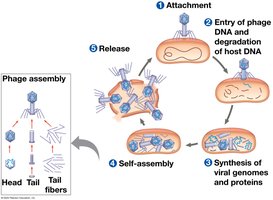
Bacteriophages (phages) can replicate by two main mechanisms: the lytic cycle and the lysogenic cycle.
The Lytic Cycle
Definition: A replicative cycle that results in the destruction (lysis) of the host cell and release of new phages.
Steps: Attachment, entry of DNA, synthesis of viral components, assembly, and release.
Virulent Phage: A phage that reproduces only by the lytic cycle.
The Lysogenic Cycle
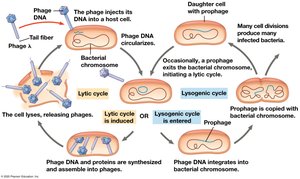
Definition: A cycle in which the phage genome integrates into the host chromosome as a prophage and is replicated along with the host DNA without killing the host.
Temperate Phages: Phages capable of both lytic and lysogenic cycles.
Prophage: The integrated viral DNA in the host genome.
Induction: Environmental signals can trigger the prophage to exit the host genome and enter the lytic cycle.
Bacterial Defenses Against Phages
Bacteria have evolved several mechanisms to defend against viral infection:
Surface Protein Variation: Mutations in surface proteins can prevent phage attachment.
Restriction Enzymes: Enzymes that recognize and cut foreign DNA, such as phage DNA.
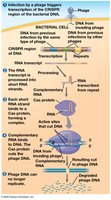
CRISPR-Cas System: A form of adaptive immunity where sequences from invading phages are stored and used to recognize and destroy future infections by the same phage.
Animal Viruses
Classification and Replication
Animal viruses are classified based on their genome type (DNA or RNA, single- or double-stranded) and the presence or absence of an envelope. The replication strategies of animal viruses are diverse.
Enveloped Viruses: Use their envelope to enter host cells, often by fusion with the plasma membrane.
Viral Glycoproteins: Mediate attachment to specific host cell receptors (e.g., SARS-CoV-2 spike protein binds ACE2).
Budding: Many animal viruses exit the cell by budding, which does not necessarily kill the host cell.
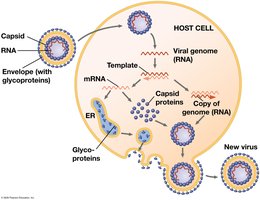
RNA as Viral Genetic Material
RNA viruses are especially diverse and include important human pathogens. Some RNA genomes can serve directly as mRNA, while others require transcription. Retroviruses, such as HIV, use reverse transcriptase to convert their RNA genome into DNA, which integrates into the host genome as a provirus.
Retrovirus: An RNA virus that uses reverse transcriptase to make a DNA copy of its genome (e.g., HIV).
Provirus: Integrated viral DNA in the host genome; a permanent resident.
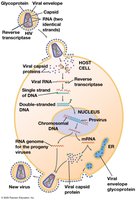
Evolution and Impact of Viruses
Evolution of Viruses
Viruses likely evolved after the first cells, possibly from mobile genetic elements such as plasmids and transposons. They do not fit the traditional definition of living organisms because they require host cells for replication.
Mobile Genetic Elements: Plasmids, transposons, and viruses can move genetic material within and between genomes.
Viral Diseases in Animals
Viruses can cause disease by killing host cells, releasing toxins, or triggering immune responses. Vaccines are the primary tool for prevention, while antiviral drugs can treat, but not cure, infections. Cell surface receptors are important in determining susceptibility to viral infection.
Vaccines: Stimulate the immune system to recognize and fight specific viruses.
Antiviral Drugs: Inhibit viral replication; multidrug treatments are effective against HIV.
Receptor Proteins: HIV uses CD4 and CCR5 to infect cells; some individuals with altered CCR5 are resistant to HIV.
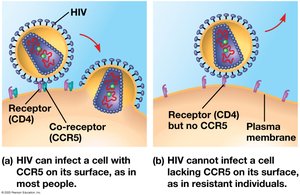
Emerging Viruses
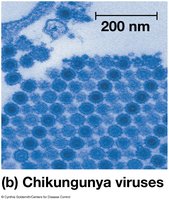
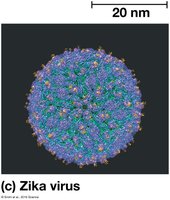
Emerging viruses are those that suddenly become apparent, often due to mutation, spread from isolated populations, or transmission from animal reservoirs. Examples include HIV, Ebola, chikungunya, Zika, and SARS-CoV-2.
Mutation: Especially common in RNA viruses, leading to new strains.
Animal Reservoirs: Many new human diseases originate in animals (zoonoses).
Environmental Change: Can facilitate the spread of viruses to new regions.
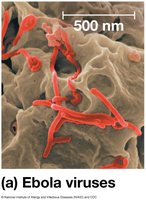
Movement of Viruses Between Host Species
Viruses can move between species, sometimes causing pandemics. Influenza A viruses, for example, infect multiple animal species and have caused several human pandemics. Mosquitoes are important vectors for many viruses, and environmental changes can affect their distribution.
Influenza A: Infects birds, pigs, horses, and humans; named by hemagglutinin (H) and neuraminidase (N) types (e.g., H1N1).
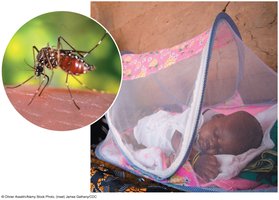
Mosquito Transmission: Dengue, Zika, and chikungunya viruses are spread by mosquitoes.
Prevention: Insecticides and netting are important tools for controlling mosquito-borne viruses.
Viral Diseases in Plants
Plant Viruses
Plant viruses have similar structures and replication strategies as animal viruses, but most have RNA genomes and helical capsids. They spread by horizontal transmission (from external sources, often via insects) and vertical transmission (from parent to offspring).
Horizontal Transmission: Virus enters through damaged plant tissues, often aided by herbivores.
Vertical Transmission: Virus is inherited from parent plants.
Prions: Proteins as Infectious Agents
Prion Diseases
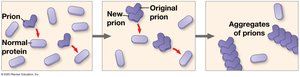
Prions are infectious proteins that cause degenerative brain diseases in animals. They act slowly, are highly resistant to destruction, and currently have no cure. Prions propagate by inducing misfolding in normal proteins, leading to aggregates that disrupt cell function.
Examples: Mad cow disease, Creutzfeldt-Jakob disease.
Mechanism: Misfolded prion proteins convert normal proteins into the abnormal form, forming aggregates.
Research: Stanley Prusiner won the Nobel Prize for discovering prions and has proposed their involvement in diseases like Alzheimer's and Parkinson's.