 Indietro
Water and Carbon: The Chemical Basis of Life (Chapter 2 Study Notes)
Guida di studio - Note intelligenti
 Appunti personalizzati basati sui tuoi materiali, ampliati con definizioni chiave, esempi e contesto.
Chapter 2: Water and Carbon – The Chemical Basis of Life
2.1 Atoms, Ions, and Molecules: The Building Blocks of Chemical Evolution
Understanding the structure and behavior of atoms is fundamental to biology, as all living matter is composed of atoms and molecules. The most common elements in living organisms are hydrogen (H), carbon (C), nitrogen (N), and oxygen (O).
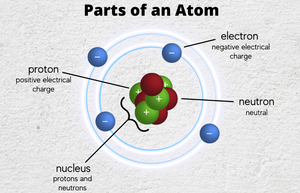
Atom: The smallest identifiable unit of matter, consisting of a nucleus (protons and neutrons) surrounded by electrons.
Proton: Positively charged particle found in the nucleus.
Neutron: Electrically neutral particle found in the nucleus.
Electron: Negatively charged particle orbiting the nucleus.
Element: A substance consisting entirely of one type of atom (e.g., hydrogen).
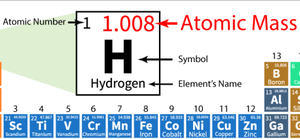
Atomic Number: The number of protons in an atom, unique to each element.
Mass Number: The sum of protons and neutrons in an atom.
Dalton (Da): A unit of mass used to express atomic and molecular weights.
2.1 Ions and Ionic Bonds
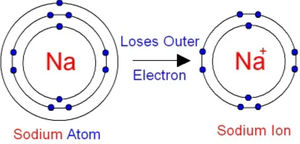
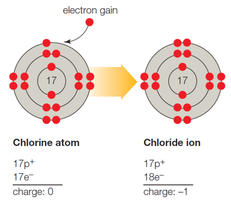
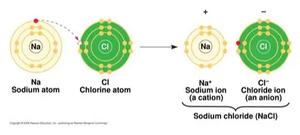
Atoms can gain or lose electrons to achieve a full valence shell, resulting in ions. Ionic bonds form when electrons are transferred from one atom to another, creating charged particles.
Cation: A positively charged ion (e.g., Na+).
Anion: A negatively charged ion (e.g., Cl-).
Ionic Bond: The electrostatic attraction between oppositely charged ions.
2.1 Covalent Bonds and Simple Molecules
Covalent bonds involve the sharing of electron pairs between atoms. The arrangement of electrons in the valence shell determines how atoms bond and the geometry of the resulting molecules.
Covalent Bond: A chemical bond formed by the sharing of electron pairs between atoms.
Valence Electrons: Electrons in the outermost shell, involved in bonding.
Molecule Geometry: The three-dimensional arrangement of atoms in a molecule, which influences its function.
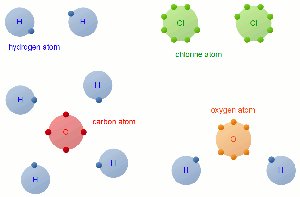
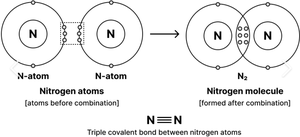
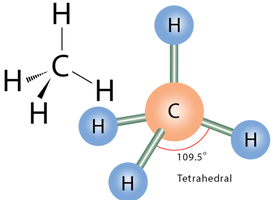
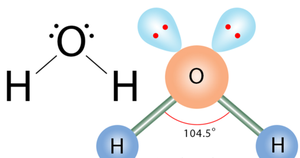
2.1 Representing Molecules
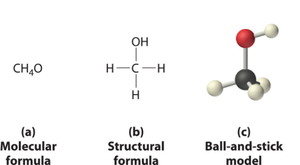
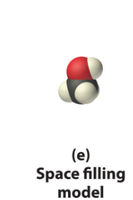
Molecules can be represented in several ways, including molecular formulas, structural formulas, ball-and-stick models, and space-filling models. Each representation provides different information about the molecule's composition and structure.
Molecular Formula: Indicates the types and numbers of atoms (e.g., CH4O).
Structural Formula: Shows how atoms are bonded together.
Ball-and-Stick Model: Illustrates the 3D arrangement and bonding of atoms.
Space-Filling Model: Depicts the relative sizes and spatial relationships of atoms.
2.2 Properties of Water and the Early Oceans
2.2 Water: Structure and Properties
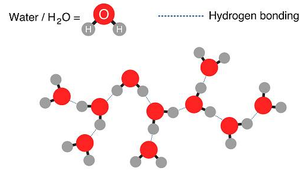
Water is the most abundant molecule in living organisms and is essential for life. Its unique properties arise from its polarity and ability to form hydrogen bonds.
Polar Molecule: Water has partial positive (H) and partial negative (O) charges, making it polar.
Hydrogen Bond: A weak bond between the partial positive charge of hydrogen and the partial negative charge of oxygen in adjacent water molecules.
Solvent: Water dissolves many substances, making it an excellent solvent for biological reactions.
2.2 Hydrophilic and Hydrophobic Interactions
Water interacts differently with polar (hydrophilic) and nonpolar (hydrophobic) molecules. Hydrophilic substances dissolve in water, while hydrophobic substances do not.
Hydrophilic: "Water-loving"; substances that dissolve in water (e.g., ions, polar molecules).
Hydrophobic: "Water-fearing"; substances that do not dissolve in water (e.g., oils, nonpolar molecules).
Hydrophobic Interactions: Nonpolar molecules cluster together in water due to exclusion by water molecules.
Van der Waals Interactions: Weak attractions that stabilize hydrophobic molecules.
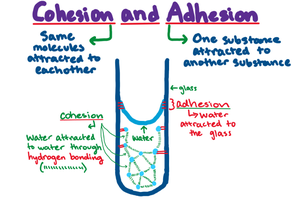
2.2 Cohesion and Adhesion
Water molecules exhibit cohesion (attraction to each other) and adhesion (attraction to other substances), which are critical for processes like water transport in plants and the formation of a meniscus in a glass tube.
Cohesion: Attraction between like molecules (e.g., water to water).
Adhesion: Attraction between unlike molecules (e.g., water to glass).
Surface Tension: The result of cohesive forces at the surface of water.
2.3 Chemical Reactions, Energy, and Chemical Evolution
2.3 Chemical Reactions and Equations
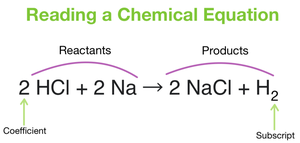
Chemical reactions involve the rearrangement of atoms to form new substances. Equations must be balanced to reflect the conservation of mass.
Reactants: Substances present before the reaction.
Products: Substances formed by the reaction.
Coefficient: Indicates the number of molecules.
Subscript: Indicates the number of atoms in a molecule.

Law of Conservation of Mass: Mass is neither created nor destroyed in a chemical reaction.
2.3 Energy in Chemical Reactions
Energy is required for chemical reactions and can be stored (potential energy) or in motion (kinetic energy).
Potential Energy: Stored energy, often in chemical bonds.
Kinetic Energy: Energy of motion; in molecules, this is thermal energy.
Endothermic Reaction: Absorbs energy (e.g., photosynthesis).
Exothermic Reaction: Releases energy (e.g., combustion).
Spontaneous Reaction: Occurs without external input if products have lower potential energy or greater disorder than reactants.
Heat: Transfer of thermal energy between objects of different temperatures.
2.4 Investigating Chemical Evolution
Stanley Miller's Experiment
Stanley Miller's 1953 experiment simulated early Earth conditions to test whether complex organic molecules could form from simple precursors. The results showed that amino acids and other organic compounds could be synthesized abiotically, supporting the theory of chemical evolution.
Conclusion: Chemical evolution is possible if simple molecules with high free energy are exposed to a source of kinetic energy.
2.5 Life is Carbon Based
2.5 The Versatility of Carbon
Carbon is the backbone of biological molecules due to its ability to form four covalent bonds, allowing for a diversity of stable structures.
Organic Molecules: Compounds containing carbon, such as glucose and octane.
Functional Groups: Specific groups of atoms (H, N, O, P, S) bonded to carbon that determine the chemical behavior of molecules.
Examples of Functional Groups:
Amino and Carboxyl Groups: Found in amino acids; can attract or release hydrogen ions.
Carbonyl Group: Found in molecules like acetaldehyde and acetone; important in linking molecules.
Hydroxyl Group: Polar, acts as a weak acid, increases solubility in water.
Phosphate Group: Carries negative charges, stores chemical energy.
Sulfhydryl Group: Important for forming disulfide bonds in proteins.
2.5 Macromolecules and Polymerization
Macromolecules are large molecules formed by the polymerization of smaller subunits called monomers. The process of joining monomers is called a condensation (dehydration) reaction, while breaking polymers involves hydrolysis.
Monomer: A small molecular subunit (e.g., amino acid, nucleotide, monosaccharide).
Polymer: A large molecule made of repeating monomers (e.g., protein, nucleic acid, carbohydrate).
Condensation Reaction: Joins monomers by removing a water molecule.
Hydrolysis: Breaks polymers by adding a water molecule.
Examples: Proteins, nucleic acids, and carbohydrates are all macromolecules formed by polymerization of their respective monomers.
