 Indietro
Water and Life: Properties, Structure, and Biological Importance
Guida di studio - Note intelligenti
 Appunti personalizzati basati sui tuoi materiali, ampliati con definizioni chiave, esempi e contesto.
Water and Life
Introduction
Water is essential for all known forms of life. Its unique chemical and physical properties arise from its molecular structure and hydrogen bonding, making it indispensable for biological processes. This chapter explores the structure of water, its properties, and its critical roles in supporting life on Earth.
Chemical Structure of Water
Polarity and Hydrogen Bonding
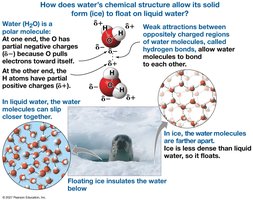
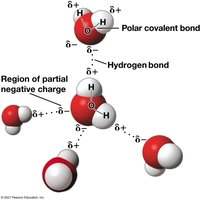
The water molecule (H2O) is polar due to the unequal sharing of electrons between oxygen and hydrogen atoms. This polarity allows water molecules to form hydrogen bonds with each other, which are weak attractions between the partially positive hydrogen of one molecule and the partially negative oxygen of another.
Polar Covalent Bonds: Oxygen is more electronegative than hydrogen, resulting in a partial negative charge (δ-) on oxygen and a partial positive charge (δ+) on hydrogen.
Hydrogen Bonds: These bonds are responsible for many of water’s unique properties, including cohesion, adhesion, and high specific heat.
Properties of Water
Cohesion and Surface Tension
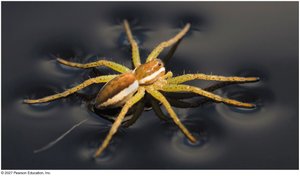
Cohesion refers to the attraction between water molecules due to hydrogen bonding. This property results in high surface tension, allowing certain organisms to move across water surfaces without sinking.
Surface Tension: The measure of how difficult it is to stretch or break the surface of a liquid.
Example: Some insects, such as water striders, can walk on water due to surface tension.
Cohesion and Adhesion in Plants
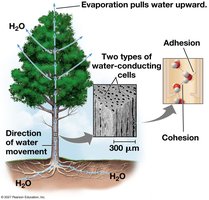
Cohesion helps transport water and dissolved nutrients against gravity in plants, while adhesion (attraction between different substances) helps water stick to plant cell walls, counteracting gravity.
Adhesion: Attraction between water molecules and other substances, such as plant cell walls.
Biological Importance: Essential for water transport in plant vascular tissue.
Water’s Ability to Moderate Temperature
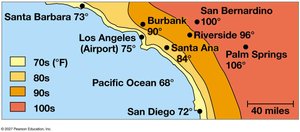
Water can absorb or release large amounts of heat with only slight changes in its own temperature, due to its high specific heat. This property helps stabilize temperatures in organisms and environments.
Kinetic Energy: The energy of motion; thermal energy is the kinetic energy associated with the random movement of atoms or molecules.
Heat: Thermal energy transferred from one body to another.
Specific Heat: The amount of heat required to change the temperature of 1 g of a substance by 1°C. For water, this is 4.184 J/g°C or 1.00 cal/g°C.
Biological Importance: Moderates climate and helps organisms maintain stable internal temperatures.
Heat of Vaporization and Evaporative Cooling
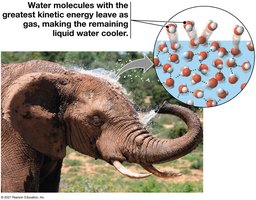
Heat of vaporization is the amount of heat a liquid must absorb for 1 g to be converted to gas. As water evaporates, it cools the surface, a process known as evaporative cooling. This helps regulate temperature in organisms and environments.
Example: Sweating in mammals and transpiration in plants are examples of evaporative cooling.
Expansion Upon Freezing
Water is less dense as a solid than as a liquid because hydrogen bonds stabilize and keep the molecules farther apart in ice. This property allows ice to float on liquid water, insulating aquatic life in winter.
Density: Ice is about 10% less dense than liquid water.
Biological Importance: Prevents bodies of water from freezing solid, allowing life to persist beneath the ice.
Water: The Solvent of Life
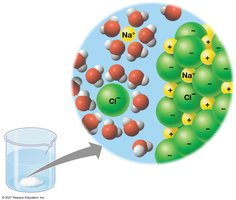
Water’s polarity makes it an excellent solvent, capable of dissolving a wide variety of substances. Solutions in which water is the solvent are called aqueous solutions.
Solvent: The dissolving agent of a solution.
Solute: The substance that is dissolved.
Hydration Shell: Sphere of water molecules surrounding each ion when an ionic compound dissolves in water.
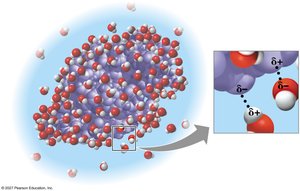
Versatility: Water can dissolve ionic compounds and polar molecules, including large molecules like proteins if they have ionic and polar regions.
Hydrophilic and Hydrophobic Substances
Hydrophilic substances have an affinity for water, while hydrophobic substances do not. Hydrophobic molecules, such as oils, are major components of cell membranes.
Example: Cell membranes are composed of hydrophobic molecules, which help form a barrier in aqueous environments.
Acids, Bases, and pH
Dissociation of Water Molecules
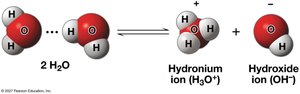
Water molecules can dissociate into hydronium ions (H3O+) and hydroxide ions (OH-). This process is rare but significant for biological systems, as it affects the pH of solutions.
Dynamic Equilibrium: Water molecules dissociate and reform at equal rates.
Equation:
Acids, Bases, and the pH Scale
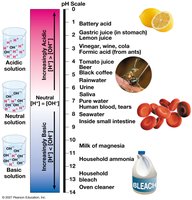
Acids increase the concentration of protons (H+) in a solution, while bases reduce it. The pH scale measures the acidity or basicity of a solution, with lower values being more acidic and higher values more basic.
pH Scale: Ranges from 0 (most acidic) to 14 (most basic), with 7 being neutral.
Biological Fluids: Most have pH values between 6 and 8.
Buffers
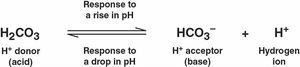
Buffers are substances that minimize changes in the concentrations of protons and hydroxide ions in a solution. They typically consist of a weak acid and its corresponding base, which can absorb or release protons as needed to maintain a stable pH.
Example: The bicarbonate buffer system in blood helps maintain a stable pH.
Equation:
Summary Table: Key Properties of Water
Property | Description | Biological Importance |
|---|---|---|
Cohesion | Hydrogen bonds hold water molecules together | Transport of water in plants |
Adhesion | Attraction between water and other substances | Helps counteract gravity in plant transport |
High Specific Heat | Resists temperature changes | Stabilizes climate and organism temperature |
Expansion Upon Freezing | Ice is less dense than liquid water | Insulates aquatic life in winter |
Versatile Solvent | Dissolves many substances | Facilitates chemical reactions in cells |
