 Indietro
Water and Life: Properties, Structure, and Biological Importance
Guida di studio - Note intelligenti
 Appunti personalizzati basati sui tuoi materiali, ampliati con definizioni chiave, esempi e contesto.
Water and Life
Key Concepts
Water is fundamental to life due to its unique chemical structure and properties. The polar covalent bonds in water molecules result in hydrogen bonding, which gives rise to four emergent properties that make Earth suitable for life: cohesive behavior, ability to moderate temperature, expansion upon freezing, and versatility as a solvent. Acidic and basic conditions also affect living organisms.
Polar Covalent Bonds and Hydrogen Bonding
Structure of Water Molecules
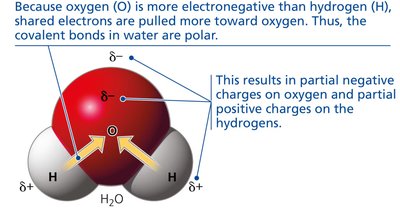
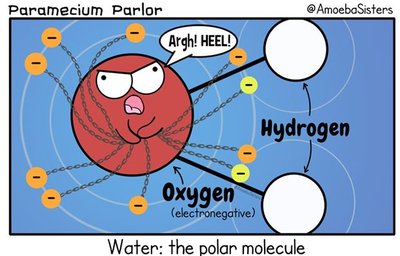
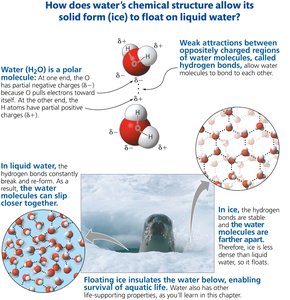
The water molecule (H2O) is shaped like a wide V, with two hydrogen atoms joined to an oxygen atom by single covalent bonds. Oxygen is more electronegative than hydrogen, causing electrons to spend more time closer to oxygen, resulting in polar covalent bonds.
Polar Molecule: A molecule with an uneven distribution of charges in different regions.
Partial Charges: Oxygen has partial negative charges; hydrogens have partial positive charges.
Hydrogen Bonding
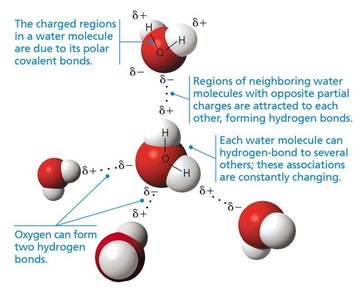
The unequal sharing of electrons and the V-like shape make water a polar molecule. Neighboring water molecules are attracted to each other by hydrogen bonds, which are constantly forming and breaking.
Hydrogen Bond: Weak attraction between the partial positive charge of hydrogen and partial negative charge of oxygen in adjacent molecules.
Multiple Bonds: Each water molecule can form hydrogen bonds with several others.
Emergent Properties of Water
Cohesive Behavior
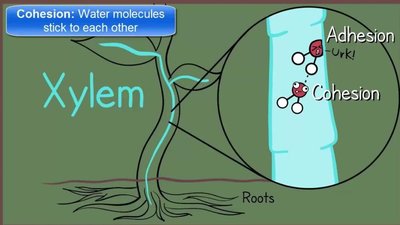
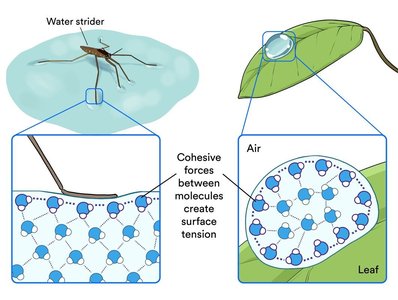
Hydrogen bonding causes water molecules to stay close together, resulting in cohesion and high surface tension. Cohesion is the linking together of like molecules, while adhesion is the clinging of one substance to another.
Cohesion: Responsible for water transport in plants and high surface tension.
Adhesion: Helps water stick to other substances, aiding capillary action.

Surface Tension
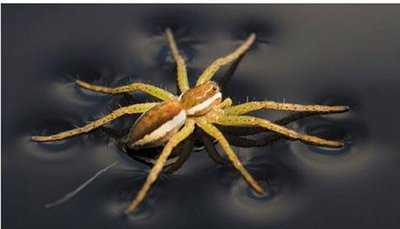
Surface tension is a measure of how difficult it is to stretch or break the surface of a liquid. Water's high surface tension allows some organisms to walk on water and plants to float.
Example: Water striders walking on water; floating plants.
Moderation of Temperature
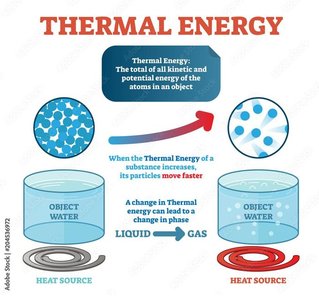
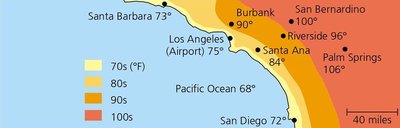
Water moderates air temperature by absorbing heat from warmer air and releasing stored heat to cooler air. Water acts as a heat bank, absorbing or releasing large amounts of heat with only slight changes in its own temperature.
Kinetic Energy: Energy of motion; faster molecules have greater kinetic energy.
Thermal Energy: Total kinetic energy associated with random movement of atoms or molecules.
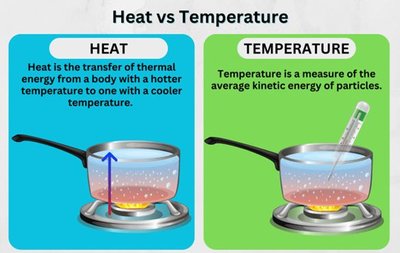
Temperature: Average kinetic energy of molecules in a body of matter.
Heat: Thermal energy transferred from one body of matter to another.
Units of Heat
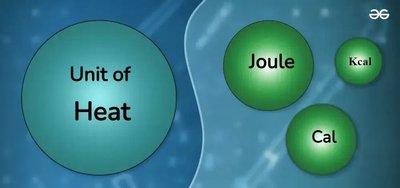
Heat is measured in calories and joules. One calorie is the amount of heat needed to raise 1 gram of water by 1°C. One kilocalorie (kcal) equals 1,000 calories. One joule equals 0.239 calories.
Calorie: Heat required to raise 1 g of water by 1°C.
Kilocalorie: 1,000 calories; used in food energy.
Joule: SI unit of energy; 1 calorie = 4.184 joules.
Specific Heat of Water
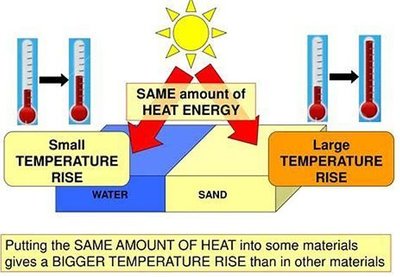
Water has a high specific heat, meaning it resists changes in temperature. Specific heat is the amount of heat required to change the temperature of 1 g of a substance by 1°C. Water's specific heat is 1 cal/g/°C, much higher than most other liquids due to hydrogen bonding.
Formula: (where q is heat, m is mass, c is specific heat, ΔT is temperature change)
Biological Relevance: Moderates air temperatures, stabilizes ocean temperatures, helps organisms resist temperature changes.
Evaporative Cooling
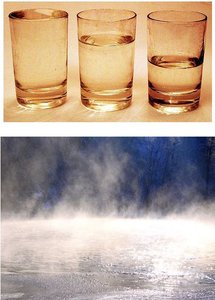
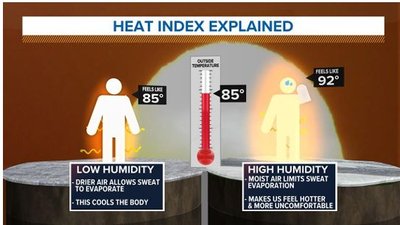
Evaporation is the transformation from liquid to gas. Water has a high heat of vaporization, requiring much energy to convert 1 g of water to gas. As water evaporates, the surface cools, stabilizing temperatures in lakes and preventing overheating in organisms.
Heat of Vaporization: Quantity of heat a liquid must absorb for 1 g to be converted to gas.
Evaporative Cooling: Surface cools as hottest molecules leave as gas.
Expansion Upon Freezing
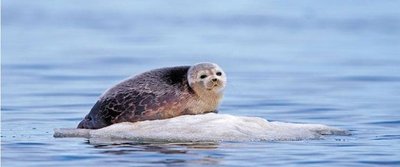
Water is less dense as a solid than as a liquid, so ice floats. As water freezes, molecules form a crystalline lattice, making ice less dense. This property is crucial for aquatic life, as floating ice insulates water below.
Density: Water expands as it solidifies; ice is less dense than liquid water.
Biological Importance: Floating ice insulates aquatic environments.
Global Warming and Water
Global warming affects icy environments, raising average air temperatures and impacting ecosystems.
Example: Arctic air temperature has risen 2.2°C since 1961.
Water: The Solvent of Life
Solutions, Solvents, and Solutes
Water is a versatile solvent due to its polarity. A solution is a homogeneous mixture of two or more substances. The solvent is the dissolving agent, and the solute is the substance dissolved. An aqueous solution is one where water is the solvent.
Hydrophilic: Substances with affinity for water.
Hydrophobic: Substances with no affinity for water; form droplets.
Solute Concentrations in Aqueous Solutions
Most chemical reactions in organisms involve solutes dissolved in water. Molecular mass is calculated as the sum of the masses of all atoms in a molecule. Substances are measured in moles, where one mole equals the molecular mass in grams and contains Avogadro's number of molecules ().
Molarity: Number of moles of solute per liter of solution.
Example: To make a 1 M solution of sucrose, dissolve 342 g in 1 L of water.
Acidic and Basic Conditions Affect Living Organisms
Acids, Bases, and pH
Acids increase hydrogen ion concentration; bases reduce it. The pH scale measures how acidic or basic a solution is. In pure water, [H+] and [OH-] are equal. The product of their concentrations is constant at at 25°C.
Formula:
pH:
Neutral Solution: ,
Buffers and Acidification
Buffers minimize changes in pH by combining reversibly with hydrogen ions. The bicarbonate buffer system maintains blood pH. Ocean acidification occurs when excess CO2 dissolves in seawater, forming carbonic acid and lowering pH.
Buffer: Substance that minimizes changes in H+ and OH- concentrations.
Example: Bicarbonate buffer system in blood.
Acidification: Increased atmospheric CO2 leads to ocean acidification.
Possible Evolution of Life on Other Planets
Water and the Search for Extraterrestrial Life
Biologists searching for life elsewhere focus on planets with water. Evidence from Mars suggests liquid water was present billions of years ago, and current missions seek signs of past or present life.
Example: Mars rover Perseverance collecting surface samples for analysis.
