 Indietro
Water and Life: Properties, Structure, and Biological Importance
Guida di studio - Note intelligenti
 Appunti personalizzati basati sui tuoi materiali, ampliati con definizioni chiave, esempi e contesto.
Water: The Molecule That Supports All of Life
Introduction to Water's Biological Importance
Water is essential for all known forms of life and is the only common substance that exists naturally on Earth in all three physical states: solid, liquid, and gas. Its unique chemical and physical properties make Earth suitable for life, largely due to the structure and interactions of water molecules.
Structure and Polarity of Water Molecules
Polar Covalent Bonds and Hydrogen Bonding
Polar covalent bonds in water result from the unequal sharing of electrons between oxygen and hydrogen atoms, causing a partial negative charge (δ–) near the oxygen and a partial positive charge (δ+) near the hydrogens.
This polarity allows water molecules to form hydrogen bonds with each other, where the slightly positive hydrogen of one molecule is attracted to the slightly negative oxygen of another.
Hydrogen bonding is responsible for many of water’s unique properties.
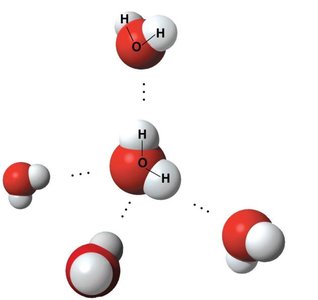
Example: The hydrogen bonds between water molecules are responsible for water’s high cohesion and surface tension.
Emergent Properties of Water
Four Key Properties Facilitating Life
Cohesive behavior: Water molecules stick together due to hydrogen bonding, aiding in the transport of water against gravity in plants.
Ability to moderate temperature: Water absorbs and releases heat with only slight changes in its own temperature, stabilizing environments and organisms.
Expansion upon freezing: Water is less dense as a solid than as a liquid, allowing ice to float and insulate aquatic life in winter.
Versatility as a solvent: Water’s polarity enables it to dissolve a wide variety of substances, making it the solvent of life.
Water as a Solvent
Solutions, Solvents, and Solutes
A solution is a homogeneous mixture of two or more substances. The solvent is the dissolving agent, and the solute is the substance dissolved. An aqueous solution is one where water is the solvent.
Water’s polarity allows it to surround and separate ions or polar molecules, forming a hydration shell around each ion.
Even large polar molecules, such as proteins, can dissolve in water if they have ionic or polar regions.
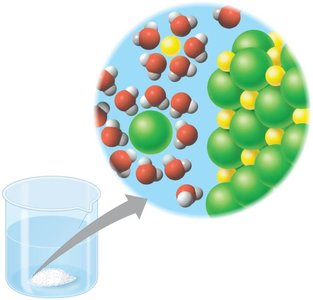
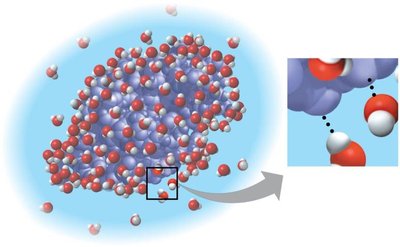
Example: Table salt (NaCl) dissolves in water as Na+ and Cl– ions become surrounded by water molecules.
Hydrophilic and Hydrophobic Substances
Affinity for Water
A hydrophilic substance has an affinity for water and dissolves easily (e.g., salts, sugars).
A hydrophobic substance does not have an affinity for water and does not dissolve (e.g., oils, fats).
Hydrophobic molecules are major components of cell membranes, contributing to the formation of biological barriers.
Acids, Bases, and pH
Dissociation of Water and pH Scale
Water molecules can dissociate into hydrogen ions (H+) and hydroxide ions (OH–):
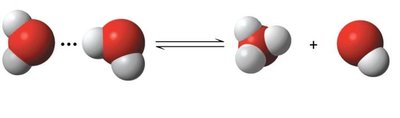
In pure water, the concentrations of H+ and OH– are equal.
An acid increases the H+ concentration of a solution, while a base reduces it.
The pH scale measures the concentration of H+ ions:
At 25°C,
Acidic solutions have pH < 7, basic solutions have pH > 7, and neutral solutions have pH = 7.
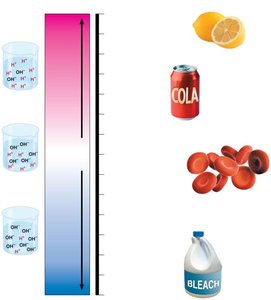
Example: Human blood has a pH of about 7.4, while lemon juice is much more acidic with a pH around 2.
Buffers and Biological pH Regulation
Maintaining pH Stability
Buffers are substances that minimize changes in the concentrations of H+ and OH– in a solution.
Most buffers consist of a weak acid and its corresponding base, which combine reversibly with H+ ions.
Buffers are crucial for maintaining the internal pH of living cells, which is typically close to 7.
Example: The bicarbonate buffer system helps maintain blood pH in humans.
