 Indietro
Water and Life: Structure, Properties, and Biological Importance
Guida di studio - Note intelligenti
 Appunti personalizzati basati sui tuoi materiali, ampliati con definizioni chiave, esempi e contesto.
Water and Life
Hydrogen Bonding in Water
Water's unique chemical structure and its ability to form hydrogen bonds are fundamental to life. The polarity of water molecules leads to a range of emergent properties that support biological systems.
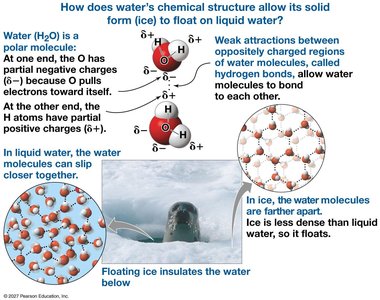
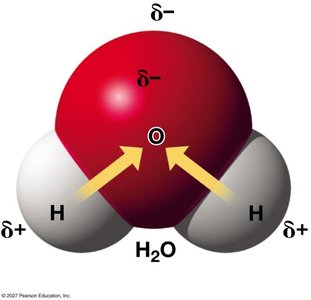
Water Is a Polar Molecule: Oxygen attracts shared electrons more strongly than hydrogen, creating a partial negative charge near oxygen and partial positive charges near each hydrogen. This uneven charge distribution makes water a polar molecule.
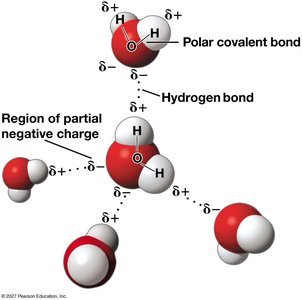
Polarity Creates Hydrogen Bonds: The positive end of one water molecule is attracted to the negative end of another, forming weak hydrogen bonds. Each water molecule can form hydrogen bonds with up to four neighbors.
Hydrogen Bonding: These bonds are responsible for many of water's properties, including cohesion, adhesion, and high specific heat.
Example: Water molecules can slip closer together in liquid form, but in ice, they are farther apart due to hydrogen bonding.
Emergent Properties of Water
Hydrogen bonding gives rise to four key properties of water that are essential for life: cohesion, temperature moderation, expansion upon freezing, and versatility as a solvent.
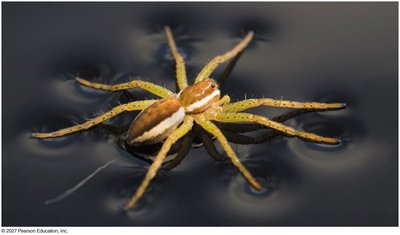
Cohesion: Water molecules stick to each other, producing high surface tension. This allows small organisms to rest or walk on water surfaces.
Surface Tension: Cohesion creates a "skin" on top of still water.
Example: A raft spider's weight is supported by surface tension.
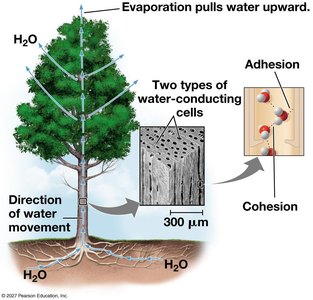
Adhesion: Water's attraction to other substances, such as cell walls, helps move water against gravity in plants. Cohesion and adhesion together pull water upward from roots to leaves.
Example: Water travels through a plant via evaporation, adhesion, and cohesion.
Temperature Moderation: Water resists rapid temperature changes due to its high specific heat. Breaking hydrogen bonds absorbs heat, while forming them releases heat.
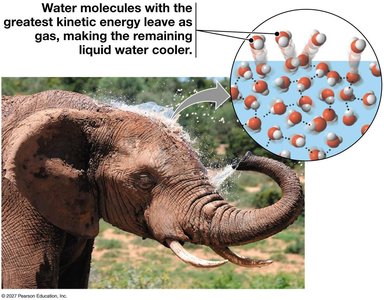
Evaporative Cooling: As water evaporates, molecules with the most energy leave first, cooling the remaining liquid. This stabilizes body temperature in organisms.
Example: Ultrarunner cooling by evaporation.

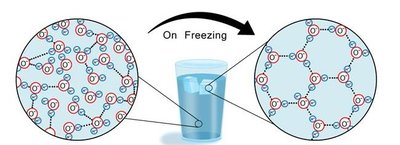
Expansion on Freezing: Hydrogen bonds lock water molecules into a crystal lattice as water freezes, making ice less dense than liquid water. Water reaches maximum density at 4°C.
Example: Ice floats because its molecules are farther apart.
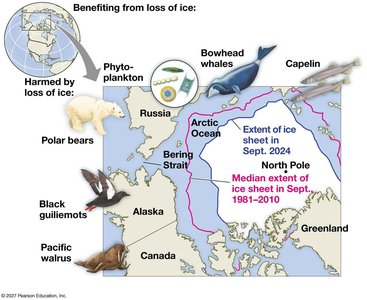
Biological Importance: Floating ice insulates water below, preventing lakes and oceans from freezing solid and protecting aquatic life.
Example: Arctic sea ice decline affects habitats for polar bears, walruses, and other species.
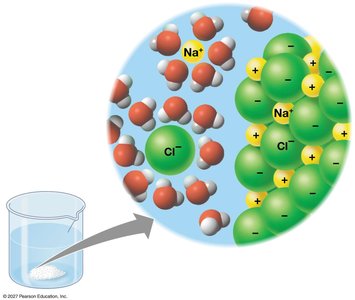
Versatility as a Solvent: Water's polarity allows it to dissolve a wide range of substances. Dissolved ions are surrounded by a "hydration shell" of water molecules.
Example: Salt dissolving in water, with water molecules separating sodium and chloride ions.
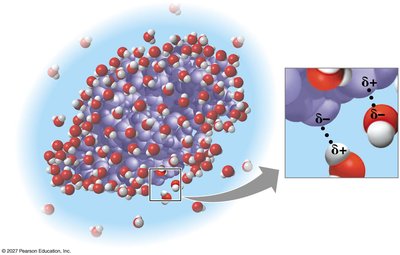
Hydrophilic vs. Hydrophobic: Hydrophilic substances dissolve readily in water, while hydrophobic substances (like oils) resist mixing. Large molecules such as proteins can dissolve if they have polar or ionic regions.
Example: Water-soluble protein (lysozyme) with charged and polar regions attracting water molecules.
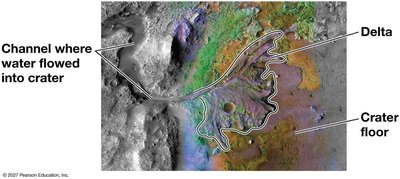
Water and Life Elsewhere: Scientists search for water as a sign of potential life on other planets. Mars shows evidence of past or present water.
Example: Dark streaks on Mars consistent with liquid water flow.
Acids, Bases, and Buffers
Water molecules can split apart, forming ions that are central to acid-base chemistry. The balance of these ions is crucial for biological systems.
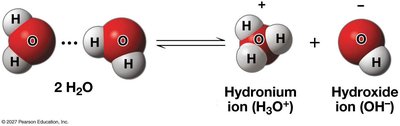
Water Molecule Dissociation: A hydrogen atom can shift from one water molecule to another, forming a hydroxide ion (OH⁻) and a hydronium ion (H3O+).
Equation:
Dynamic Equilibrium: In pure water, hydronium and hydroxide ions are equal.
Acids and Bases: Acids add H⁺ to a solution; bases remove H⁺ or add OH⁻. Strong acids and bases dissociate completely, while weak ones only partially.
The pH Scale: The product of H⁺ and OH⁻ concentrations is constant at 25°C: pH is defined as Neutral solution: , so pH = 7. Acidic solutions have pH < 7; basic solutions have pH > 7.
Example: Common solutions span the pH scale from battery acid (pH 1) to oven cleaner (pH 13.5).
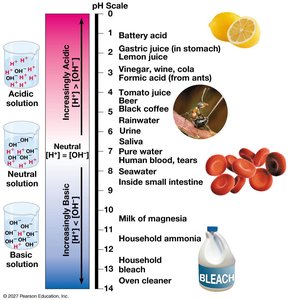
Buffers: Buffers resist pH changes by absorbing or releasing H⁺. Most buffers pair a weak acid with its corresponding base. Living cells function best near pH 7.
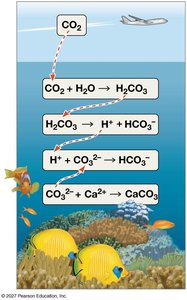
Ocean Acidification: Human-produced CO₂ dissolves in oceans, forming carbonic acid and reducing carbonate ions needed by marine organisms for skeletons and reefs.
Example: CO₂ dissolving in seawater sets off reactions that reduce carbonate for shell-building organisms.
Summary Table: Water's Properties and Biological Importance
Property | Cause | Biological Importance |
|---|---|---|
Cohesion | Hydrogen bonding | Surface tension, water transport in plants |
Adhesion | Attraction to other substances | Water movement against gravity in plants |
High Specific Heat | Hydrogen bonds absorb/release heat | Moderates climate, stabilizes body temperature |
Expansion on Freezing | Crystal lattice formation | Ice floats, insulates aquatic habitats |
Versatile Solvent | Polarity | Dissolves ions and polar molecules |
Additional info: The notes expand on brief points with academic context, definitions, and examples to ensure completeness and clarity for exam preparation.
