
Ch. 2 - Water and Carbon: The Chemical Basis of Life
Freeman - Biological Science 8th Edition
Freeman8th EditionBiological ScienceISBN: 9780138276263Non è quello che usi tu?Cambia libro di testo
Capitolo 2, Problema 2

What are the defining characteristics of a condensation reaction?
a. Two monomers are covalently bonded together and a water molecule is produced.
b. Two monomers are covalently bonded together and a water molecule is used up.
c. A polymer is broken down into monomers and a water molecule is produced.
d. A polymer is broken down into monomers and a water molecule is used up.

Guida verificata passo dopo passo
1
Step 1: Understand the concept of a condensation reaction. A condensation reaction, also known as a dehydration synthesis, is a chemical process where two molecules (often monomers) are covalently bonded together, and a water molecule (H₂O) is released as a byproduct.
Step 2: Analyze the options provided in the question. Look for the option that describes the bonding of two monomers and the production of a water molecule, as this aligns with the definition of a condensation reaction.
Step 3: Eliminate options that describe the opposite process, which is hydrolysis. Hydrolysis involves breaking down polymers into monomers and requires the addition of a water molecule, not the release of one.
Step 4: Focus on the correct description of a condensation reaction. The key characteristics are the formation of a covalent bond between two monomers and the release of a water molecule during the process.
Step 5: Select the option that matches the defining characteristics of a condensation reaction: 'Two monomers are covalently bonded together and a water molecule is produced.'

Risposta video verificata per un problema simile:

Questa soluzione video è stata consigliata dai nostri tutor come utile per risolvere questo problema.
Durata del video:
2m

Concetti chiave

Ecco i concetti essenziali che devi comprendere per rispondere correttamente alla domanda.

Condensation Reaction

A condensation reaction, also known as a dehydration synthesis, is a chemical process where two molecules combine to form a larger molecule, releasing a small molecule, typically water, as a byproduct. This reaction is fundamental in the formation of polymers from monomers, such as in the synthesis of proteins from amino acids or carbohydrates from simple sugars.
Video consigliato:
01:56
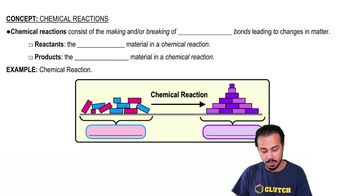
Chemical Reactions

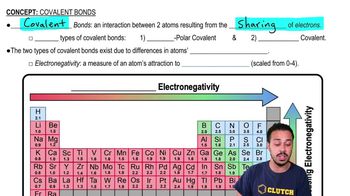
Covalent Bonding

Covalent bonding involves the sharing of electron pairs between atoms, which allows for the formation of stable molecules. In the context of condensation reactions, covalent bonds are formed between monomers, resulting in the creation of larger macromolecules. This type of bonding is crucial for the structural integrity and function of biological macromolecules.
Video consigliato:
04:28
Covalent Bonds

Water as a Byproduct

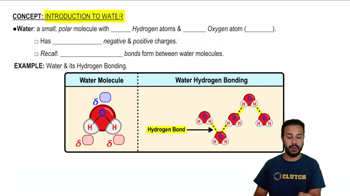
In condensation reactions, water is produced as a byproduct when two monomers are joined together. This occurs because a hydroxyl group (–OH) from one monomer and a hydrogen atom (–H) from another monomer combine to form water (H2O). Understanding the role of water in these reactions is essential for grasping how biological macromolecules are synthesized and how they function in living organisms.
Video consigliato:
01:54
Introduction to Water