
Ch. 2 - Water and Carbon: The Chemical Basis of Life
Freeman - Biological Science 8th Edition
Freeman8th EditionBiological ScienceISBN: 9780138276263Non è quello che usi tu?Cambia libro di testo
Capitolo 2, Problema 1

Which of the following occurs when a covalent bond forms?


a. Electrons in valence shells are transferred from one atom to another.
b. Electrons in valence shells are shared between atoms.
c. Partial charges on polar molecules interact.

Guida verificata passo dopo passo
1
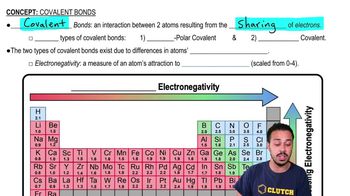
Identify the definition of a covalent bond: A covalent bond involves the sharing of electron pairs between atoms. These electron pairs are known as shared pairs or bonding pairs, and the stable balance of attractive and repulsive forces between atoms when they share electrons is known as covalent bonding.
Analyze option a: This option describes the transfer of electrons from one atom to another, which is characteristic of ionic bonds, not covalent bonds.
Analyze option b: This option states that electrons in valence shells are shared between atoms. This aligns with the definition of covalent bonds, where atoms share electrons to achieve stability.
Analyze option c: This option describes interactions involving partial charges on polar molecules, which refers to dipole-dipole interactions, a type of intermolecular force, rather than the formation of covalent bonds.
Conclude that the correct answer must involve the sharing of electrons between atoms, as this is the defining feature of covalent bonds.

Risposta video verificata per un problema simile:

Questa soluzione video è stata consigliata dai nostri tutor come utile per risolvere questo problema.
Durata del video:
1m

Concetti chiave

Ecco i concetti essenziali che devi comprendere per rispondere correttamente alla domanda.

Covalent Bonding

Covalent bonding occurs when two atoms share one or more pairs of electrons in their outermost shells, known as valence shells. This sharing allows each atom to attain a more stable electronic configuration, often resembling that of noble gases. Covalent bonds can be single, double, or triple, depending on the number of shared electron pairs.
Video consigliato:
04:28
Covalent Bonds

Valence Electrons

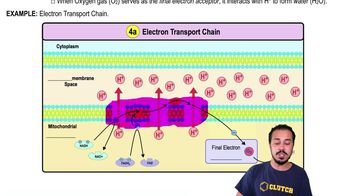
Valence electrons are the electrons located in the outermost shell of an atom and are crucial for chemical bonding. The number of valence electrons determines an atom's reactivity and its ability to form bonds with other atoms. Atoms tend to bond in ways that allow them to achieve a full valence shell, typically consisting of eight electrons, known as the octet rule.
Video consigliato:
07:41
Electron Transport Chain

Polar Molecules

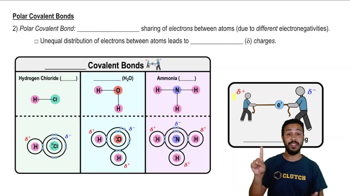
Polar molecules are molecules that have a partial positive charge on one side and a partial negative charge on the other due to an uneven distribution of electrons. This polarity arises from differences in electronegativity between atoms in a molecule, leading to dipole moments. Polar molecules can interact with each other through dipole-dipole interactions, which are distinct from the sharing of electrons in covalent bonds.
Video consigliato:
06:59
Polar Covalent Bonds