 Indietro
Business Calculus Study Notes: Introduction to Limits
Guida di studio - Note intelligenti
 Appunti personalizzati basati sui tuoi materiali, ampliati con definizioni chiave, esempi e contesto.
Limits: Graphical Approach
Understanding Limits with Graphs
The concept of a limit is fundamental in calculus and describes the behavior of a function as its input approaches a particular value. Graphs are often used to visually analyze how a function behaves near a specific point.
Definition: The limit of a function f(x) as x approaches c is written as if f(x) gets arbitrarily close to L whenever x is close to c (but not equal to c).
Graphical Example: For f(x) = x + 1, as x approaches 1, f(x) approaches 2.
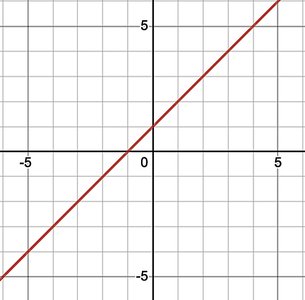
Example: If you observe the graph, as x gets closer to 1 from either side, the value of f(x) gets closer to 2.
One-Sided Limits and Existence of Limits
Left-Hand and Right-Hand Limits
Limits can be approached from either side of a point. These are called one-sided limits:
Left-Hand Limit: means x approaches c from the left.
Right-Hand Limit: means x approaches c from the right.
Existence of a Limit: The limit exists if and only if the left and right limits both exist and are equal.
Example: For the function , analyze the behavior near x = 0. The left and right limits may differ, so the overall limit may not exist.
Limits from Graphs: Examples
Analyzing Limits at Specific Points
By examining a graph, you can determine the left-hand limit, right-hand limit, and the value of the function at a point.
Example: For a given graph of f(x), analyze the behavior near x = 3 and x = 0 by observing the values as x approaches these points from both sides.
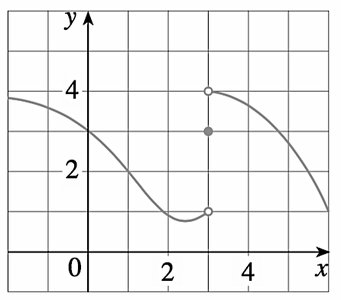
Example: The graph shows open and closed circles, indicating where the function is defined and where limits may differ from the function value.
Piecewise Functions and Limits
Limits at Points of Discontinuity
Piecewise functions may have different expressions on either side of a point, leading to different one-sided limits.
Example: For a piecewise function, analyze the left and right limits at the point where the definition changes.
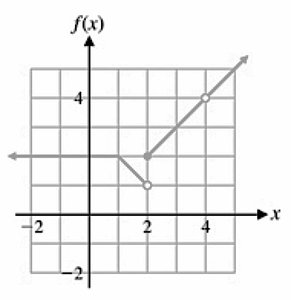
Example: The graph shows a function with a jump at x = 2, illustrating how left and right limits can differ.
Limits: Algebraic Approach
Evaluating Limits Algebraically
Limits can often be evaluated by direct substitution, especially for polynomial and rational functions.
Polynomial Functions: for any polynomial f(x).
Rational Functions: as long as the denominator is not zero.
Properties of Limits
Limit Laws and Operations
Several properties allow the computation of limits for combinations of functions.
Sum, Difference, Product, and Quotient Rules: Limits can be distributed over addition, subtraction, multiplication, and division (when the denominator's limit is not zero).
Constant Multiple Rule: for any constant k.
Root Rule: if the limit is defined.
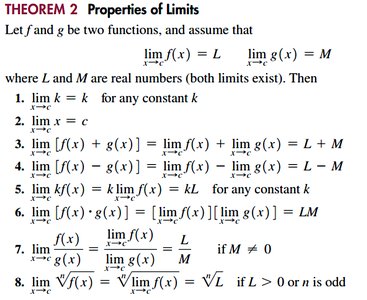
Example: If and , then .
Indeterminate Forms and Techniques
Factoring and One-Sided Limits
Sometimes, direct substitution leads to indeterminate forms such as . In these cases, algebraic techniques like factoring or considering one-sided limits are used to resolve the limit.
Indeterminate Form: If both numerator and denominator approach zero, the limit is indeterminate and requires further analysis.
Technique: Factor the expression or use one-sided limits to find the correct value.
Limits That Do Not Exist
Undefined Quotients
If the denominator approaches zero while the numerator approaches a nonzero value, the limit does not exist because division by zero is undefined.
Definition: If (where ) and , then does not exist.
Limits of Difference Quotients
Definition and Application
The difference quotient is a fundamental concept in calculus, used to define the derivative. The limit of the difference quotient as h approaches zero gives the instantaneous rate of change.
Definition:
Application: Used to compute the derivative of a function at a point.
Example: For f(x) = 7 - 2x, find .
Example: For f(x) = |x - 1|, find .
Example: For g(x) = \sqrt{x}, find .
