 Indietro
Business Calculus Study Notes: Product Rule, Quotient Rule, Chain Rule, and Applications
Guida di studio - Note intelligenti
 Appunti personalizzati basati sui tuoi materiali, ampliati con definizioni chiave, esempi e contesto.
Product Rule and Quotient Rule
Product Rule
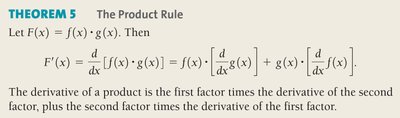
The Product Rule is used to differentiate functions that are the product of two other functions. The derivative of a product is not simply the product of the derivatives. Instead, it follows a specific formula:
Formula:
The derivative of a product is the first factor times the derivative of the second factor, plus the second factor times the derivative of the first factor.
Steps for Applying the Product Rule:
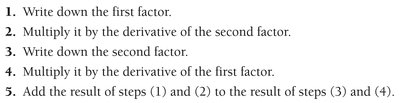
Write down the first factor.
Multiply it by the derivative of the second factor.
Write down the second factor.
Multiply it by the derivative of the first factor.
Add the results from steps 1-2 and 3-4.
Example: Find . Do not simplify.

Quotient Rule
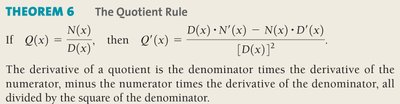
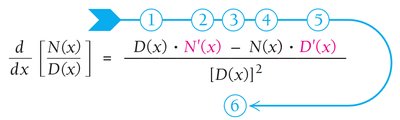
The Quotient Rule is used to differentiate functions that are the quotient of two other functions. The derivative of a quotient is not simply the quotient of the derivatives. The rule is as follows:
Formula:
The derivative of a quotient is the denominator times the derivative of the numerator, minus the numerator times the derivative of the denominator, all divided by the square of the denominator.
Steps for Applying the Quotient Rule:
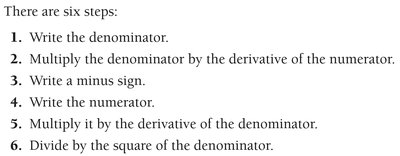
Write the denominator.
Multiply the denominator by the derivative of the numerator.
Write a minus sign.
Write the numerator.
Multiply it by the derivative of the denominator.
Divide by the square of the denominator.
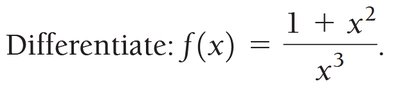
Example: Differentiate .
Applications in Business Context
Average Cost, Revenue, and Profit
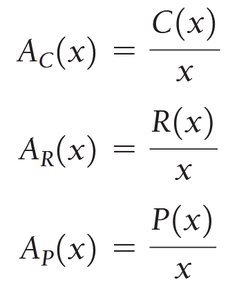
In business calculus, average cost, revenue, and profit are important for analyzing production and sales. These are defined as follows:
Average Cost:
Average Revenue:
Average Profit:
Where is cost, is revenue, and is profit for producing and selling units.
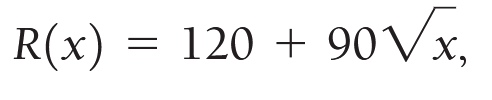
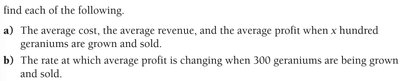
Example: Given , find the average cost, average revenue, and average profit when hundred geraniums are grown and sold. Also, find the rate at which average profit is changing when 300 geraniums are being grown and sold.
Chain Rule and Composition of Functions
Composition of Functions
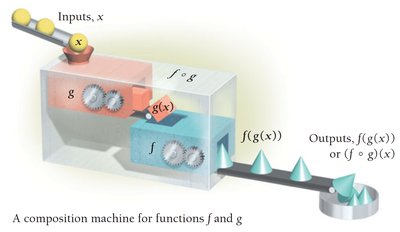
The composition of functions is a fundamental concept in calculus. If and are functions, the composition is defined as:


Chain Rule
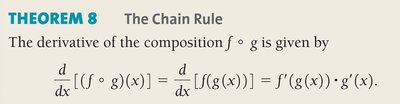
The Chain Rule is used to differentiate composite functions. It states:
The derivative of the composition is the derivative of the outer function evaluated at the inner function, times the derivative of the inner function.
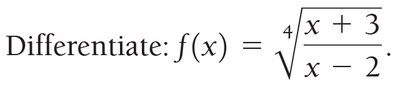
Example: Differentiate .
Extended Power Rule
The Extended Power Rule is a special case of the Chain Rule for functions raised to a power:

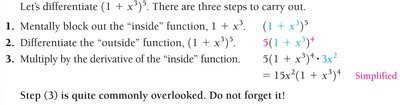
Example: Differentiate .
Block out the "inside" function:
Differentiate the "outside" function:
Multiply by the derivative of the "inside" function:
Final answer:
Higher Order Derivatives and Applications
Velocity and Acceleration
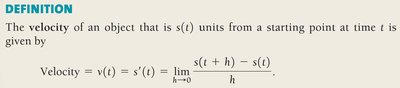
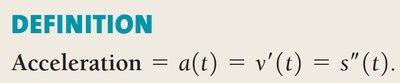
Higher order derivatives are used to analyze rates of change in various contexts, such as physics and business.
Velocity:
Acceleration:
Application Example: The Chain Rule can be used to relate rates of change in business, such as profit per time, by multiplying the rate of profit per item by the production rate in items per time.
Summary Table: Rules for Differentiation
Rule | Formula | Application |
|---|---|---|
Product Rule | Product of two functions | |
Quotient Rule | Quotient of two functions | |
Chain Rule | Composition of functions | |
Extended Power Rule | Power of a function |
