 Indietro
Chapter 2: Limits and The Derivative – Introduction to Limits 2.1
Guida di studio - Note intelligenti
 Appunti personalizzati basati sui tuoi materiali, ampliati con definizioni chiave, esempi e contesto.
Limits and The Derivative
Introduction to Limits
Calculus is fundamentally concerned with how quantities change, distinguishing it from algebra, which focuses on static relationships. The concept of a limit is central to calculus, providing the foundation for both derivatives and integrals. This section introduces the basic ideas behind limits and their importance in understanding dynamic mathematical phenomena.
Static vs. Dynamic: Algebra solves for specific values (static), while calculus studies how changes in one variable affect another (dynamic).
Historical Context: Calculus was independently developed by Isaac Newton and Gottfried Wilhelm von Leibniz to address problems involving motion and change.
Applications: Calculus is widely used in business, economics, physical sciences, life sciences, and social sciences.
Key Concepts of Calculus
There are two main concepts in calculus: the derivative and the integral. Both rely on the notion of a limit. This chapter focuses on the derivative, with the integral discussed in later chapters.
Derivative: Measures the rate at which a quantity changes.
Integral: Measures the accumulation of quantities.
Limit: Describes the behavior of a function as its input approaches a particular value.
Functions and Graphs: Brief Review
Understanding Functions and Their Graphs
A function is a rule that assigns each input value (domain) to exactly one output value (range). The graph of a function is the set of all ordered pairs (x, f(x)) that satisfy the function's equation.
Example: For :
When , ; point (2, 3) is on the graph.
When , ; point (0, -1) is on the graph.
When , ; point (-1, -3) is on the graph.
The x-axis represents domain values, and the y-axis represents range values.
Finding Function Values from a Graph
To find the value of a function at a specific point, locate the corresponding x-value on the graph and read the associated y-value.
Example: For , to find , locate on the x-axis and read the y-value where the graph passes through.
Analyzing a Limit
Understanding Limits
The limit of a function at examines how the output values behave as the input values get closer to . The notation for the limit is:
This reads as "the limit of f(x) as x approaches a is L."
If the function value at matches the limit, the function is continuous at that point.
Example: Analyzing a Limit
Let . As approaches 2, approaches 4. This can be visualized on the graph by drawing vertical lines near and observing the corresponding $f(x)$ values.
As , .
The value of the function at is also 4, so the limit and the function value agree.
One-Sided Limits
A one-sided limit considers the behavior of a function as the input approaches a value from only one side (left or right). If no direction is specified, the limit is assumed to be two-sided.
Left-hand limit:
Right-hand limit:
Theorem 1: On the Existence of a Limit
A limit exists at if and only if the left-hand and right-hand limits both exist and are equal.
Example: Analyze Limits Graphically
Consider the graph below. For near on either side, the function value is close to 1. The left- and right-hand limits are equal and agree with the function value at .
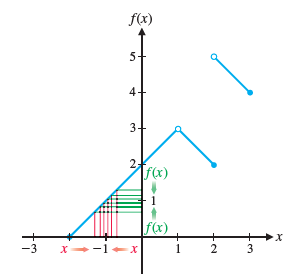
Example: Analyze Limits Graphically (Undefined Function Value)
For near 1, the function value is close to 3 from both sides, but is not defined. The left- and right-hand limits are equal, but the function does not exist at .
Example: Analyze Limits Graphically (Limit Does Not Exist)
If the graph has an abrupt break at , the left- and right-hand limits are not equal. The function exists at $x = 2$, but the limit does not exist at that point.
Properties of Limits
Theorem 2: Properties of Limits
If and , then:
(where c is a constant)
, provided
These properties apply to both left and right limits.
Theorem 3: Limits of Polynomial and Rational Functions
If is a polynomial or rational function and is in the domain of , then:
Indeterminate Forms
An indeterminate form occurs when evaluating a limit leads to an expression like . This does not represent a real number, and further analysis is required to determine if the limit exists.
Algebraic simplification is often used to resolve indeterminate forms.
Theorem 4: Limit of a Quotient
If and with , then:
Limits of Difference Quotients
The difference quotient is a foundational concept for derivatives. It is defined as:
The limit as gives the derivative of at .
Summary Table: Properties of Limits
Property | Formula |
|---|---|
Sum | |
Difference | |
Constant Multiple | |
Product | |
Quotient | , |
Additional info: The above notes expand on the provided content with definitions, examples, and theorem statements to ensure a self-contained, academically robust study guide for Business Calculus students.
