 Indietro
Analyzing Limits and Continuity from a Graph
Guida di studio - Note intelligenti
 Appunti personalizzati basati sui tuoi materiali, ampliati con definizioni chiave, esempi e contesto.
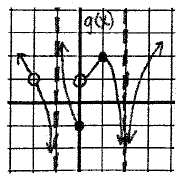
Q5. For the function shown in the graph, answer each part for each of the following values of : :
(a)
(b)
(c)
(d)
(e) Is in the domain of ? Why or why not?
(f) Is continuous at ? Why or why not?
Background
Topic: Limits and Continuity from a Graph
This question tests your ability to interpret a graph to determine one-sided and two-sided limits, function values, domain, and continuity at specific points.
Key Terms and Formulas
One-sided limit: (from the right), (from the left)
Two-sided limit: exists if and only if both one-sided limits exist and are equal
Function value: is the value of the function at (if defined)
Continuity at : is continuous at if is defined, exists, and
Step-by-Step Guidance
For each value of (), examine the graph of at and around .
To find , look at the -values as approaches from the left. For , look as approaches from the right.
Determine if the two one-sided limits are equal. If so, the two-sided limit exists and equals that value. If not, the two-sided limit does not exist.
Check if there is a filled (solid) dot at on the graph. If so, is defined and equals the -value of that dot. If there is an open circle, is not defined at that -value.
Decide if is in the domain of by checking if is defined (solid dot at ).
To determine continuity at , check if is defined, the two-sided limit exists, and equals the limit. If any of these fail, is not continuous at .
Repeat this process for each value of .
Try solving on your own before revealing the answer!
Final Answer:
For each value, the limits, function values, domain status, and continuity are as follows (read from the graph):
At : , , does not exist (one-sided limits not equal), is not defined (open circle), is not in the domain, is not continuous at .
At : , , does not exist, (solid dot), is in the domain, is not continuous at .
At : , , does not exist, is not defined (open circle), is not in the domain, is not continuous at .
At : , , does not exist, (solid dot), is in the domain, is not continuous at .
At : , , does not exist, (solid dot), is in the domain, is not continuous at .
For each , the function is not continuous because either the limit does not exist or the function value does not match the limit.
