 Indietro
Calculus Chapter 3: Derivatives and Their Applications
Guida di studio - Note intelligenti
 Appunti personalizzati basati sui tuoi materiali, ampliati con definizioni chiave, esempi e contesto.
Derivatives as a Function
Definition of Differentiability
The concept of differentiability is central to calculus. A function is said to be differentiable at a point if its derivative exists at that point. This means the function has a well-defined tangent (slope) at that location.
Differentiability Condition: The left-hand and right-hand limits of the difference quotient must be equal at the point.
Continuity: If a function is differentiable at a point, it is also continuous at that point.
Non-differentiable Points: A function is not differentiable where it is not continuous or where the graph has a sharp corner or vertical tangent.
Theorem: If f is differentiable at a, then it is continuous at a.
Example: The function is not differentiable at because the left and right derivatives are not equal.
Derivatives as Rates of Change
Velocity and Acceleration
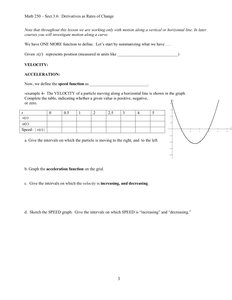
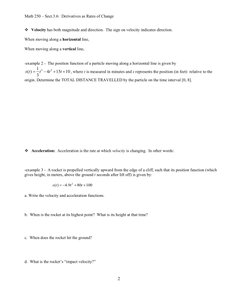
Derivatives are used to describe rates of change in various contexts, such as physics. The velocity of a particle is the derivative of its position function with respect to time, and the acceleration is the derivative of the velocity function.
Velocity: , where is the position function.
Acceleration: .
Speed: The magnitude of velocity, .
Example: For a particle moving along a line with position , the velocity is and the acceleration is .
Analyzing Motion
To analyze the motion of a particle, consider the intervals where the velocity is positive (moving right/up) or negative (moving left/down). The acceleration indicates whether the velocity is increasing or decreasing.
Find intervals where the particle changes direction by solving .
Determine when the particle is speeding up or slowing down by comparing the signs of velocity and acceleration.
Example: If , the particle changes direction at .
The Chain Rule
Differentiating Composite Functions
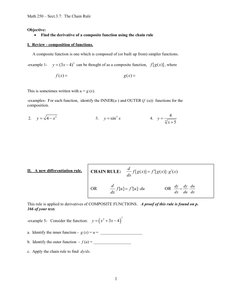
The chain rule is a fundamental technique for finding the derivative of a composite function. If , then the derivative is:
Inner Function:
Outer Function: , where
Example: For , let , then .
Applying the chain rule:
Applications of Derivatives
Motion Problems
Derivatives are used to solve real-world problems involving motion, such as finding average and instantaneous velocity, and analyzing the trajectory of objects.
Average Velocity:
Instantaneous Velocity:
Example: A ball is thrown off a 40 ft. cliff with an initial velocity of -10 ft/s. The position function is . Find the average velocity over the first 2 seconds and the instantaneous velocity at .
Graphical Interpretation
The graph of a function and its derivative provides insight into the behavior of the function, such as where it is increasing, decreasing, or has local extrema.
Where the derivative is positive, the function is increasing.
Where the derivative is negative, the function is decreasing.
Where the derivative is zero, the function may have a local maximum or minimum.
Summary Table: Key Concepts
Concept | Definition | Formula |
|---|---|---|
Differentiability | Function has a derivative at a point | exists |
Velocity | Rate of change of position | |
Acceleration | Rate of change of velocity | |
Chain Rule | Derivative of composite function |
