 Indietro
Calculus I Exam 1 Review: Limits, Continuity, and Asymptotes
Guida di studio - Note intelligenti
 Appunti personalizzati basati sui tuoi materiali, ampliati con definizioni chiave, esempi e contesto.
Limits and Their Properties
Average Velocity Formula
The average velocity of an object over an interval [a, b] is calculated using the change in position divided by the change in time. This concept is foundational for understanding rates of change in calculus.
Formula:
Application: Used to estimate instantaneous velocity as the interval shrinks.
Evaluating Limits from Graphs
Limits can often be estimated by observing the behavior of a function as x approaches a particular value on its graph. This is essential for understanding continuity and discontinuity.
Left-hand limit: The value the function approaches as x approaches from the left.
Right-hand limit: The value the function approaches as x approaches from the right.
Two-sided limit: Exists if both one-sided limits are equal.
Limit Laws
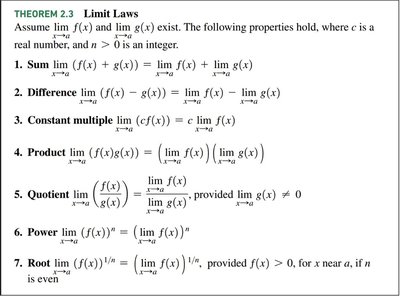
Limit laws provide rules for evaluating limits analytically. These laws allow us to break down complex limits into simpler parts.
Sum Law:
Difference Law:
Constant Multiple Law:
Product Law:
Quotient Law: , provided
Power Law:
Root Law: , provided for near if is even
Evaluating Limits Analytically
To evaluate limits analytically, apply the limit laws and substitute values as appropriate. If direct substitution leads to an indeterminate form, algebraic manipulation or other techniques may be necessary.
Example: If and with as , then .
Limits Involving Infinity and Asymptotes
Infinite Limits and Vertical Asymptotes
An infinite limit occurs when the values of a function increase or decrease without bound as x approaches a certain value. This behavior is associated with vertical asymptotes.
If , then the line is a vertical asymptote of .

Limits at Infinity and Horizontal Asymptotes
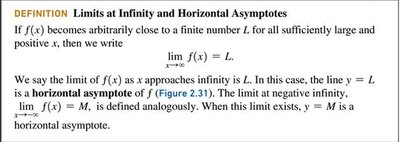
As x approaches infinity (or negative infinity), the behavior of a function can approach a finite value, called a horizontal asymptote. This concept is crucial for understanding end behavior of functions.
If , then is a horizontal asymptote.
If , then is a horizontal asymptote.
Infinite Limits at Infinity
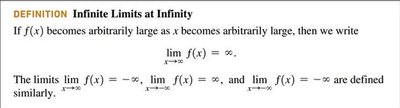
If becomes arbitrarily large as becomes arbitrarily large, we write . Similar definitions apply for negative infinity.
Limits at Infinity of Powers and Polynomials
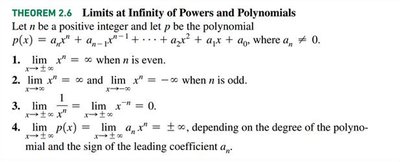
The behavior of powers and polynomials as approaches infinity depends on the degree and leading coefficient.
If is even: ,
If is odd: ,
,
For a polynomial , , depending on the degree and sign of .
Continuity and Discontinuity
Continuity at a Point
A function is continuous at a point if the limit as x approaches that point equals the function's value at that point. Discontinuities occur where this condition fails.
Removable discontinuity: The limit exists, but the function value is different or undefined.
Jump discontinuity: The left and right limits exist but are not equal.
Infinite discontinuity: The function approaches infinity at the point.
Finding Points of Discontinuity
To find points of discontinuity, examine where the function is undefined or where the limit does not exist or does not equal the function value.
Set the denominator equal to zero for rational functions.
Check for piecewise definitions or absolute values that may cause jumps.
Graphical Analysis of Limits and Asymptotes
Sketching Graphs with Vertical Asymptotes
Vertical asymptotes occur where the function grows without bound as x approaches a certain value. These are typically found by setting the denominator of a rational function to zero.
Example: For , vertical asymptotes are at and .

Determining Horizontal and Vertical Asymptotes
Horizontal asymptotes are found by evaluating limits as or . Vertical asymptotes are found by identifying values where the function is undefined and the limit approaches infinity.
For rational functions, compare the degrees of the numerator and denominator to determine horizontal asymptotes.
Vertical asymptotes occur where the denominator is zero and the numerator is nonzero.
Summary Table: Types of Asymptotes
Type | Equation | How to Find |
|---|---|---|
Vertical Asymptote | x = a | Set denominator = 0; check if limit is infinite |
Horizontal Asymptote | y = L | Compute or |
Additional info: This guide covers core concepts from Calculus I related to limits, continuity, and asymptotes, as outlined in the exam review and supported by textbook definitions and theorems.
