 Indietro
Calculus I: Techniques for Computing Limits
Guida di studio - Note intelligenti
 Appunti personalizzati basati sui tuoi materiali, ampliati con definizioni chiave, esempi e contesto.
Chapter 2: Limits
2.3 Techniques for Computing Limits
Analytical methods for evaluating limits provide precise results, overcoming the limitations of graphical and numerical estimation. This section introduces foundational theorems and laws for computing limits, especially for polynomial and rational functions.
Limit Laws
Theorem 2: Limit Laws
The following properties simplify the evaluation of limits. Assume and exist, is a real number, and is an integer:
Sum Law:
Difference Law:
Constant Multiple Law:
Product Law:
Quotient Law: , provided
Power Law:
Root Law: , provided near if is even
Limits of Polynomial and Rational Functions
Theorem 4: Limits of Polynomial and Rational Functions
For polynomials and , and constant :
Polynomial:
Rational: , provided
Example: To evaluate , apply the limit laws to each term:
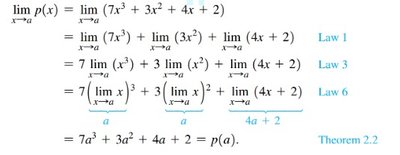
This demonstrates that the limit of a polynomial as approaches is simply the value of the polynomial at $a$.
One-Sided Limits
Theorem 7: Limit Laws for One-Sided Limits
Limit laws 1–6 apply to left-sided () and right-sided () limits. For the root law, the function must be non-negative near from the appropriate side if is even.
Right-sided root law: , provided for
Left-sided root law: , provided for
Other Techniques for Evaluating Limits
Factoring, Conjugates, and Common Denominators
When direct substitution fails (e.g., results in ), alternative algebraic techniques are used:
Factoring and canceling common terms
Multiplying by conjugates to simplify radicals
Finding common denominators
Example: can be evaluated by multiplying numerator and denominator by the conjugate .
The Squeeze Theorem
Theorem 10: Squeeze Theorem
If for all near (except possibly at $a$), and , then .
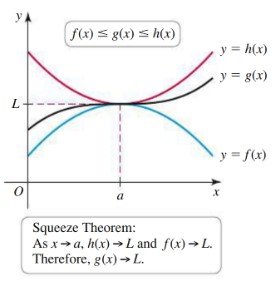
This theorem is especially useful when a function is bounded by two others whose limits are known.
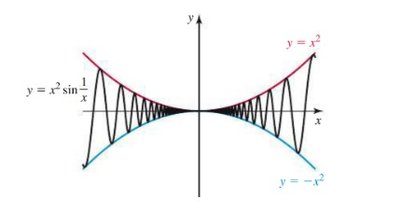
Example: Applying the Squeeze Theorem
To verify :
Since , multiplying by gives .
Both and .
By the Squeeze Theorem, .
Trigonometric Limits
Key Trigonometric Limits
Two important trigonometric limits are:
These results allow the evaluation of more complex trigonometric limits using identities and limit laws.
Example: Evaluate and using trigonometric identities such as and .
Summary Table: Limit Laws
Law | Formula | Condition |
|---|---|---|
Sum | Both limits exist | |
Difference | Both limits exist | |
Constant Multiple | Limit exists | |
Product | Both limits exist | |
Quotient | ||
Power | Limit exists | |
Root | near if even |
Additional info: These notes cover the essential analytical techniques for evaluating limits, including the use of algebraic manipulation, the Squeeze Theorem, and trigonometric identities. Mastery of these concepts is foundational for further study in calculus, including derivatives and integrals.
