 Indietro
Calculus Practice Test 1 – Step-by-Step Study Guidance
Guida di studio - Note intelligenti
 Appunti personalizzati basati sui tuoi materiali, ampliati con definizioni chiave, esempi e contesto.
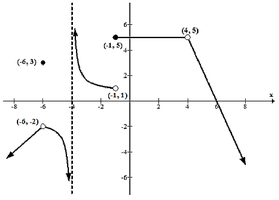
Q6. Use the graph of the function to find the following limits and continuity properties.
Background
Topic: Limits and Continuity from Graphs
This question tests your ability to interpret a graph to determine left-hand and right-hand limits, evaluate the function at specific points, identify vertical asymptotes, and assess continuity at a given value.
Key Terms and Concepts:
Limit: The value that approaches as approaches a specific point from the left () or right ().
Vertical Asymptote: A line where increases or decreases without bound as approaches .
Continuity: A function is continuous at if and both left and right limits exist and are equal.
Step-by-Step Guidance
Examine the graph at each specified value. Identify whether there are open or filled dots, jumps, or vertical dashed lines (asymptotes).
For left-hand and right-hand limits ( and ), trace the graph as approaches from each side. Note the -value the graph approaches, not necessarily the value at the dot.
For , check if both one-sided limits exist and are equal. If not, the limit does not exist (DNE).
To find vertical asymptotes, look for dashed vertical lines or places where the graph goes to or as approaches a value.
For continuity at , check if exists and equals . If not, identify which condition fails (limit existence, equality, or function value).
Try solving on your own before revealing the answer!
Final Answers:
a) : (approaching from the left, the graph goes to the open dot at )
b) : $3(-6, 3)$)
c) : DNE (left and right limits are not equal)
d) : The graph approaches (goes up without bound as from the left)
e) : The graph approaches (goes down without bound as from the right)
f) : DNE (left and right limits are not equal)
g) : $5(-1, 5)$)
h) : $1(-1, 1)$)
i) : DNE (left and right limits are not equal)
j) : $5y = 5x-1)
k) : $5x = 4y = 5$)
l) Vertical asymptote(s) of : (vertical dashed line)
m) Is continuous at ? No, is not continuous at because the function value at is an open dot (not defined), so does not exist or does not equal the limit.
These answers are based on careful analysis of the graph, considering open/closed dots, jumps, and asymptotes.
