 Indietro
Calculus Study Notes: Functions, Limits, and Differentiation
Guida di studio - Note intelligenti
 Appunti personalizzati basati sui tuoi materiali, ampliati con definizioni chiave, esempi e contesto.
Functions, Graphs, and Models
Set Notation and Interval Notation
Understanding how to describe sets of numbers is foundational in calculus. Set-builder notation and interval notation are two common ways to represent sets, especially subsets of real numbers.
Set-builder notation: Describes a set by stating the properties its members must satisfy.
Interval notation: Uses endpoints to describe all numbers between (and possibly including) those endpoints.
Types of intervals:
Open interval: (does not include endpoints)
Closed interval: (includes endpoints)
Half-open intervals: or
Intervals involving infinity: , , etc.
Example: The set of all such that is written as in interval notation.
Domain and Range of a Function
The domain of a function is the set of all possible input values (-values), and the range is the set of all possible output values (-values).
A function is a set of ordered pairs where no two pairs have the same -coordinate.
To find the domain, identify all -values for which the function is defined.
To find the range, determine all possible -values the function can take.
Example: For , the domain is because square roots are only defined for non-negative numbers.
Nonlinear Functions and Models
Quadratic Functions and Parabolas
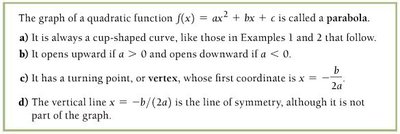
A quadratic function is given by , where . Its graph is called a parabola.
Shape: Always a cup-shaped curve.
Direction: Opens upward if , downward if .
Vertex: The turning point, with -coordinate .
Axis of symmetry: The vertical line .
Example: For , the vertex is at .
Limits and Continuity
Understanding Limits
The concept of a limit describes the behavior of a function as the input approaches a certain value. If approaches as approaches , we write:
One-sided limits: (from the left), (from the right).
A limit exists only if both one-sided limits exist and are equal.
Example: For , .
Algebraic Properties of Limits
Limits can be evaluated using several properties:
The limit of a sum is the sum of the limits.
The limit of a product is the product of the limits.
The limit of a quotient is the quotient of the limits (if the denominator's limit is not zero).
The limit of a constant is the constant itself.
Example: .
Continuity
A function is continuous at if:
exists,
exists,
.
If any of these conditions fail, the function is discontinuous at .
Differentiation Using Limits
Secant and Tangent Lines
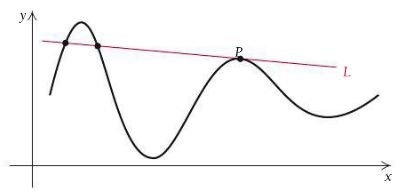
The secant line to a curve passes through two points on the curve, while the tangent line touches the curve at exactly one point and has the same slope as the curve at that point.
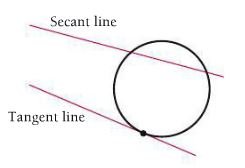
The slope of the secant line between and is:
As , the secant line approaches the tangent line.
The Difference Quotient and the Derivative
The difference quotient is used to compute the average rate of change of a function. The derivative is the limit of the difference quotient as approaches zero:
This gives the instantaneous rate of change of at , or the slope of the tangent line at that point.
Example: For , .
Where a Function is Not Differentiable
If a function is not defined at a point, it is not differentiable there.
If a function is discontinuous at a point, it is not differentiable there.
If a function has a sharp corner or cusp at a point, it is not differentiable there.
