 Indietro
Chapter 2: Exponential and Logarithmic Functions – Calculus and Its Applications
Guida di studio - Note intelligenti
 Appunti personalizzati basati sui tuoi materiali, ampliati con definizioni chiave, esempi e contesto.
Exponential and Logarithmic Functions of Natural Base, e
Introduction to the Natural Base e
The natural base, denoted e, is a fundamental mathematical constant approximately equal to 2.71828. It arises naturally in problems involving continuous growth or decay.
Definition:
Continuous Exponential Growth: If a quantity P grows continuously at an annual percentage rate r (as a decimal), its value after t years is .
Example: Continuous Growth
Luis invests A = 5000e^{0.0325 \times 5} \approx 5882.24$.
Natural Logarithms
The natural logarithm of a positive number x is the logarithm to the base e, denoted as ln x. It is the inverse function of the exponential function.
Definition: if and only if
Properties of Natural Logarithms
for all real numbers
for all
Example: Evaluating Natural Logarithms
Domain of Logarithmic Functions
The natural logarithm function is defined only for . Its domain is and its range is .
For , solve to find the domain.
Example: Domain
For , domain is .
Solving Exponential and Logarithmic Equations
To solve , take the natural logarithm of both sides:
To solve , exponentiate both sides:
Example: Solving Exponential Equation
Exponential Growth Rate and Doubling Time
The exponential growth rate r and the doubling time T are related by:
Example: Doubling Time
If a population doubles every 8 months, (8.7% per month).
Derivatives of Exponential (Base-e) Functions
Differentiation Rules
The derivative of is .
For , (Chain Rule).
Examples
Applications: Growth of an Account
If , then gives the instantaneous rate of growth.
Example
,
Derivatives of Natural Logarithmic Functions
Differentiation Rules
for
For ,
Examples
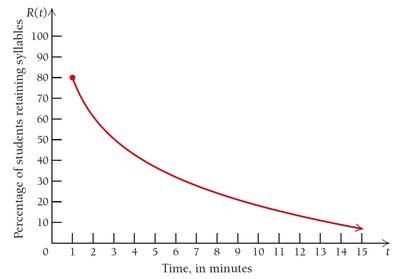
Application: Forgetting Curve in Psychology
The percentage of students retaining information over time can be modeled by a logarithmic function.
Example: ,
At ,
Rate of change at : (percentage decreases by 13.5% per minute at $t = 2$)
Applications: Uninhibited and Limited Growth Models
Uninhibited (Exponential) Growth
Differential equation:
Solution: , where is the initial population
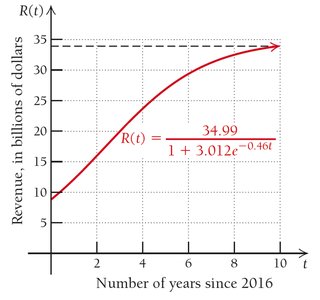
Logistic Growth Model
Differential equation: , where is the carrying capacity
Solution:
Example: Netflix Revenue Model
models revenue in billions of dollars, years after 2016
Point of diminishing returns: billion dollars
Applications: Exponential Decay
Exponential Decay Model
Differential equation:
Solution:
Half-Life and Decay Rate
Relationship: , ,
Example: Carbon Dating
Half-life of carbon-14: 5730 years
Decay rate:
If 22.3% of carbon-14 is lost, age years
Present Value with Continuous Compounding
Present value: , where is the future value, is the interest rate, is time
Newton’s Law of Cooling
Differential equation: , where is the ambient temperature
Solution:
Example: Forensics – Time of Death
Given two temperature readings and room temperature, solve for and to estimate time of death.
Derivatives of and
Exponential Functions with Base
Logarithmic Functions with Base
Examples
Base-n Exponential Growth
If a quantity increases n-fold every units of time:
Example: Population Decline
If a population loses 15% every 4 years:
