 Indietro
Chapter 2: Limits – Definition and Evaluation
Guida di studio - Note intelligenti
 Appunti personalizzati basati sui tuoi materiali, ampliati con definizioni chiave, esempi e contesto.
Chapter 2: Limits
2.2 Definition of Limits
The concept of a limit is fundamental in calculus, describing how a function behaves as its input approaches a particular value. Limits allow us to rigorously define instantaneous rates of change and continuity, which are foundational for derivatives and integrals.
Limit of a Function: The limit of a function f(x) as x approaches a is the value that f(x) gets closer to as x gets arbitrarily close to a (from either side), regardless of the value of f(a) itself.
Notation:
Key Point: The existence of the limit depends on the behavior of f(x) near a, not necessarily at a.
Example: Consider . To find , we examine values of x approaching 2 from both sides.

From the table, as x approaches 2 from both the left and right, f(x) approaches 3. Thus, .
Informal Definition of a Limit
Suppose f is defined for all x near a (except possibly at a). If f(x) can be made arbitrarily close to L for all x sufficiently close (but not equal) to a, then:
Important Note: The value of f(a) does not affect the limit. The limit only concerns the behavior of f(x) as x approaches a.
Finding Limits from Graphs and Tables
Limits can be estimated using tables of values or by analyzing the graph of a function. For example, consider the following table for as x approaches 1:

From the table, as x approaches 1 from both sides, f(x) approaches 2. Therefore, .
Two-Sided and One-Sided Limits
A two-sided limit considers the behavior of f(x) as x approaches a from both the left and right. In some cases, it is useful to consider one-sided limits:
Right-sided limit: (as x approaches a from the right)
Left-sided limit: (as x approaches a from the left)
Theorem: if and only if and .
Example: One-Sided Limits
Consider . Using the graph, we find:
does not exist since the left and right limits are not equal.
Limits with Unusual Behavior
Some functions do not have limits at certain points due to oscillatory behavior. For example, examine :
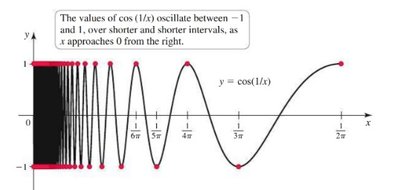
As x approaches 0, oscillates infinitely between -1 and 1, so the limit does not exist.
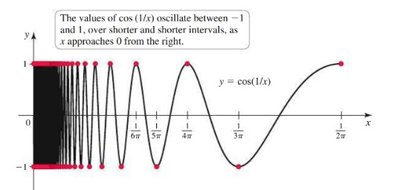
The table above shows the values of for values of x close to 0, illustrating the lack of a single limiting value.
Summary Table: Key Limit Concepts
Concept | Description |
|---|---|
Two-sided limit | Approaches the same value from both sides |
One-sided limit | Approaches value from only one side (left or right) |
Limit does not exist | Left and right limits are not equal, or function oscillates |
Key Formulas
General limit:
Right-sided limit:
Left-sided limit:
Additional info: The examples and tables provided reinforce the importance of analyzing both numerical and graphical evidence when evaluating limits. Special attention should be given to cases where the function is not defined at the point of interest, or where the function exhibits oscillatory or discontinuous behavior.
