 Indietro
Chapter 2: Limits – The Foundation of Calculus
Guida di studio - Note intelligenti
 Appunti personalizzati basati sui tuoi materiali, ampliati con definizioni chiave, esempi e contesto.
Chapter 2: Limits
2.1 The Idea of Limits
Limits are a fundamental concept in calculus, underlying both differentiation and integration. This section introduces limits through two motivating problems: finding the instantaneous velocity of a moving object and determining the slope of a tangent line to a curve.
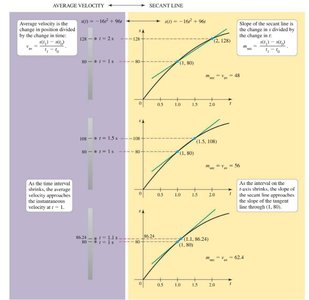
Key Point 1: Average Rate of Change: The average rate of change of a function f over the interval [a, x] is given by the difference quotient: This represents the slope of the secant line connecting the points (a, f(a)) and (x, f(x)) on the graph of f.
Key Point 2: Secant Line: The secant line is a straight line joining two points on a curve. Its slope is the average rate of change between those points.
Example: For the position function (representing the height of a rock launched vertically), the average velocity between s and s is: ft/s.
Instantaneous Velocity and the Limit Concept
To find the instantaneous velocity at a specific time, we examine the average velocity over intervals that shrink toward a single point. As the interval becomes infinitesimally small, the average velocity approaches the instantaneous velocity, which is defined as a limit.
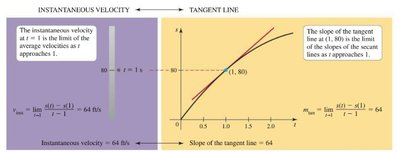
Key Point 1: Instantaneous Velocity: The instantaneous velocity at is the limit of the average velocities as the interval approaches zero:
Key Point 2: Numerical Estimation: By calculating average velocities over intervals [1, t] for values of t increasingly close to 1, we observe the values approach 64 ft/s. For example:
[1, 1.1]: 62.4 ft/s
[1, 1.01]: 63.84 ft/s
[1, 1.001]: 63.984 ft/s
[1, 1.0001]: 63.9984 ft/s
As t approaches 1, the average velocity approaches 64 ft/s.
Key Point 3: One-Sided Limits: The same instantaneous velocity is obtained as t approaches 1 from either the left or the right.
Example: For , the instantaneous velocity at is: ft/s.
Slope of the Tangent Line
The tangent line to a curve at a point is the line that just touches the curve at that point and has the same slope as the curve there. The slope of the tangent line is found as the limit of the slopes of secant lines as the second point approaches the point of tangency.
Definition: A tangent line to the curve at is a line passing through with a slope equal to the limit of the slopes of secant lines as the second point approaches .
Key Point 1: Secant Lines Approaching Tangent Line: As the interval between two points shrinks, the secant line approaches the tangent line, and the slope of the secant line approaches the slope of the tangent line.
Key Point 2: Slope as a Limit: The slope of the tangent line at is: ft/s.
Key Point 3: Connection to Instantaneous Velocity: The instantaneous velocity at is numerically equal to the slope of the tangent line to the position curve at $t = 1$.
Summary Table: Average and Instantaneous Velocity
Time Interval | Average Velocity (ft/s) |
|---|---|
[1, 1.1] | 62.4 |
[1, 1.01] | 63.84 |
[1, 1.001] | 63.984 |
[1, 1.0001] | 63.9984 |
As t → 1 | 64 (limit) |
Additional info:
The concept of a limit is foundational for defining derivatives and integrals in calculus.
Continuity and the formal definition of a limit will be introduced in later sections.
