 Indietro
Chapter 4: Integration – Comprehensive Study Notes
Guida di studio - Note intelligenti
 Appunti personalizzati basati sui tuoi materiali, ampliati con definizioni chiave, esempi e contesto.
Integration
Introduction to Integration
Integration is a fundamental concept in calculus that allows us to find areas under curves, solve real-world problems involving accumulation, and reverse the process of differentiation. This chapter focuses on the theory, techniques, and applications of integration, including both indefinite and definite integrals.
Antidifferentiation and Indefinite Integrals
Definition and Basic Properties
An antiderivative of a function f(x) is a function F(x) such that F'(x) = f(x). The set of all antiderivatives of f(x) is written as F(x) + C, where C is the constant of integration.
Indefinite Integral:
Constant of Integration: The arbitrary constant C accounts for all possible vertical shifts of the antiderivative.
Basic Rules for Antidifferentiation
Constant Rule:
Power Rule: , for
Natural Logarithm Rule:
Exponential Rule (base e): ,
Examples
Example 1:
Example 2:
Example 3:
Example 4:
Properties of Indefinite Integrals
Linearity:
Sum/Difference: The integral of a sum/difference is the sum/difference of the integrals.
Antiderivatives as Areas
Area Under a Curve and Applications
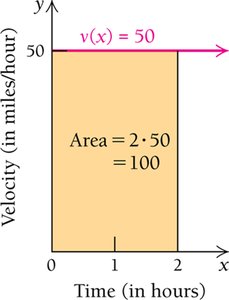
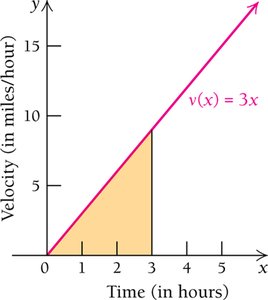
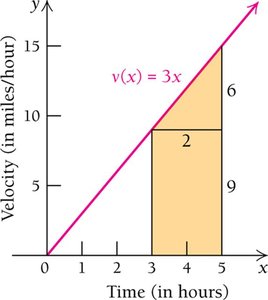
The area under the graph of a function can be interpreted as the accumulation of a quantity, such as distance traveled or total profit. For constant velocity, the area under the velocity-time graph is a rectangle; for variable velocity, it may be a triangle or trapezoid.
Example: A vehicle travels at 50 mi/hr for 2 hours. The area under the velocity-time graph is miles.
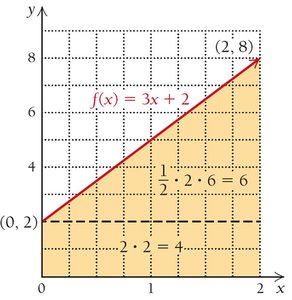
Example: For , the area under the curve from to is a triangle with area miles.
Example: For from to , the area is a trapezoid, which can be split into a rectangle and a triangle.
Riemann Sums
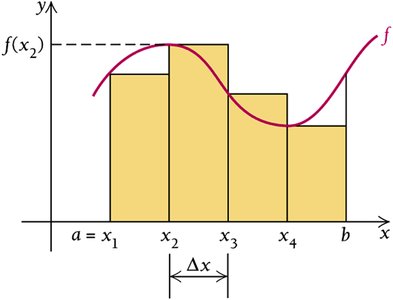
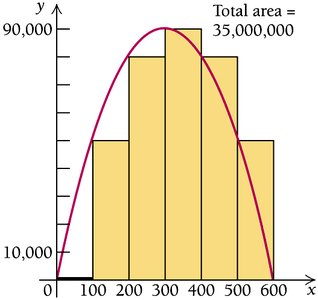
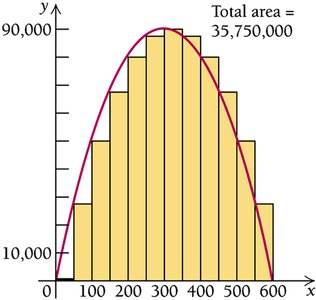
To approximate the area under a curve, the interval is divided into subintervals of equal width . The sum of the areas of rectangles approximates the total area:
Riemann Sum:
Graphical Representation:
Improving Approximations
Increasing the number of rectangles (subintervals) improves the approximation.
Example: Approximating the area under over with 6 and 12 rectangles:
Definite Integrals
Definition and Notation
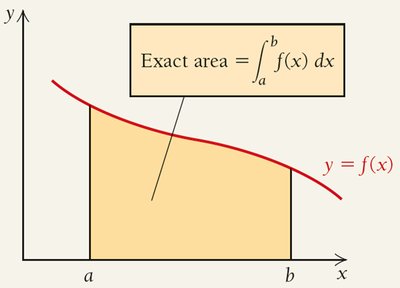
The definite integral of a continuous function over is the limit of the Riemann sum as the number of subintervals approaches infinity:
This represents the exact area under from to .
Evaluating Definite Integrals Using Geometry
For linear functions, the area can often be found using geometric formulas for rectangles, triangles, or trapezoids.
Fundamental Theorem of Calculus
If is any antiderivative of , then:
Applications of Definite Integrals
Area Under a Nonnegative Function
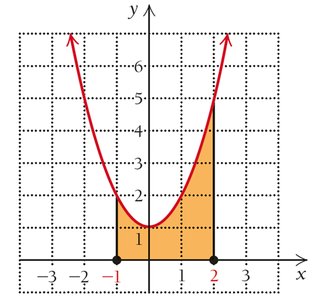
To find the area under over , compute .
Example: Area under from to .
Interpreting Definite Integrals in Context
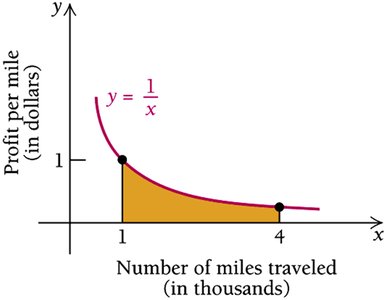
Example: The area under from to represents total profit as miles increase from 1000 to 4000.
Signed Area and Net Accumulation
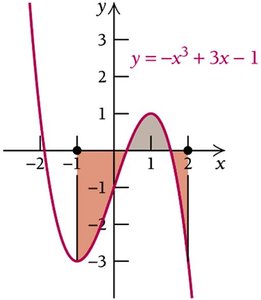
If the function dips below the x-axis, the definite integral gives the net signed area (positive above, negative below).
Example: over .
Business Application: Marginal Profit
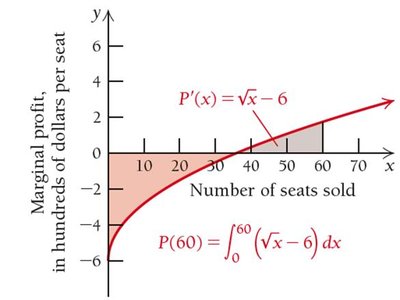
The definite integral of a marginal profit function over an interval gives the total profit over that interval.
Properties of Definite Integrals
Additive Property
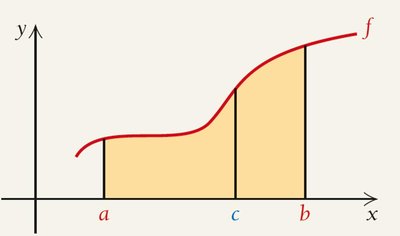
If , then .
Area Between Curves
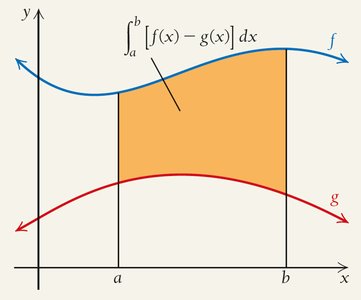
If on , the area between the curves is .
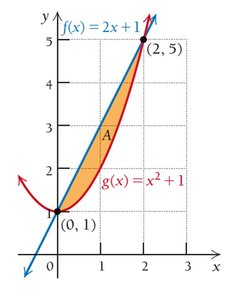
Example: Area between and .
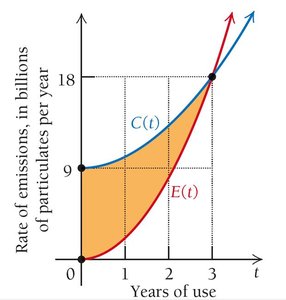
Applied Example: Emission Control
The area between two rate functions over a time interval represents the total reduction in emissions.
Average Value of a Function
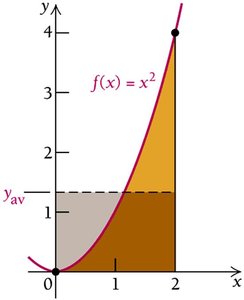
The average value of over is .
Example: Average value of over .
Moving Average
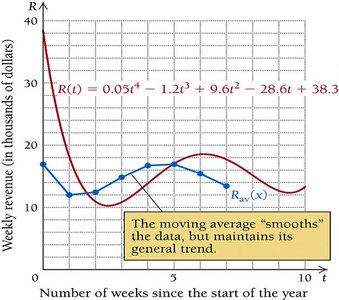
The moving average function over an interval of length is .
Example: Moving average of weekly revenue for Trux Rentals.
Integration Techniques: Substitution
Substitution Method
The substitution method is used to evaluate integrals involving composite functions. It is the reverse process of the chain rule in differentiation.
General Formula: , where
Examples
Example 1:
Let ,
Example 2:
Let ,
Definite Integrals with Substitution
When changing variables in a definite integral, update the limits of integration to match the new variable.
Summary Table: Basic Antiderivative Rules
Rule | Formula |
|---|---|
Constant Rule | |
Power Rule | , |
Exponential Rule | |
Logarithm Rule | |
Sum/Difference |
Additional info: These notes cover the core concepts, properties, and applications of integration as presented in a standard Calculus course, including geometric and applied interpretations, and the substitution technique for integration.
