 Indietro
Chapter 4: Integration – Concepts, Properties, and Applications
Guida di studio - Note intelligenti
 Appunti personalizzati basati sui tuoi materiali, ampliati con definizioni chiave, esempi e contesto.
Integration
Antidifferentiation
Antidifferentiation is the process of finding a function whose derivative is the given function. This process is fundamental to integral calculus and forms the basis for evaluating areas, solving differential equations, and modeling real-world phenomena.
Antiderivative: If $F(x)$ is an antiderivative of $f(x)$, then $F'(x) = f(x)$.
Indefinite Integral: The set of all antiderivatives of $f(x)$ is denoted by $\int f(x) dx = F(x) + C$, where $C$ is the constant of integration.
Checking: Differentiate your result to verify it matches the original function.
Basic Rules for Antiderivatives
Constant Rule: $\int k\,dx = kx + C$
Power Rule: $\int x^n dx = \frac{x^{n+1}}{n+1} + C$, $n \neq -1$
Natural Logarithm Rule: $\int \frac{1}{x} dx = \ln|x| + C$
Exponential Rule (base $e$): $\int e^{ax} dx = \frac{1}{a} e^{ax} + C$, $a \neq 0$
Examples
Example 1: $\int 8 dx = 8x + C$
Example 2: $\int 3x^2 dx = x^3 + C$
Example 3: $\int e^x dx = e^x + C$
Example 4: $\int \frac{1}{x} dx = \ln|x| + C$
Properties of Antiderivatives
Constant Multiple: $\int c f(x) dx = c \int f(x) dx$
Sum/Difference: $\int [f(x) \pm g(x)] dx = \int f(x) dx \pm \int g(x) dx$
Antiderivatives as Areas
Area Under a Graph
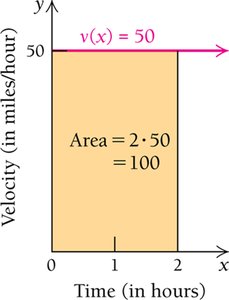
The area under a velocity-time graph represents the distance traveled. For constant velocity, the area is a rectangle; for variable velocity, it may be a triangle, trapezoid, or more complex region.
Example: A vehicle travels at 50 mi/hr for 2 hr. The area under the graph is $2 \times 50 = 100$ mi.
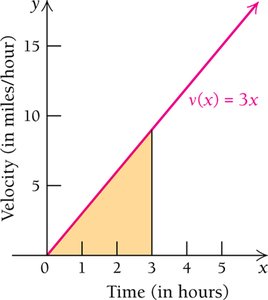
Example: For $v(x) = 3x$, the area from $x=0$ to $x=3$ is a triangle with area $\frac{1}{2} \times 3 \times 9 = 13.5$ mi.
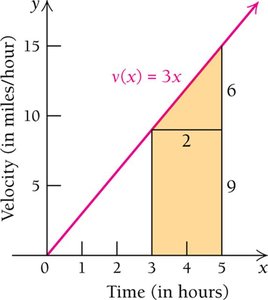
Example: For $x=3$ to $x=5$, the area is a trapezoid (rectangle plus triangle): $18 + 6 = 24$ mi.
Riemann Sums
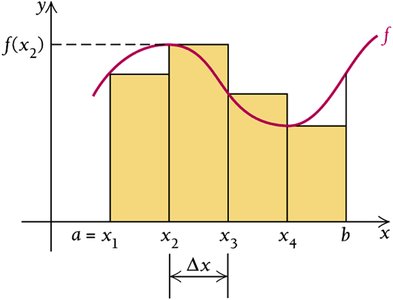
Riemann sums approximate the area under a curve by dividing the interval into subintervals and summing the areas of rectangles.
General Form: $\sum_{i=1}^n f(x_i) \Delta x$
As $n \to \infty$ and $\Delta x \to 0$, the sum approaches the exact area.
Definite Integral
The definite integral gives the exact area under a curve $y = f(x)$ from $x = a$ to $x = b$:
$\int_a^b f(x) dx$
Represents the limit of Riemann sums as the number of rectangles increases without bound.
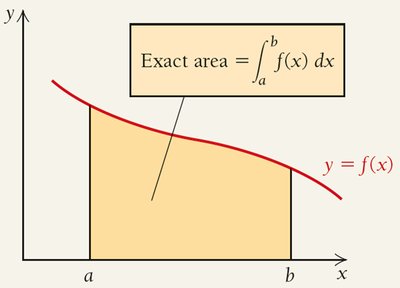
Area and Definite Integrals
Evaluating Definite Integrals
To find the area under a curve, find an antiderivative $F(x)$ of $f(x)$ and compute $F(b) - F(a)$.
Fundamental Theorem of Calculus: $\int_a^b f(x) dx = F(b) - F(a)$, where $F'(x) = f(x)$.
Example
Find the area under $y = 3x + 2$ from $x = 0$ to $x = 2$:
Antiderivative: $F(x) = \frac{3}{2}x^2 + 2x$
Area: $F(2) - F(0) = (6 + 4) - 0 = 10$
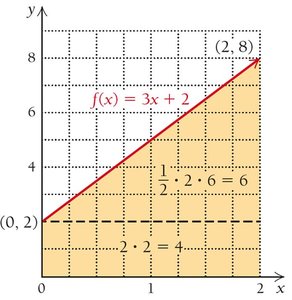
Applications of Definite Integrals
Profit Example: The area under $y = 1/x$ from $x = 1$ to $x = 4$ represents total profit as miles increase from 1000 to 4000.
Calculation: $\int_1^4 \frac{1}{x} dx = \ln 4 - \ln 1 = \ln 4 \approx 1.3863$
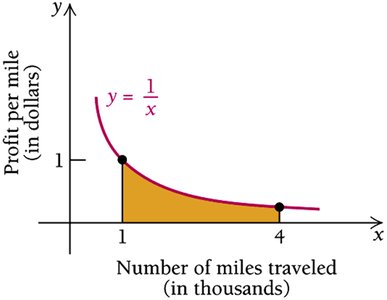
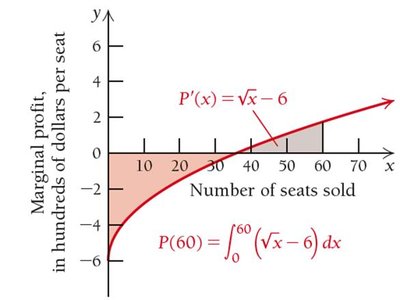
Net Signed Area: If the function dips below the x-axis, the definite integral gives the net area (positive above, negative below).
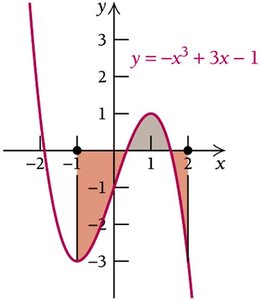
Business Example: Marginal profit $P'(x) = \sqrt{x} - 6$; total profit for 60 seats is $\int_0^{60} (\sqrt{x} - 6) dx$.
Properties of Definite Integrals
Additive Property
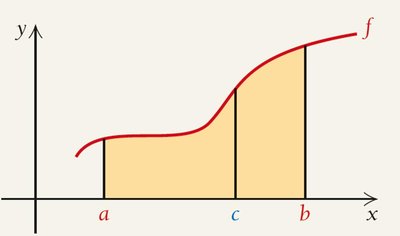
The definite integral over an interval can be split at any point $c$ between $a$ and $b$:
$\int_a^b f(x) dx = \int_a^c f(x) dx + \int_c^b f(x) dx$
Area Between Curves
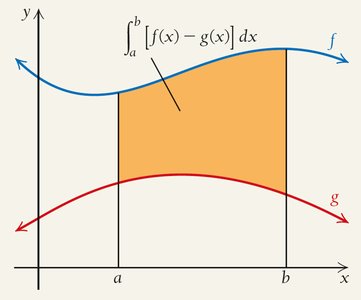
The area between two curves $f(x)$ and $g(x)$ (where $f(x) \geq g(x)$ on $[a, b]$) is:
$\int_a^b [f(x) - g(x)] dx$
Example
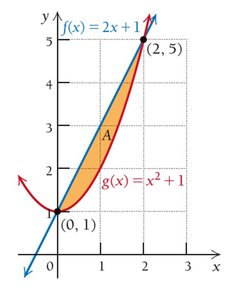
Find the area between $f(x) = 2x + 1$ and $g(x) = x^2 + 1$ from $x = 0$ to $x = 2$.
Average Value of a Function
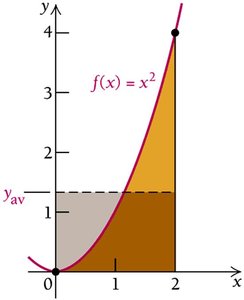
The average value of a continuous function $f(x)$ over $[a, b]$ is:
$y_{av} = \frac{1}{b-a} \int_a^b f(x) dx$
Moving Average
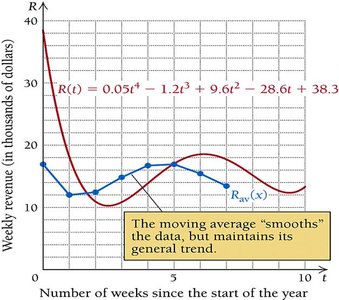
The moving average function smooths out fluctuations in data by averaging over a fixed interval $L$:
$f_{av}(x) = \frac{1}{L} \int_x^{x+L} f(t) dt$
Integration Techniques: Substitution
Substitution Method
Substitution is used to simplify integrals by changing variables. It is especially useful when the integrand contains a function and its derivative.
General Steps:
Let $u = g(x)$, where $g(x)$ is a function inside the integrand.
Compute $du = g'(x) dx$.
Rewrite the integral in terms of $u$ and $du$.
Integrate with respect to $u$.
Substitute back $u = g(x)$.
Common Substitution Formulas
$\int u^r du = \frac{u^{r+1}}{r+1} + C$, $r \neq -1$
$\int e^u du = e^u + C$
$\int \frac{1}{u} du = \ln|u| + C$
Examples
Example 1: $\int 3x^2 (x^3 + 1)^{10} dx$ Let $u = x^3 + 1$, $du = 3x^2 dx$ $\int u^{10} du = \frac{u^{11}}{11} + C = \frac{(x^3 + 1)^{11}}{11} + C$
Example 2: $\int \frac{2x}{x^2 + 1} dx$ Let $u = x^2 + 1$, $du = 2x dx$ $\int \frac{1}{u} du = \ln|u| + C = \ln|x^2 + 1| + C$
Definite Integrals with Substitution
Change the limits of integration to match the new variable $u$.
Alternatively, substitute back to $x$ before evaluating at the original limits.
Summary Table: Key Integration Formulas
Rule | Formula |
|---|---|
Constant Rule | $\int k dx = kx + C$ |
Power Rule | $\int x^n dx = \frac{x^{n+1}}{n+1} + C$, $n \neq -1$ |
Exponential Rule | $\int e^{ax} dx = \frac{1}{a} e^{ax} + C$ |
Logarithm Rule | $\int \frac{1}{x} dx = \ln|x| + C$ |
Sum/Difference | $\int [f(x) \pm g(x)] dx = \int f(x) dx \pm \int g(x) dx$ |
Constant Multiple | $\int c f(x) dx = c \int f(x) dx$ |
Additional info: These notes cover the core concepts of integration, including antidifferentiation, definite integrals, properties, applications, and the substitution technique, as presented in a standard Calculus college course.
