Indietro
Chapter 6: Applications of Integration – Velocity, Net Change, and Physical Applications
Guida di studio - Note intelligenti
 Appunti personalizzati basati sui tuoi materiali, ampliati con definizioni chiave, esempi e contesto.
6.1 Velocity and Net Change
Displacement and Distance Traveled
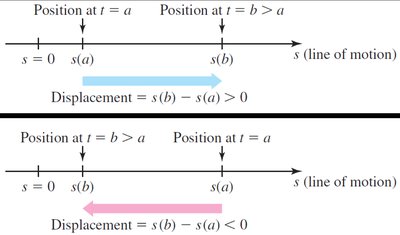
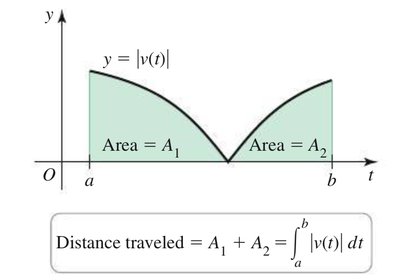
In calculus, integration is used to analyze motion along a straight line by relating position, velocity, and acceleration. The displacement of an object is the net change in its position over a time interval, while the distance traveled is the total length of the path, regardless of direction.
Displacement: If s(t) is the position function, the displacement over [a, b] is s(b) - s(a).
Distance Traveled: The total distance is the integral of the speed (the absolute value of velocity):
Velocity and Position: Velocity is the derivative of position: v(t) = s'(t).
Fundamental Theorem of Calculus (FTC): Relates the integral of velocity to displacement:
Example: Jogger's Motion
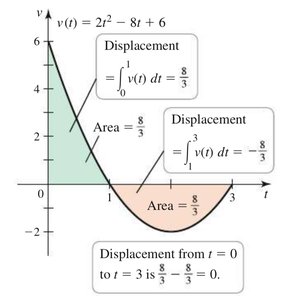
Consider a jogger with velocity function v(t) = 2t^2 - 8t + 6 for 0 \leq t \leq 3 (in mi/hr). We analyze the motion as follows:
Direction of Motion: The jogger moves in the positive direction when v(t) > 0 and in the negative direction when v(t) < 0.
Displacement on Intervals:
On [0, 1]:
On [1, 3]:
On [0, 3]:
Distance Traveled:
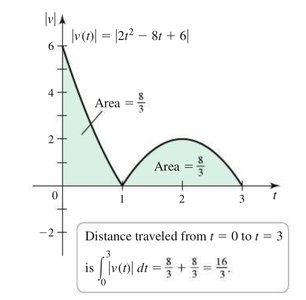
Position from Velocity
Given the velocity function and initial position, the position at any time t is found by integrating velocity:
Theorem 6.1:
Example: If v(t) = \frac{1}{4} \sin t, s(0) = -\frac{1}{4}, then
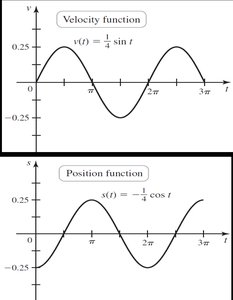
Piecewise Velocity Example
For a skydiver with a piecewise velocity function, the total distance is the sum of integrals over each interval:
Velocity from Acceleration
Given acceleration a(t) and initial velocity v(0), the velocity is:
Example: Projectile Motion
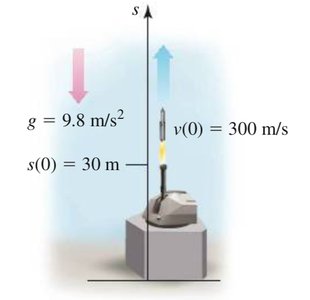
An artillery shell is fired upward with v(0) = 300 m/s from s(0) = 30 m. Gravity acts with a(t) = -9.8 m/s2.
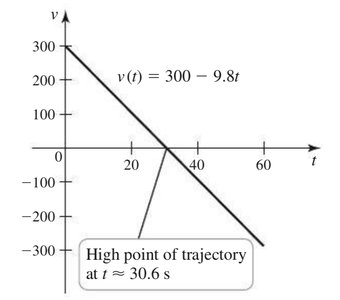
Velocity:
Position:
Highest Point: Occurs when s, m
Time to Ground: Solve s
6.1 Net Change and Future Value
Net Change Theorem
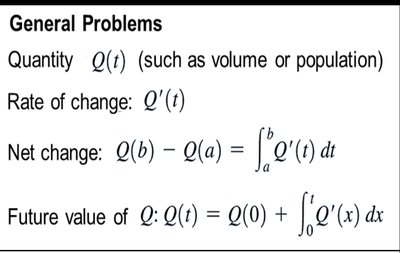
The Net Change Theorem states that the net change in a quantity Q(t) over [a, b] is the integral of its rate of change:
Future value from initial value:
Example: Population Growth
A town has initial population 250 and grows at rate .
Net Change (10 to 20 years):
Population at time t:
Summary Tables
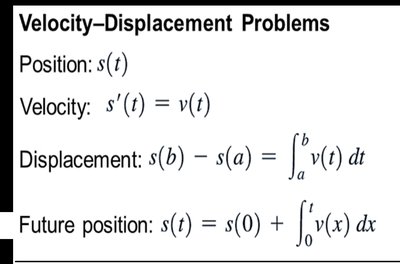
Velocity–Displacement Problems |
|---|
Position: |
Velocity: |
Displacement: |
Future position: |
General Problems |
|---|
Quantity: (e.g., volume, population) |
Rate of change: |
Net change: |
Future value: |