 Indietro
Complex Numbers: Foundations, Properties, and Calculus Applications
Guida di studio - Note intelligenti
 Appunti personalizzati basati sui tuoi materiali, ampliati con definizioni chiave, esempi e contesto.
Complex Numbers
Introduction to Complex Numbers
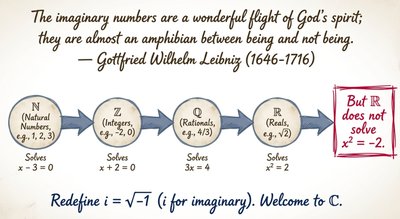
Complex numbers extend the real number system to include solutions to equations that have no real solutions, such as . The set of complex numbers is denoted by \( \mathbb{C} \) and is defined as all numbers of the form \( z = x + yi \), where \( x, y \in \mathbb{R} \) and \( i = \sqrt{-1} \).
Natural Numbers (\( \mathbb{N} \)): Solve equations like \( x = 3 \).
Integers (\( \mathbb{Z} \)): Solve equations like \( x + 2 = 0 \).
Rationals (\( \mathbb{Q} \)): Solve equations like \( 3x = 4 \).
Reals (\( \mathbb{R} \)): Solve equations like \( x^2 = 2 \).
Complex Numbers (\( \mathbb{C} \)): Solve equations like \( x^2 = -2 \) by defining \( i = \sqrt{-1} \).
Rectangular (Cartesian) Form
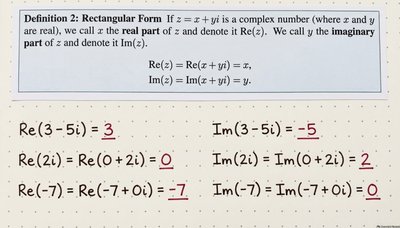
Any complex number can be written as \( z = x + yi \), where \( x \) is the real part and \( y \) is the imaginary part:
\( \operatorname{Re}(z) = x \)
\( \operatorname{Im}(z) = y \)
For example:
\( \operatorname{Re}(3 - 5i) = 3 \), \( \operatorname{Im}(3 - 5i) = -5 \)
\( \operatorname{Re}(2i) = 0 \), \( \operatorname{Im}(2i) = 2 \)
\( \operatorname{Re}(-7) = -7 \), \( \operatorname{Im}(-7) = 0 \)
Geometric Representation: Argand Diagram
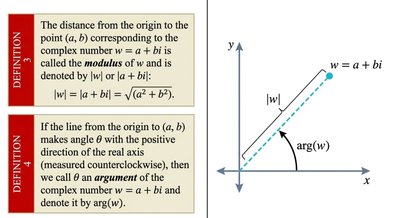
Complex numbers can be represented as points or vectors in the complex plane (Argand diagram), where the horizontal axis is the real part and the vertical axis is the imaginary part. The modulus and argument provide a polar coordinate description:
Modulus (magnitude): \( |z| = \sqrt{x^2 + y^2} \)
Argument (angle): \( \arg(z) = \omega \), where \( \tan \omega = \frac{y}{x} \)
Calculating Moduli and Arguments
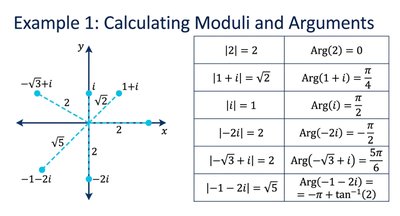
To find the modulus and argument of a complex number, use the formulas above. The argument is typically given in radians and may require adjustment based on the quadrant.
z | |z| | Arg(z) |
|---|---|---|
2 | 2 | 0 |
1 + i | \( \sqrt{2} \) | \( \frac{\pi}{4} \) |
i | 1 | \( \frac{\pi}{2} \) |
-2i | 2 | \( -\frac{\pi}{2} \) |
-\sqrt{3} + i | 2 | \( \frac{5\pi}{6} \) |
-1 - 2i | \( \sqrt{5} \) | \( -\pi + \tan^{-1}(2) \) |
Polar and Exponential Form (Euler's Formula)
Any complex number can also be written in polar or exponential form:
\( z = r(\cos \omega + i \sin \omega) = re^{i\omega} \)
Euler's identity: \( e^{i\omega} = \cos \omega + i \sin \omega \)
This form is especially useful for multiplication, division, and finding powers and roots.
Complex Conjugate
The complex conjugate of \( z = x + yi \) is \( \overline{z} = x - yi \). Geometrically, this is the reflection of \( z \) across the real axis. Key properties:
\( \operatorname{Re}(z) = \operatorname{Re}(\overline{z}) \)
\( \operatorname{Im}(\overline{z}) = -\operatorname{Im}(z) \)
\( |z| = |\overline{z}| \)
\( \arg(\overline{z}) = -\arg(z) \)
Arithmetic with Complex Numbers
Addition and Subtraction
\( (x_1 + y_1i) + (x_2 + y_2i) = (x_1 + x_2) + (y_1 + y_2)i \)
\( (x_1 + y_1i) - (x_2 + y_2i) = (x_1 - x_2) + (y_1 - y_2)i \)
Multiplication
\( (x_1 + y_1i)(x_2 + y_2i) = (x_1x_2 - y_1y_2) + (x_1y_2 + x_2y_1)i \)
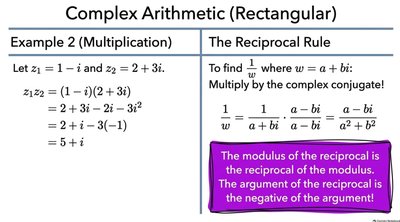
Example: \( (1 - i)(2 + 3i) = 2 + 3i - 2i - 3i^2 = 2 + i + 3 = 5 + i \)
Division and Reciprocals
To divide by a complex number, multiply numerator and denominator by the conjugate of the denominator:
\( \frac{1}{w} = \frac{\overline{w}}{|w|^2} = \frac{a - bi}{a^2 + b^2} \) for \( w = a + bi \)
The modulus of the reciprocal is the reciprocal of the modulus; the argument of the reciprocal is the negative of the argument.
Simplifying Quotients
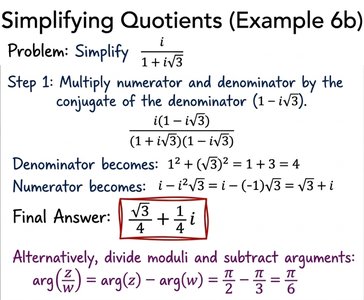
To simplify \( \frac{i}{1 + i\sqrt{3}} \):
Multiply numerator and denominator by the conjugate \( 1 - i\sqrt{3} \).
Result: \( \frac{\sqrt{3}}{4} + \frac{1}{4}i \)
Alternatively, divide moduli and subtract arguments.
De Moivre's Theorem and Powers/Roots
De Moivre's Theorem: For any real \( \omega \) and integer \( n \):
\( (\cos \omega + i \sin \omega)^n = \cos(n\omega) + i \sin(n\omega) \)
\( (re^{i\omega})^n = r^n e^{in\omega} \)
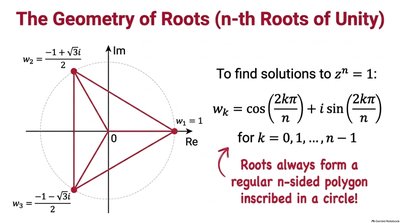
n-th Roots: The n-th roots of \( z = re^{i\omega} \) are:
\( w_k = r^{1/n} e^{i(\omega + 2k\pi)/n} \), for \( k = 0, 1, ..., n-1 \)
These roots are equally spaced around the unit circle, forming a regular n-sided polygon.
Applications and Geometric Loci
The set of points \( |z - z_0| \leq R \) in the complex plane is a closed disk centered at \( z_0 \) with radius \( R \).
Equations involving modulus and argument describe circles, lines, and other loci in the complex plane.
Summary Table: Key Properties of Complex Numbers
Property | Rectangular Form | Polar/Exponential Form |
|---|---|---|
General Form | \( x + yi \) | \( re^{i\omega} \) |
Modulus | \( \sqrt{x^2 + y^2} \) | \( r \) |
Argument | \( \tan^{-1}(y/x) \) | \( \omega \) |
Conjugate | \( x - yi \) | \( re^{-i\omega} \) |
Multiplication | Distributive | Multiply moduli, add arguments |
Division | Multiply by conjugate | Divide moduli, subtract arguments |
