 Indietro
2.5
Guida di studio - Note intelligenti
 Appunti personalizzati basati sui tuoi materiali, ampliati con definizioni chiave, esempi e contesto.
Continuity
Continuity at a Point
Continuity is a fundamental concept in calculus that describes whether a function behaves predictably at a specific point. A function f(x) is said to be continuous at a point x = c if it satisfies three essential conditions:
f(c) exists: The function is defined at c (i.e., c is in the domain of f).
\lim_{x \to c} f(x) exists:
\lim_{x \to c} f(x) = f(c): The limit equals the function value at c.
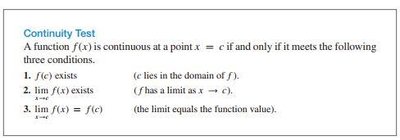
If any of these conditions fail, the function f is discontinuous at c, and a discontinuity occurs.
Types of Discontinuities
Discontinuities can occur in several ways, such as:
Jump Discontinuity: The left and right limits exist but are not equal.
Infinite Discontinuity: The function approaches infinity at the point.
Removable Discontinuity: The limit exists, but the function value does not match the limit.
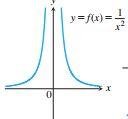
Right and Left Continuity
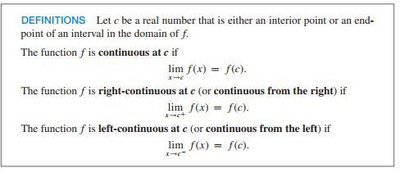
Sometimes, a function may be continuous only from one side at a point. The definitions are:
Right-continuous at c:
Left-continuous at c:
Continuity of Common Functions
Functions Continuous Everywhere in Their Domains
The following types of functions are continuous at every number in their domains:
Polynomials
Rational functions (except where the denominator is zero)
Radical/root functions (where the radicand is defined)
Trigonometric functions
Inverse trigonometric functions
Logarithmic functions (where the argument is positive)
Exponential functions
Compositions of the above functions (in their common domains)
Examples and Applications
Example 1: Identifying Points of Discontinuity
Given a graph or formula, determine where f is not continuous by checking the three continuity conditions.
Example 2: One-Sided Continuity
For each discontinuity, determine if f is continuous from the right, left, or neither by evaluating the one-sided limits.
Example 3: Continuity of a Composite Function
Consider . The function is continuous wherever the denominator is not zero and the numerator is defined. Thus, f is continuous for , , .
Example 4: Continuity Test at a Specific Point
For at :
exists:
exists: The function is defined and continuous at .
: True.
Thus, f is continuous at .
Example 5: Piecewise Function Continuity
For at :
Since the left and right limits are not equal, f is not continuous at .
Example 6: Interval of Continuity
For , find where f is continuous. The function is continuous everywhere except possibly at . Check the limit and function value at to determine continuity.
Example 7: Continuity of a Piecewise Function with a Constant
For , find values of for which f is continuous everywhere. Set the left and right limits at equal and solve for :
Set and solve for .
Additional info: These examples illustrate the application of the continuity test and the importance of checking both the function value and the limit at a point, especially for piecewise functions.
