 Indietro
Derivatives of Inverse Functions and Logarithms
Guida di studio - Note intelligenti
 Appunti personalizzati basati sui tuoi materiali, ampliati con definizioni chiave, esempi e contesto.
Derivatives of Inverse Functions and Logarithms
Properties of Logarithms
The natural logarithm, denoted as ln, possesses several important algebraic properties that are fundamental in calculus, especially when simplifying expressions before differentiation.
Product Rule:
Quotient Rule:
Reciprocal Rule:
Power Rule:
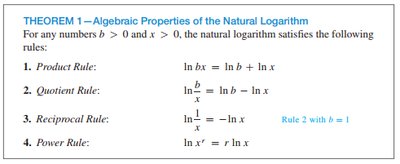
Example: Using these properties, can be expanded to .
Derivatives of the Natural Logarithmic Function
The derivative of the natural logarithm function is a fundamental result in calculus:
, for
For a positive differentiable function , the chain rule gives:
Example:
Derivatives of Exponential and Logarithmic Functions
For exponential and logarithmic functions with base :
, where ,
For a positive differentiable function :
Example:
Logarithmic Differentiation
Logarithmic differentiation is a technique used to differentiate functions that are products, quotients, or powers, especially when the function does not initially contain a logarithm. The steps are:
Take the natural logarithm of both sides:
Expand the right side using logarithm properties.
Differentiate implicitly with respect to .
Solve for and substitute back .
Example: To differentiate , take , then differentiate:
Worked Examples
Example 1:
Example 2:
Example 3: Logarithmic differentiation yields
Example 4: Logarithmic differentiation:
Additional info: Logarithmic differentiation is especially useful for functions where both the base and exponent are variable, or for products and quotients of complicated expressions.
