 Indietro
Derivatives: Tangent Lines, Differentiability, and Basic Rules
Guida di studio - Note intelligenti
 Appunti personalizzati basati sui tuoi materiali, ampliati con definizioni chiave, esempi e contesto.
Derivatives: Tangent Lines, Differentiability, and Basic Rules
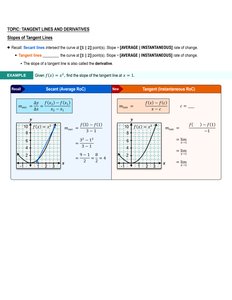
Slopes of Tangent Lines
The concept of the tangent line is fundamental in calculus, as it provides the instantaneous rate of change of a function at a point. The slope of a tangent line at a point on a curve is defined as the derivative of the function at that point.
Secant Line (Average Rate of Change): The slope between two points on a curve, given by the formula:
Tangent Line (Instantaneous Rate of Change): The slope at a single point, defined as the limit of the secant slope as the two points approach each other:
Derivative: The slope of the tangent line is also called the derivative of the function at that point.
Example: Given , find the slope of the tangent line at .
Equations of Tangent Lines
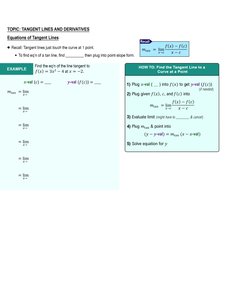
To find the equation of a tangent line to a curve at a specific point, follow these steps:
Find the derivative to determine the slope at the point of tangency.
Evaluate at the given -value to get the slope .
Use the point-slope form of a line: .
Example: Find the equation of the tangent line to at .
Derivatives as Functions
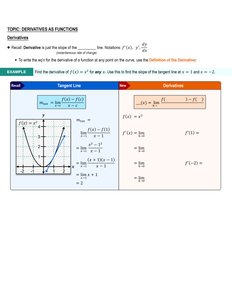
The derivative of a function , denoted or , gives the slope of the tangent line at any point . The derivative itself is a function that describes the instantaneous rate of change at every point on the original function.
Definition of the Derivative:
Example: Find the derivative of for any , and use it to find the slope at and .
Graphing the Derivative
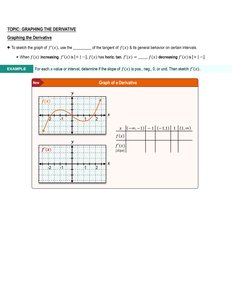
To sketch the graph of , use the slopes of the tangent lines to at various points. The sign and magnitude of indicate where is increasing, decreasing, or has horizontal tangents (where ).
Where is increasing, .
Where is decreasing, .
Where has a horizontal tangent, .
Example: For each value or interval, determine if the slope of is positive, negative, or zero, then sketch .
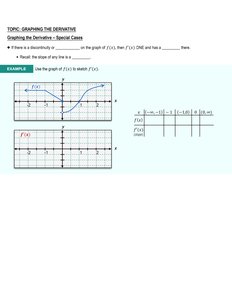
Graphing the Derivative – Special Cases
If there is a discontinuity or sharp corner on the graph of , then does not exist (DNE) at that point and has a jump or undefined value.
The slope of any straight line is constant, so its derivative is a constant function.
Example: Use the graph of to sketch , noting points of discontinuity or non-differentiability.
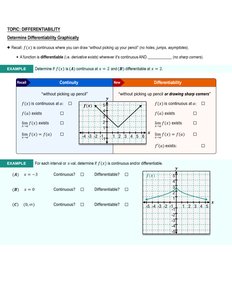
Differentiability
A function is continuous if you can draw its graph without lifting your pencil (no holes, jumps, or asymptotes). A function is differentiable at a point if it is continuous there and has no sharp corners or cusps.
Continuous: is continuous at if .
Differentiable: is differentiable at if exists.
Example: For each interval or value, determine if is continuous and/or differentiable.
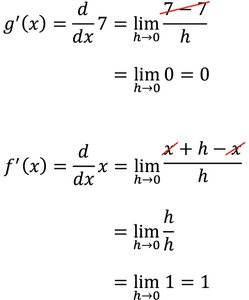
Basic Rules of Differentiation
Several rules allow us to compute derivatives efficiently without using the limit definition each time:
Constant Rule:
Power Rule:
Sum/Difference Rule:
Constant Multiple Rule:
Example: Find the derivative of .
Product, Quotient, and Chain Rules
For more complex functions, use these rules:
Product Rule:
Quotient Rule:
Chain Rule:
Example:

Additional info: The images included above are directly relevant to the explanation of the corresponding paragraphs, visually reinforcing the concepts of secant and tangent lines, the process of finding tangent line equations, the definition and computation of derivatives, graphing derivatives, differentiability, and the application of basic differentiation rules.
