 Indietro
Implicit Differentiation and Implicitly Defined Functions
Guida di studio - Note intelligenti
 Appunti personalizzati basati sui tuoi materiali, ampliati con definizioni chiave, esempi e contesto.
Implicit Differentiation
Implicitly Defined Functions
In calculus, many functions are defined explicitly, such as or . However, some functions are defined implicitly by a relation involving both and , such as or . In these cases, it may not be straightforward to solve for $y$ in terms of $x$, so we use implicit differentiation to find derivatives.
Explicit Function: is given directly in terms of .
Implicit Function: and are related by an equation, not solved for $y$.
Application Example: Topographic maps use implicitly defined functions to represent elevation as a function of position. The contour lines on a map represent points of equal elevation, which can be described by an equation for some constant .
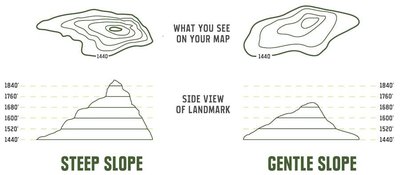
Additional info: The image illustrates how contour lines on a map (implicit relations) correspond to the steepness of slopes in the landscape. Closely spaced lines indicate a steep slope, while widely spaced lines indicate a gentle slope.
Implicit Differentiation: The Method
When a function is defined implicitly, we can differentiate both sides of the equation with respect to , treating as a differentiable function of $x$. The steps are:
Differentiating both sides with respect to , applying the chain rule to terms involving .
Collecting all terms involving on one side of the equation.
Solving for .
Examples of Implicit Differentiation
Example 1: Calculate the following derivatives, paying close attention to the variables.
(by chain rule)
(by chain rule)
Example 2: If , find .
Differentiating both sides:
Solving for :
Example 3: Find the derivative for .
Differentiating:
Collecting terms and solving for yields the derivative.
Example 4:
Differentiating both sides requires the quotient rule and implicit differentiation for .
Example 5:
Differentiating both sides:
Solve for .
Example 6: Find the slope of the tangent line to at .
Differentiating:
Solving for at gives the slope.
Example 7: Find the equation of the tangent line to at .
Differentiating:
Solve for and use the point-slope form for the tangent line.
Summary Table: Steps in Implicit Differentiation
Step | Description |
|---|---|
1 | Differentiate both sides with respect to |
2 | Apply the chain rule to terms involving |
3 | Collect all terms on one side |
4 | Solve for |
