 Indietro
Implicit Differentiation and Tangent Lines to Implicit Curves
Guida di studio - Note intelligenti
 Appunti personalizzati basati sui tuoi materiali, ampliati con definizioni chiave, esempi e contesto.
Implicit Differentiation
Definition and Application
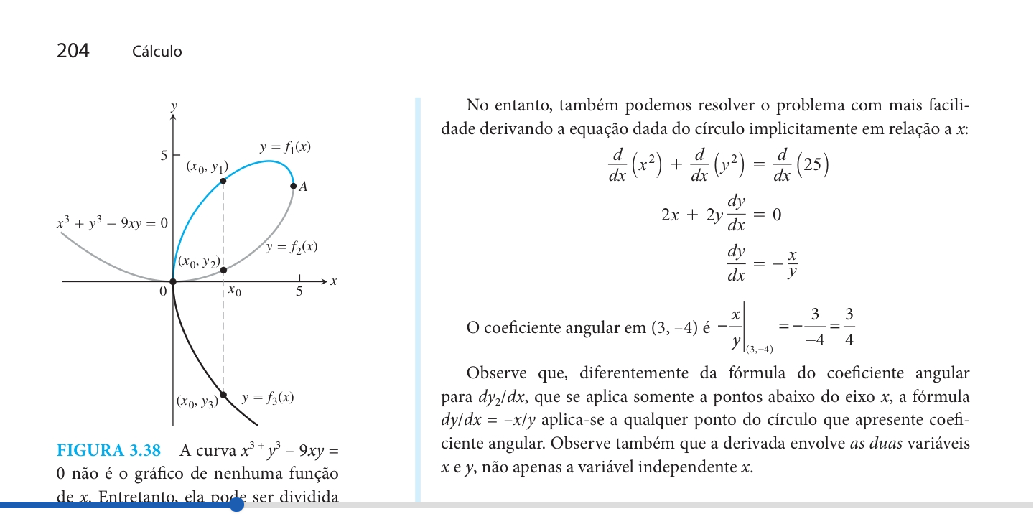
Implicit differentiation is a technique used to find the derivative of a function when it is not given explicitly in terms of one variable. Instead, the function is defined by an equation involving both x and y. This method is essential for analyzing curves that cannot be written as y = f(x) or x = g(y).
Implicit Equation: An equation where y is not isolated, such as .
Implicit Differentiation: Differentiate both sides of the equation with respect to x, treating y as a function of x.
Key Formula: For the equation , differentiating both sides gives:
Tangent Lines to Implicit Curves
To find the slope of the tangent line at a specific point on an implicit curve, use the derivative obtained from implicit differentiation. The slope at a point (x, y) is given by evaluated at that point.
Example: For the point (3, -4) on the circle , the slope is:
At (3, -4):
General Applicability: The formula applies to any point on the circle, not just those below the x-axis.
Comparison with Explicit Differentiation
Explicit differentiation applies only when y is given as a function of x. Implicit differentiation is more general and can be used for curves where y cannot be isolated. The derivative may involve both variables, reflecting the relationship between x and y on the curve.
Explicit: for y = f(x) is straightforward.
Implicit: may involve both x and y.
Key Points
Implicit differentiation is necessary for curves not expressible as functions.
The derivative may involve both x and y.
The slope of the tangent line can be found at any point where the curve is defined.
