 Indietro
Limits and Continuity from a Graph – Step-by-Step Study Guide
Guida di studio - Note intelligenti
 Appunti personalizzati basati sui tuoi materiali, ampliati con definizioni chiave, esempi e contesto.
Q1. Find using the graph.
Background
Topic: One-Sided Limits from a Graph
This question tests your ability to determine the left-hand limit of a function at a specific point by analyzing its graph. The left-hand limit, , is the value that approaches as approaches from the left.
Key Terms and Formulas:
Left-hand limit:
Graphical approach: Trace the curve as approaches from values less than $a$.
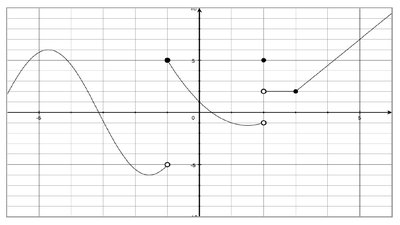
Step-by-Step Guidance
Locate on the -axis of the graph.
Observe the behavior of as approaches from the left (values less than $-1$).
Follow the curve from the left side and see what -value the function is approaching as gets closer to .
Identify if the function approaches a specific -value, or if there is a jump, hole, or asymptote at .
Try solving on your own before revealing the answer!
Final Answer:
As approaches from the left, the graph approaches the -value of .
This is determined by tracing the curve from the left side of and observing the -value it gets close to.
Q2. Find using the graph.
Background
Topic: One-Sided Limits from a Graph
This question asks you to determine the right-hand limit of a function at a specific point by analyzing its graph. The right-hand limit, , is the value that approaches as approaches from the right.
Key Terms and Formulas:
Right-hand limit:
Graphical approach: Trace the curve as approaches from values greater than $a$.
Step-by-Step Guidance
Find on the -axis of the graph.
Look at the behavior of as approaches from the right (values greater than $-1$).
Follow the curve from the right side and see what -value the function is approaching as gets closer to .
Check if the function approaches a specific -value, or if there is a discontinuity at .
Try solving on your own before revealing the answer!
Final Answer: $5$
As approaches from the right, the graph approaches the -value of $5$.
This is seen by tracing the curve from the right side of and observing the -value it gets close to.
Q3. What is ?
Background
Topic: Evaluating a Function from a Graph
This question asks you to find the value of the function at a specific point by looking at the graph. is the -value of the function at .
Key Terms and Formulas:
Function value: is the -coordinate of the point on the graph where .
Closed circle: Indicates the function is defined at that point.
Open circle: Indicates the function is not defined at that point.
Step-by-Step Guidance
Locate on the -axis of the graph.
Look for a closed (filled-in) circle at to determine the value of .
If there is a closed circle, the -value at that point is .
If there is an open circle, is not defined at that -value; check for a closed circle at a different $y$-value at .
Try solving on your own before revealing the answer!
Final Answer: $5$
At , there is a closed circle at , so .
Q4. Find using the graph.
Background
Topic: Two-Sided Limits from a Graph
This question tests your understanding of the two-sided limit at a point. The two-sided limit exists only if both the left-hand and right-hand limits exist and are equal.
Key Terms and Formulas:
Two-sided limit:
Exists if:
Step-by-Step Guidance
Recall the left-hand and right-hand limits you found for .
Compare the values of and .
If the two one-sided limits are not equal, the two-sided limit does not exist at .
If they are equal, the two-sided limit is that common value.
Try solving on your own before revealing the answer!
Final Answer: DNE (Does Not Exist)
The left-hand and right-hand limits at are not equal, so the two-sided limit does not exist.
Q5. Is continuous at ?
Background
Topic: Continuity from a Graph
This question tests your understanding of the definition of continuity at a point. A function is continuous at if the following three conditions are met:
is defined
exists
Key Terms and Formulas:
Continuity at : is defined, exists, and
Step-by-Step Guidance
Check if is defined by looking for a closed circle at .
Determine if exists by comparing the left and right limits.
If both are true, check if the limit equals the function value at .
If any of these conditions fail, the function is not continuous at .
Try solving on your own before revealing the answer!
Final Answer: No
The function is not continuous at because the two-sided limit does not exist, even though is defined.
