 Indietro
Limits in Calculus: Concepts, Definitions, and Techniques
Guida di studio - Note intelligenti
 Appunti personalizzati basati sui tuoi materiali, ampliati con definizioni chiave, esempi e contesto.
Chapter 2: Limits
Section 2.1 The Idea of Limits
The concept of a limit is foundational in calculus, describing how a function behaves as its input approaches a particular value. Limits are used to define derivatives, integrals, and continuity.
Key Point 1: The limit of a function f(x) as x approaches a value a is the value that f(x) gets closer to as x gets closer to a.
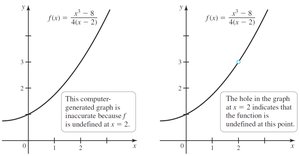
Key Point 2: Limits can exist even if the function is not defined at the point a.
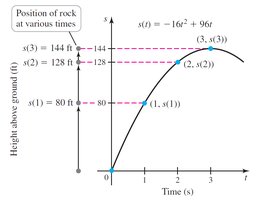
Example: The position of a rock thrown upward can be modeled by . The height at various times illustrates how the function approaches certain values as time changes.
Section 2.2 Definitions of Limits
Limits are formally defined to capture the behavior of functions near a specific point. One-sided limits consider approaching from only one direction.
Definition: The limit of f(x) as x approaches a is L if f(x) gets arbitrarily close to L for all x sufficiently close to a (but not equal to a).
One-Sided Limits:
Right-sided limit:
Left-sided limit:
Example: Graphs can illustrate how a function approaches different values from the left and right.
Section 2.3 Techniques for Computing Limits
Several algebraic and graphical techniques are used to compute limits, including substitution, factoring, and using limit laws.
Limit Laws:
Sum:
Difference, Product, Quotient, Power, and Root laws follow similarly.
Polynomial and Rational Functions:
For polynomials:
For rational functions: if
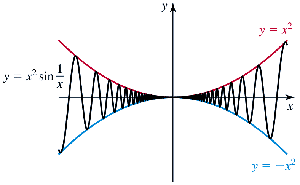
Squeeze Theorem: If and , then .
Section 2.4 Infinite Limits
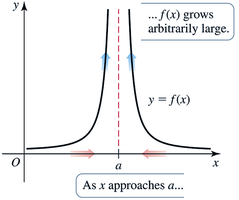
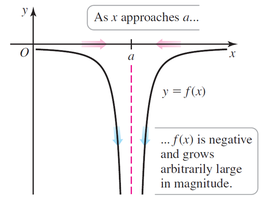
Infinite limits describe situations where a function increases or decreases without bound as x approaches a certain value. This often leads to vertical asymptotes.
Definition: means f(x) grows arbitrarily large as x approaches a.
Vertical Asymptote: The line x = a is a vertical asymptote if the function approaches infinity or negative infinity as x approaches a.
Example: as x approaches 0.
Section 2.5 Limits at Infinity
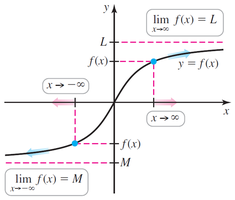
Limits at infinity describe the behavior of a function as x becomes very large (positive or negative). Horizontal asymptotes are associated with these limits.
Definition: means f(x) approaches L as x becomes arbitrarily large.
Horizontal Asymptote: The line y = L is a horizontal asymptote if .
Example: Rational functions often have horizontal asymptotes determined by the degrees of the numerator and denominator.
Section 2.6 Continuity
A function is continuous at a point if its value at that point equals the limit as x approaches that point. Continuity is essential for many calculus concepts.
Definition: f is continuous at a if:
f(a) is defined
exists
Continuity Checklist: All three conditions above must be satisfied.
Continuity Rules: Sums, differences, products, quotients (where denominator is nonzero), and compositions of continuous functions are continuous.
Example: Polynomial functions are continuous everywhere; rational functions are continuous where the denominator is nonzero.
Section 2.7 Precise Definitions of Limits
The formal (epsilon-delta) definition of a limit provides a rigorous foundation for calculus. It states that for every ε > 0, there exists a δ > 0 such that the function stays within ε of the limit whenever x is within δ of the point (excluding the point itself).
Definition: if for every , there exists such that whenever .
Steps for Proof:
Find δ in terms of ε.
Write a proof using the relationship between ε and δ.
Two-Sided Infinite Limit: For any N > 0, there exists δ > 0 such that whenever .
Summary Table: Types of Limits
Type | Definition | Notation |
|---|---|---|
Two-sided limit | f(x) approaches L as x approaches a from both sides | |
Right-sided limit | f(x) approaches L as x approaches a from the right | |
Left-sided limit | f(x) approaches L as x approaches a from the left | |
Infinite limit | f(x) grows without bound as x approaches a | |
Limit at infinity | f(x) approaches L as x becomes very large |
Additional info:
These notes expand on the brief points in the original materials, providing definitions, examples, and visual aids to reinforce understanding. The images included are directly relevant to the concepts discussed and illustrate key ideas such as the behavior of functions near points, the approach to asymptotes, and the rigorous definition of limits.
