 Indietro
2.6
Guida di studio - Note intelligenti
 Appunti personalizzati basati sui tuoi materiali, ampliati con definizioni chiave, esempi e contesto.
Limits Involving Infinity; Asymptotes of Graphs
Infinite Limits
Infinite limits describe the behavior of a function as the input approaches a specific value and the output grows without bound. This concept is fundamental in understanding discontinuities and asymptotic behavior in calculus.
Definition: If , the values of can be made arbitrarily large by requiring to be sufficiently close to .
Negative Infinite Limit: means becomes arbitrarily negative as approaches .
Vertical Asymptote: The line is a vertical asymptote of if or if any one-sided limit equals .
Example: Find .
As approaches 0 from either side, increases rapidly.
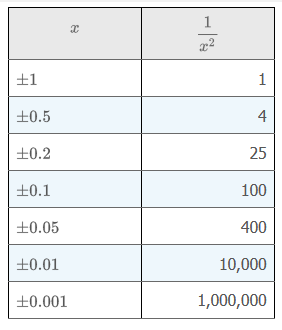
Table Purpose: This table demonstrates how becomes extremely large as gets closer to 0, illustrating the concept of an infinite limit.
Finding Vertical Asymptotes Algebraically
Vertical asymptotes occur where the denominator of a rational function equals zero and the numerator does not cancel the zero.
Steps:
Factor both numerator and denominator.
Reduce the fraction, if possible.
Set the denominator equal to zero and solve for .
Example: has vertical asymptotes at and a removable discontinuity at .
Finite Limits as
Definition of a Limit at Infinity
Limits at infinity describe the behavior of a function as the input grows without bound in either the positive or negative direction.
Definition: means approaches as becomes very large.
Horizontal Asymptote: The line is a horizontal asymptote if .
Example:
General Rule: for any real numbers , where .
Finding Infinite Limits Algebraically
When evaluating limits at infinity for rational functions, focus on the highest power terms in the numerator and denominator.
If the highest power in the numerator () equals the highest power in the denominator ():
If :
If :
Infinite Limits at Infinity
Infinite limits at infinity occur when the function grows without bound as approaches infinity or negative infinity.
Notation:
Example:
Oblique (Slant) Asymptotes
Definition and Identification
Oblique asymptotes occur when the degree of the numerator is exactly one greater than the degree of the denominator in a rational function.
Form:
Finding: Divide the numerator by the denominator to express as a linear function plus a remainder that vanishes as .
Example: For , perform polynomial division to find the oblique asymptote.
Summary: Infinite Limit vs Limit at Infinity
Infinite Limits (Vertical Asymptotes): ; asymptote at .
Limit at Infinity (Horizontal Asymptotes): ; asymptote at .
Oblique Asymptotes: Occur when numerator degree is one higher than denominator.
Worked Examples and Graphical Analysis
Example: Analyzing Limits and Asymptotes from a Graph
The graph below illustrates a rational function with both vertical and horizontal asymptotes, as well as removable discontinuities.
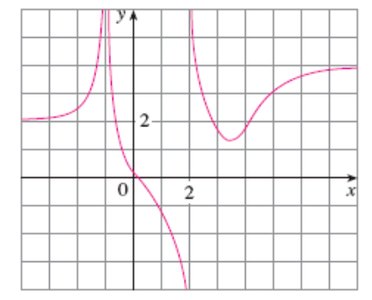
Graph Purpose: This graph is used to visually identify vertical and horizontal asymptotes, and to analyze the behavior of the function near these points.
Vertical Asymptotes: Where the function approaches infinity as approaches a specific value.
Horizontal Asymptotes: Where the function approaches a constant value as approaches infinity or negative infinity.
Removable Discontinuities: Points where the function is not defined but can be made continuous by redefining the value.
Summary Table: Behavior of Near Zero
This table shows how increases rapidly as approaches zero, illustrating the concept of infinite limits.
x | \frac{1}{x^2} |
|---|---|
\pm 1 | 1 |
\pm 0.5 | 4 |
\pm 0.2 | 25 |
\pm 0.1 | 100 |
\pm 0.05 | 400 |
\pm 0.01 | 10,000 |
\pm 0.001 | 1,000,000 |
Key Takeaways
Infinite limits describe unbounded behavior near specific points (vertical asymptotes).
Limits at infinity describe the behavior as grows large (horizontal asymptotes).
Oblique asymptotes occur when the numerator's degree is one higher than the denominator's.
Algebraic techniques and graphical analysis are essential for identifying asymptotes and understanding function behavior.
