 Indietro
Linear Approximation, Critical Numbers, and Absolute Extrema in Calculus
Guida di studio - Note intelligenti
 Appunti personalizzati basati sui tuoi materiali, ampliati con definizioni chiave, esempi e contesto.
Linear Approximation and Tangent Line
Definition and Formula
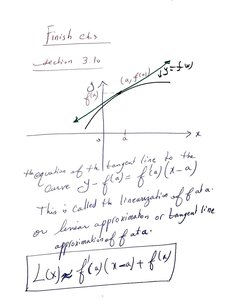
Linear approximation is a method used in calculus to estimate the value of a function near a given point using the tangent line. The tangent line provides the best linear estimate of the function at that point.
Tangent Line Equation: The equation of the tangent line to the curve y = f(x) at x = a is given by:
Purpose: This is called the linearization of f at a, or linear approximation, or tangent line approximation of f at a.
Example: Linear Approximation for Square Root Function
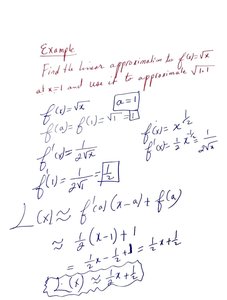
To find the linear approximation of f(x) = \sqrt{x} at x = 1 and use it to approximate \sqrt{1.1}:
Step 1: Compute f(1) = 1.
Step 2: Compute f'(x) = \frac{1}{2\sqrt{x}}, so f'(1) = \frac{1}{2}.
Step 3: Apply the linear approximation formula:
Step 4: For x = 1.1:
Example: Linear Approximation for Fourth Root Function
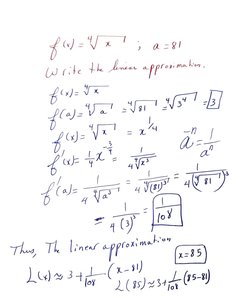
Find the linear approximation for f(x) = \sqrt[4]{x} at a = 81:
Step 1: f(81) = 3
Step 2: f'(x) = \frac{1}{4}x^{-3/4}, so f'(81) = \frac{1}{4 \cdot 27} = \frac{1}{108}
Step 3: Linear approximation:
Step 4: For x = 85:
Critical Numbers and Their Calculation
Definition of Critical Numbers
Critical numbers of a function are values of x where the derivative is zero or undefined. These points are important for finding local extrema (maximum or minimum values).
To find critical numbers:
Compute f'(x).
Solve f'(x) = 0 or find where f'(x) is undefined.
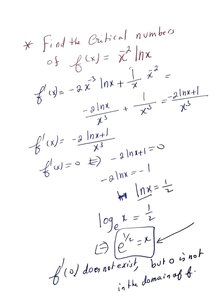
Example: Critical Numbers for f(x) = x^2 \ln x
Step 1: f'(x) = 2x \ln x + x
Step 2: Set f'(x) = 0:
Note: f(0) does not exist, and 0 is not in the domain of f.
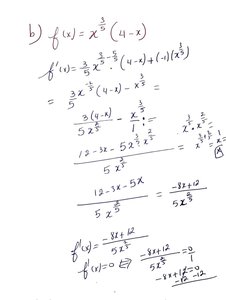
Example: Critical Numbers for f(x) = x^{3/5}(4-x)
Step 1: f'(x) = \frac{3}{5}x^{-2/5}(4-x) - x^{3/5}
Step 2: Set f'(x) = 0 and solve for x:
Step 3: The critical numbers are found by solving the resulting equation.
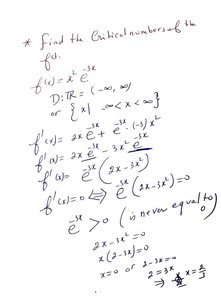
Example: Critical Numbers for f(x) = x^2 e^{-3x}
Step 1: f'(x) = 2x e^{-3x} + x^2 (-3) e^{-3x} = e^{-3x}(2x - 3x^2)
Step 2: Set f'(x) = 0: or
Absolute Maximum and Minimum Values
Finding Absolute Extrema on a Closed Interval
To find the absolute maximum and minimum values of a continuous function on a closed interval [a, b]:
Find the critical numbers in [a, b].
Evaluate the function at the endpoints a and b.
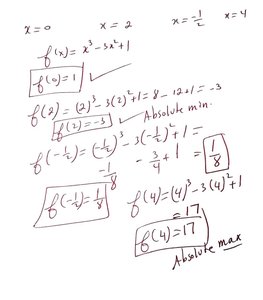
Compare all values to determine the largest (absolute maximum) and smallest (absolute minimum).
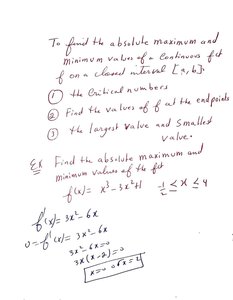
Example: Absolute Extrema for f(x) = x^3 - 3x^2 + 1 on [0, 4]
Step 1: Find critical numbers by solving f'(x) = 3x^2 - 6x = 0 or
Step 2: Evaluate f(x) at x = 0, 2, 4, -\frac{1}{2} (if in domain): (absolute minimum) (absolute maximum)
Additional info: These notes cover differentiation techniques, applications of derivatives, and linear approximation, which are core topics in Calculus chapters 3 and 4.
