 Indietro
MAC 2312 Exam 1 Review – Calculus Study Guidance
Guida di studio - Note intelligenti
 Appunti personalizzati basati sui tuoi materiali, ampliati con definizioni chiave, esempi e contesto.
Q1. Find the length of the arc of on the interval .
Background
Topic: Arc Length of a Curve
This question tests your ability to compute the arc length of a curve defined by as a function of over a given interval.
Key formula:
The arc length for a curve from to is:
Step-by-Step Guidance
Identify the function: .
Compute for the function.
Set up the arc length integral using the formula above, with ranging from $0.
Simplify the integrand as much as possible before integrating.
Try solving on your own before revealing the answer!
Final Answer:
After computing , the arc length integral becomes . Evaluating this definite integral gives the arc length.
Q2. Find the length of the curve from to .
Background
Topic: Arc Length of a Curve
This question tests your ability to compute the arc length of a curve defined by as a function of over a given interval.
Key formula:
The arc length for a curve from to is:
Step-by-Step Guidance
Identify the function: .
Compute for the function.
Set up the arc length integral using the formula above, with ranging from $1.
Simplify the integrand as much as possible before integrating.
Try solving on your own before revealing the answer!
Final Answer:
After computing , the arc length integral becomes . Evaluating this definite integral gives the arc length.
Q3. Find the area of the surface generated by revolving the curve between and about the x-axis.
Background
Topic: Surface Area of Revolution
This question tests your ability to compute the surface area generated by revolving a curve about the x-axis.
Key formula:
The surface area for revolving about the x-axis from to is:
Step-by-Step Guidance
Identify the function: .
Compute for the function.
Set up the surface area integral using the formula above, with ranging from $1.
Simplify the integrand as much as possible before integrating.
Try solving on your own before revealing the answer!
Final Answer:
After computing , plug it into the formula and evaluate the definite integral to find the surface area.
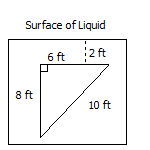
Q4. The flat surface shown is submerged vertically in a liquid of weight density lb/ft. Find the fluid force against the surface.
Background
Topic: Fluid Force on a Submerged Surface
This question tests your ability to calculate the force exerted by a fluid on a submerged surface using calculus.
Key formula:
The fluid force on a vertical surface is:
= weight density of the fluid
= depth below the surface
= width of the surface at depth
Step-by-Step Guidance
Analyze the geometry of the submerged surface (refer to the image for dimensions).
Express the depth and width as functions of based on the diagram.
Set up the integral for fluid force using the formula above, with appropriate limits for .
Simplify the integrand as much as possible before integrating.
Try solving on your own before revealing the answer!
Final Answer:
Using the diagram, set up and for the triangular surface. Plug into the integral and evaluate to find the fluid force.
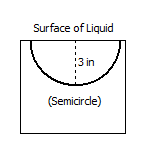
Q4b. The flat surface shown is submerged vertically in a liquid. Find the fluid force against the semicircular surface.
Background
Topic: Fluid Force on a Submerged Surface
This question tests your ability to calculate the force exerted by a fluid on a submerged semicircular surface using calculus.
Key formula:
The fluid force on a vertical surface is:
= weight density of the fluid
= depth below the surface
= width of the surface at depth
Step-by-Step Guidance
Analyze the geometry of the submerged semicircular surface (refer to the image for dimensions).
Express the depth and width as functions of based on the diagram.
Set up the integral for fluid force using the formula above, with appropriate limits for .
Simplify the integrand as much as possible before integrating.
Try solving on your own before revealing the answer!
Final Answer:
For the semicircle, is determined by the semicircular equation, and is the depth below the surface. Plug into the integral and evaluate to find the fluid force.
Q5. Find the centroid of the region bounded by , , , and .
Background
Topic: Centroid of a Region
This question tests your ability to find the centroid (center of mass for uniform density) of a bounded region using calculus.
Key formula:
The centroid is given by:
Step-by-Step Guidance
Identify the region bounded by , , , and .
Set up the area integral for the region.
Set up the integrals for and using the formulas above.
Simplify the integrands as much as possible before integrating.
Try solving on your own before revealing the answer!
Final Answer: Centroid
Compute , , and using the given bounds and formulas. The centroid is at .
Q6. Find the center of mass of a lamina with density bounded by and the x-axis.
Background
Topic: Center of Mass with Variable Density
This question tests your ability to find the center of mass of a region with variable density using calculus.
Key formula:
For a lamina with density :
Step-by-Step Guidance
Identify the region bounded by and the x-axis.
Set up the mass integral for the region using .
Set up the integrals for and using the formulas above.
Simplify the integrands as much as possible before integrating.
Try solving on your own before revealing the answer!
Final Answer: Center of Mass
Compute , , and using the given bounds and formulas. The center of mass is at .
Q7. Evaluate.
Background
Topic: Hyperbolic Functions
This question tests your ability to evaluate expressions involving hyperbolic functions.
Key formula:
is the inverse hyperbolic sine.
Step-by-Step Guidance
For , use the definition of and substitute .
For , use the formula for the inverse hyperbolic sine.
Simplify each expression as much as possible before evaluating.
Try solving on your own before revealing the answer!
Final Answer:
a)
b)
Q8. Find the first derivative of each of the following.
Background
Topic: Derivatives of Hyperbolic Functions
This question tests your ability to differentiate hyperbolic functions.
Key formula:
Step-by-Step Guidance
For , use the chain rule to differentiate.
For , use the derivative of the inverse hyperbolic cosine.
Simplify each derivative as much as possible before writing the final expression.
Try solving on your own before revealing the answer!
Final Answer:
a)
b)
Q9. Find the arc length of the catenary between and .
Background
Topic: Arc Length of a Curve
This question tests your ability to compute the arc length of a catenary curve over a given interval.
Key formula:
Step-by-Step Guidance
Identify the function: .
Compute for the function.
Set up the arc length integral using the formula above, with ranging from $0\ln 2$.
Simplify the integrand as much as possible before integrating.
Try solving on your own before revealing the answer!
Final Answer:
Since , the integral simplifies to . Evaluating this gives the arc length.
Q10. Evaluate the integrals.
Background
Topic: Integration Techniques
This question tests your ability to evaluate integrals involving hyperbolic functions and rational expressions.
Key formula:
For hyperbolic functions, use identities and substitution as needed.
For rational expressions, consider partial fraction decomposition.
Step-by-Step Guidance
For , consider substitution .
For , consider partial fraction decomposition.
Simplify each integral as much as possible before integrating.
Try solving on your own before revealing the answer!
Final Answer:
a) Use substitution to rewrite the integral and evaluate.
b) Decompose into partial fractions and integrate over from to .
