Indietro
Techniques of Differentiation: The Chain Rule, Power Rule, and Applications
Guida di studio - Note intelligenti
 Appunti personalizzati basati sui tuoi materiali, ampliati con definizioni chiave, esempi e contesto.
Techniques of Differentiation
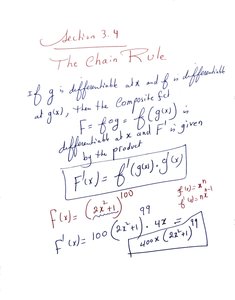
The Chain Rule
The Chain Rule is a fundamental technique for differentiating composite functions. If a function is composed of two or more functions, the derivative is found by multiplying the derivative of the outer function (evaluated at the inner function) by the derivative of the inner function.
Definition: If g is differentiable at x and f is differentiable at g(x), then the composite function F(x) = f(g(x)) is differentiable at x and its derivative is:
Example: For , let and , then:
The Power Rule Combined with the Chain Rule
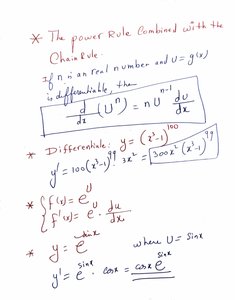
When differentiating a function of the form , where is a differentiable function and is a real number, the power rule is applied in conjunction with the chain rule.
Formula:
Example: For :
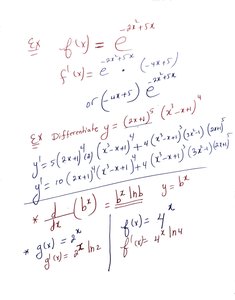
Exponential Functions: If , then .
Example: ,
Applications: Tangent Lines and Implicit Differentiation
Differentiation techniques are used to find equations of tangent lines to curves and to handle implicit functions where is not isolated.
Finding the Tangent Line to a Curve
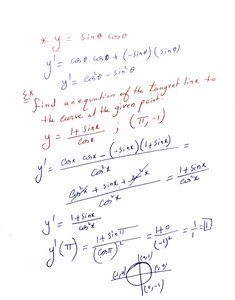
Example: Find the equation of the tangent line to at .
First, compute .
Evaluate at : .
The tangent line at is .
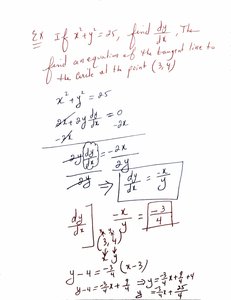
Implicit Differentiation
Used when is defined implicitly by an equation involving both and $y$.
Example: For , differentiate both sides with respect to :
At the point , .
The tangent line at :
Further Examples: Exponential and Logarithmic Differentiation
Exponential Functions: For ,
General Exponential Rule:
Example: ,