 Indietro
The Cross Product and Its Applications in 3D Calculus
Guida di studio - Note intelligenti
 Appunti personalizzati basati sui tuoi materiali, ampliati con definizioni chiave, esempi e contesto.
The Cross Product in 3D Space
Definition and Geometric Interpretation
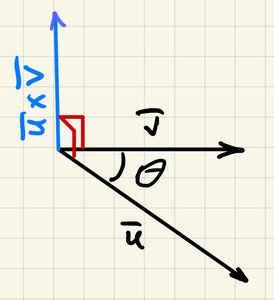
The cross product is an operation defined only in three-dimensional space. Given two vectors \( \vec{u} \) and \( \vec{v} \), their cross product \( \vec{u} \times \vec{v} \) is a vector that:
Is perpendicular to both \( \vec{u} \) and \( \vec{v} \).
Has magnitude \( |\vec{u} \times \vec{v}| = |\vec{u}| \cdot |\vec{v}| \cdot \sin \theta \), where \( \theta \) is the angle between \( \vec{u} \) and \( \vec{v} \).
If \( \vec{u} \) and \( \vec{v} \) are parallel (\( \theta = 0 \) or \( \pi \)), then \( \vec{u} \times \vec{v} = \vec{0} \).
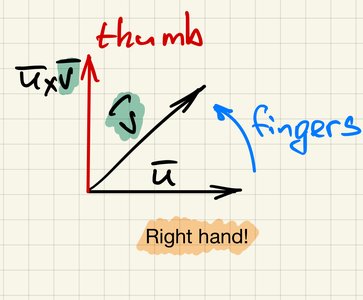
Orientation: The direction of \( \vec{u} \times \vec{v} \) is determined by the right-hand rule: curl the fingers of your right hand from \( \vec{u} \) toward \( \vec{v} \) through the smaller angle; your thumb points in the direction of the cross product.
Properties of the Cross Product
Anticommutativity: \( \vec{u} \times \vec{v} = -\vec{v} \times \vec{u} \)
Distributivity: \( \vec{u} \times (\vec{v} + \vec{w}) = \vec{u} \times \vec{v} + \vec{u} \times \vec{w} \)
Scalar multiplication: \( (k \cdot \vec{u}) \times \vec{v} = k \cdot (\vec{u} \times \vec{v}) \)
Zero vector: \( \vec{u} \times \vec{u} = \vec{0} \)
Orthogonality: \( \vec{u} \cdot (\vec{u} \times \vec{v}) = 0 \) and \( \vec{v} \cdot (\vec{u} \times \vec{v}) = 0 \)
Cross Product of Standard Basis Vectors
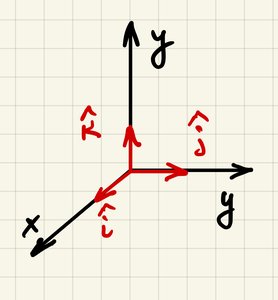
The cross product of the standard basis vectors \( \hat{i}, \hat{j}, \hat{k} \) in 3D is fundamental:
\( \hat{i} \times \hat{j} = \hat{k} \)
\( \hat{j} \times \hat{k} = \hat{i} \)
\( \hat{k} \times \hat{i} = \hat{j} \)
Switching the order reverses the sign, e.g., \( \hat{j} \times \hat{i} = -\hat{k} \)
\( \hat{i} \times \hat{i} = \hat{j} \times \hat{j} = \hat{k} \times \hat{k} = \vec{0} \)
Computing the Cross Product
Given vectors \( \vec{u} = u_1 \hat{i} + u_2 \hat{j} + u_3 \hat{k} \) and \( \vec{v} = v_1 \hat{i} + v_2 \hat{j} + v_3 \hat{k} \), the cross product is:
\( \vec{u} \times \vec{v} = (u_2 v_3 - u_3 v_2) \hat{i} + (u_3 v_1 - u_1 v_3) \hat{j} + (u_1 v_2 - u_2 v_1) \hat{k} \)
This can be computed using the determinant formula:
Example: Compute \( (3\hat{i} - \hat{k}) \times (\hat{i} + \hat{j}) \):
Expand and use properties of the cross product to find the result: \( \hat{i} - \hat{j} + 3\hat{k} \)
Applications of the Cross Product
Area of a Parallelogram
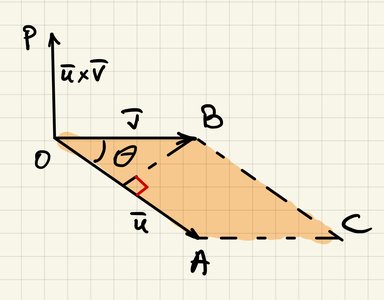
The area of a parallelogram formed by vectors \( \vec{u} \) and \( \vec{v} \) is given by the magnitude of their cross product:
\( \text{Area} = |\vec{u} \times \vec{v}| \)
The area of the triangle formed by the same vectors is half this value: \( \text{Area} = \frac{1}{2} |\vec{u} \times \vec{v}| \)
The Scalar Triple Product
The scalar triple product of vectors \( \vec{u}, \vec{v}, \vec{w} \) is defined as:
The scalar triple product is zero if any two vectors are collinear or if one is a linear combination of the others (i.e., the vectors are coplanar).
It is used to test for coplanarity and to compute volumes in 3D geometry.
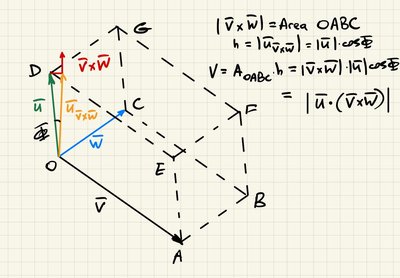
Volume of a Parallelepiped
The volume of the parallelepiped formed by vectors \( \vec{u}, \vec{v}, \vec{w} \) is given by the absolute value of the scalar triple product:
Further Applications in Physics and Engineering
Angular momentum: \( \vec{L} = \vec{r} \times m \vec{v} \)
Electromagnetic force: \( \vec{F} = q (\vec{v} \times \vec{B}) \)
Torque: \( \vec{\tau} = \vec{r} \times \vec{F} \)
Additional info: The cross product is essential in vector calculus, physics, and engineering for describing rotational effects, areas, and volumes in three dimensions.
