 Indietro
CalcReview5
Guida di studio - Note intelligenti
 Appunti personalizzati basati sui tuoi materiali, ampliati con definizioni chiave, esempi e contesto.
Vector-Valued Functions
Definition and Visualization
Vector-valued functions are functions whose outputs are vectors rather than scalar values. These functions are fundamental in describing curves and paths in space, and are commonly used in calculus to represent motion and geometry in two or three dimensions.
Vector-valued function: A function of the form , where is a parameter and , , are real-valued functions.
Visualization: The graph of traces out a curve in space as varies over an interval.
Example: traces the line in three-dimensional space.
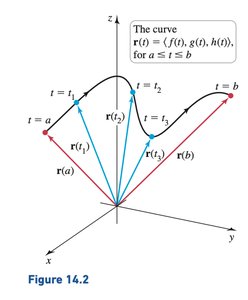
Parameterizations of Lines and Line Segments
Lines and line segments in space can be described using vector-valued functions. The general parameterization of a line passing through a point and parallel to a vector is:
, where is a real parameter.
Different choices of (e.g., , ) can restrict the curve to a ray or a line segment.
Example: To parameterize the line segment from to , use for , where .
Parameterizations of Circles, Ellipses, and Spirals
Vector-valued functions can also describe more complex curves such as circles, ellipses, and spirals.
Circle (radius 1, centered at origin): for traces the circle counterclockwise.
Ellipse (centered at origin): , where and are the semi-axes.
Spiral: traces a spiral in three dimensions.
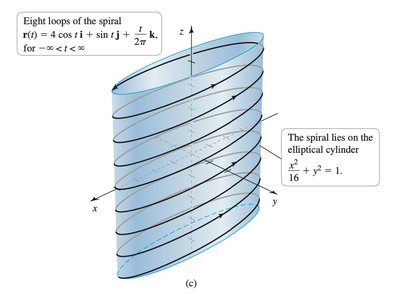
Unusual Parameterizations
Some vector-valued functions may have non-standard forms but still describe familiar geometric objects.
Example: is contained in the line but only for (a ray).
Example: describes a spiral with an exponentially increasing radius.
Classification of Curves
Given a vector-valued function, it is important to determine whether it traces a line, a line segment, or a ray:
Line: The parameter ranges over all real numbers, and the function is linear in .
Line Segment: The parameter is restricted to a finite interval.
Ray: The parameter is restricted to or .
Complex Curves and Projections
For complicated curves, analyzing their projection onto coordinate planes (such as the -plane) can help in understanding their shape.
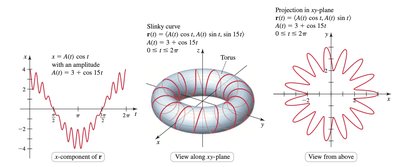
Limits of Vector-Valued Functions
Definition and Computation
The concept of a limit extends naturally to vector-valued functions. The limit of as approaches is if the distance between and approaches zero as approaches :
Definition: if .
For , the limit exists if and only if , , and all exist.
Example: Compute :
First component:
Second component:
Third component:
Thus, the limit is .
Note: Limits may not always exist, but in many calculus problems, they do.
Summary Table: Types of Curves from Parameterizations
Parameterization | Type of Curve | Interval for t |
|---|---|---|
Line | ||
Ray | or | |
Line Segment | ||
Circle | ||
Ellipse | ||
Spiral |
