 Indietro
CalcReview6
Guida di studio - Note intelligenti
 Appunti personalizzati basati sui tuoi materiali, ampliati con definizioni chiave, esempi e contesto.
Vector-Valued Functions and Their Limits
Definition and Properties
Vector-valued functions extend the concept of functions to vectors, allowing us to describe curves and motion in space. The limit of a vector-valued function \( \vec{r}(t) \) as \( t \) approaches \( a \) is defined as follows:
Limit Definition: \( \lim_{t \to a} \vec{r}(t) = \vec{L} \) if and only if \( \lim_{t \to a} |\vec{r}(t) - \vec{L}| = 0 \).
This means each component of the vector-valued function must approach the corresponding component of the limit vector.
Example: For \( \vec{r}(t) = \left( 4t^2 - 7t + 3, \frac{\sin t}{t}, e^t \right) \), as \( t \to 0 \):
\( \lim_{t \to 0} 4t^2 - 7t + 3 = 3 \)
\( \lim_{t \to 0} \frac{\sin t}{t} = 1 \)
\( \lim_{t \to 0} e^t = 1 \)
Thus, \( \lim_{t \to 0} \vec{r}(t) = (3, 1, 1) \)
Derivatives of Vector-Valued Functions
Definition and Physical Interpretation
The derivative of a vector-valued function describes the rate of change of the vector with respect to the parameter (often time). For \( \vec{r}(t) = f(t)\vec{i} + g(t)\vec{j} + h(t)\vec{k} \), the derivative is:
\( \vec{r}'(t) = f'(t)\vec{i} + g'(t)\vec{j} + h'(t)\vec{k} \)
In component form: \( \vec{r}(t) = (x(t), y(t), z(t)) \Rightarrow \vec{r}'(t) = (x'(t), y'(t), z'(t)) \)
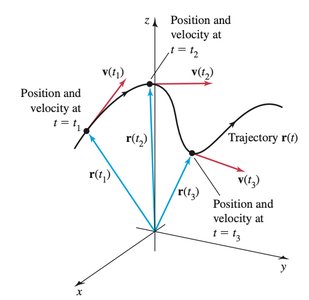
If \( \vec{r}'(t) \neq 0 \), then \( \vec{r}'(t) \) is a tangent vector to the curve at \( \vec{r}(t) \).
Physical Meaning: If \( \vec{r}(t) \) represents the position of a moving particle, then \( \vec{r}'(t) \) is the particle’s velocity.
Example: Derivative Calculation
Given \( \vec{r}(t) = (\cos(e^t), \sin(e^t), 0) \), the derivative is:
By the chain rule: \( \vec{r}'(t) = (-\sin(e^t) e^t, \cos(e^t) e^t, 0) \)
Comparison: For \( \vec{c}(t) = (\cos t, \sin t, 0) \), \( \vec{c}'(t) = (-\sin t, \cos t, 0) \). Both curves trace a circle, but \( \vec{r}(t) \) traverses it at a speed of \( e^t \), while \( \vec{c}(t) \) moves at constant speed.
Derivative Rules for Vector-Valued Functions
Theorem: Basic Rules
Let \( \vec{u}(t) \) and \( \vec{v}(t) \) be differentiable vector-valued functions, and \( f(t) \) a differentiable scalar function. The following rules apply:
Constant Rule: \( \frac{d}{dt}(\vec{c}) = 0 \)
Sum Rule: \( \frac{d}{dt}(\vec{u}(t) + \vec{v}(t)) = \vec{u}'(t) + \vec{v}'(t) \)
Product Rule: \( \frac{d}{dt}(f(t)\vec{u}(t)) = f'(t)\vec{u}(t) + f(t)\vec{u}'(t) \)
Chain Rule: \( \frac{d}{dt}(\vec{u}(f(t))) = \vec{u}'(f(t)) f'(t) \)
Dot Product Rule: \( \frac{d}{dt}(\vec{u}(t) \cdot \vec{v}(t)) = \vec{u}'(t) \cdot \vec{v}(t) + \vec{u}(t) \cdot \vec{v}'(t) \)
Cross Product Rule: \( \frac{d}{dt}(\vec{u}(t) \times \vec{v}(t)) = \vec{u}'(t) \times \vec{v}(t) + \vec{u}(t) \times \vec{v}'(t) \)
Example: For \( \vec{u}(t) = (\cos t, \sin t, 0) \) and \( \vec{v}(t) = (-\sin t, \cos t, 0) \), the derivative of their cross product is zero, since the cross product is a constant vector along the z-axis.
Motion in Space
Position, Velocity, Speed, and Acceleration
When describing the motion of a particle in space, we use vector-valued functions:
Position: \( \vec{r}(t) = \langle x(t), y(t), z(t) \rangle \)
Velocity: \( \vec{v}(t) = \vec{r}'(t) = \langle x'(t), y'(t), z'(t) \rangle \)
Speed: \( |\vec{v}(t)| = \sqrt{ x'(t)^2 + y'(t)^2 + z'(t)^2 } \)
Acceleration: \( \vec{a}(t) = \vec{v}'(t) = \vec{r}''(t) \)
Integrals of Vector-Valued Functions
To recover position from velocity, or velocity from acceleration, we use integration:
Indefinite Integral: \( \int \vec{r}(t) dt = \vec{R}(t) + \vec{C} \), where \( \vec{C} \) is a constant vector.
Component-wise: \( \int \langle f(t), g(t), h(t) \rangle dt = \langle F(t), G(t), H(t) \rangle + \langle C_1, C_2, C_3 \rangle \)
Definite Integral: \( \int_a^b \vec{r}(t) dt = \left( \int_a^b f(t) dt \right) \vec{i} + \left( \int_a^b g(t) dt \right) \vec{j} + \left( \int_a^b h(t) dt \right) \vec{k} \)
Example: Displacement Calculation
Given \( \vec{v}(t) = (-4 \sin t, 3 \cos t, 1) \), the total displacement from \( t = 0 \) to \( t = \pi \) is:
\( \int_0^{\pi} (-4 \sin t) dt = [4 \cos t]_0^{\pi} = 4(\cos \pi - \cos 0) = 4(-1 - 1) = -8 \)
\( \int_0^{\pi} 3 \cos t dt = [3 \sin t]_0^{\pi} = 3(0 - 0) = 0 \)
\( \int_0^{\pi} 1 dt = [t]_0^{\pi} = \pi - 0 = \pi \)
Total displacement: \( (-8, 0, \pi) \)
Interpretation: The particle moves halfway around a spiral from the rightmost to the leftmost side in the interval.
