 Indietro
Vectors and Geometry in 3-Space: Study Notes
Guida di studio - Note intelligenti
 Appunti personalizzati basati sui tuoi materiali, ampliati con definizioni chiave, esempi e contesto.
Vectors in Two and Three Dimensions
Definition and Representation of Vectors
Vectors are fundamental objects in mathematics and physics, characterized by both magnitude (length) and direction. They are used to represent quantities such as displacement, velocity, and force.
Vector Notation: Vectors can be denoted as \( \vec{v} \), \( \langle a, b \rangle \), or \( a \hat{i} + b \hat{j} \).
Position Vector: A vector whose tail is at the origin, representing the position of a point in space.
Unit Vector: A vector with magnitude 1, often used to indicate direction.
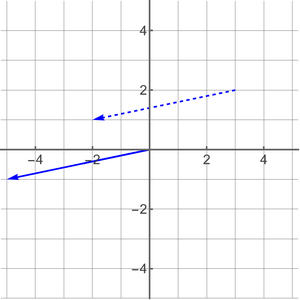
Example: To sketch the vector from P(3, 2) to Q(−2, 1), plot both points and draw an arrow from P to Q. The position vector \( \vec{PQ} \) is given by:
\( \vec{PQ} = \langle -2 - 3, 1 - 2 \rangle = \langle -5, -1 \rangle \)
Magnitude: \( |\vec{PQ}| = \sqrt{(-5)^2 + (-1)^2} = \sqrt{25 + 1} = \sqrt{26} \)
Direction: The direction angle \( \theta \) can be found using \( \tan \theta = \frac{-1}{-5} \)
Unit Vector: \( \vec{u} = \frac{\vec{PQ}}{|\vec{PQ}|} = \langle \frac{-5}{\sqrt{26}}, \frac{-1}{\sqrt{26}} \rangle \)
Scalar Multiplication and Parallel Vectors
Scalar multiplication changes the length of a vector without altering its direction (unless the scalar is negative, which reverses the direction).
Definition: For scalar c and vector \( \vec{v} = \langle v_1, v_2 \rangle \), \( c\vec{v} = \langle cv_1, cv_2 \rangle \).
Parallel Vectors: Two vectors are parallel if one is a scalar multiple of the other.
Zero Vector: The zero vector \( \vec{0} = \langle 0, 0 \rangle \) is parallel to all vectors.
Vector Addition and Subtraction
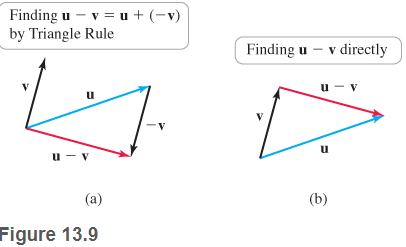
Vectors can be added or subtracted algebraically and geometrically. The sum or difference of two vectors is another vector.
Addition: \( \vec{u} + \vec{v} = \langle u_1 + v_1, u_2 + v_2 \rangle \)
Subtraction: \( \vec{u} - \vec{v} = \langle u_1 - v_1, u_2 - v_2 \rangle \)
Example: Let \( \vec{u} = \langle 4, -2 \rangle \), \( \vec{v} = \langle -4, 6 \rangle \), \( \vec{w} = \langle 0, 8 \rangle \). Evaluate \( 10\vec{u} - 3\vec{v} + \vec{w} \):
\( 10\vec{u} = \langle 40, -20 \rangle \)
\( -3\vec{v} = \langle 12, -18 \rangle \)
\( \vec{w} = \langle 0, 8 \rangle \)
Sum: \( \langle 40 + 12 + 0, -20 + (-18) + 8 \rangle = \langle 52, -30 \rangle \)
Applications of Vectors
Vectors are used to solve real-world problems involving direction and magnitude, such as navigation and force analysis.
Example: An airplane flying north at 560 mph with a wind blowing east at 75 mph. The ground speed and direction are found by vector addition:
Airplane velocity: \( \vec{v}_a = \langle 0, 560 \rangle \)
Wind velocity: \( \vec{v}_w = \langle 75, 0 \rangle \)
Resultant: \( \vec{v}_g = \vec{v}_a + \vec{v}_w = \langle 75, 560 \rangle \)
Ground speed: \( |\vec{v}_g| = \sqrt{75^2 + 560^2} \)
Direction: \( \theta = \tan^{-1}\left(\frac{560}{75}\right) \)
Geometry in Three Dimensions (R3)
The xyz-Coordinate System
Three-dimensional space is described using the xyz-coordinate system, where each point is specified by three coordinates.
Plotting Points: To plot P(−2, 3, 4) and Q(3, −2, 0), locate each coordinate along the respective axes.
Distance Formula: The distance between points P and Q is:
Position Vector: \( \vec{PQ} = \langle 3 - (-2), -2 - 3, 0 - 4 \rangle = \langle 5, -5, -4 \rangle \)
Unit Vectors: Two unit vectors parallel to \( \vec{PQ} \) are \( \frac{\vec{PQ}}{|\vec{PQ}|} \) and \( -\frac{\vec{PQ}}{|\vec{PQ}|} \).
Spheres and Balls in 3-Space
Spheres and balls are geometric objects defined by equations in three dimensions.
Sphere: The set of points satisfying \( (x - a)^2 + (y - b)^2 + (z - c)^2 = r^2 \) forms a sphere centered at \( (a, b, c) \) with radius \( r \).
Ball: The set of points satisfying \( (x - a)^2 + (y - b)^2 + (z - c)^2 \leq r^2 \) forms a ball (the interior of a sphere).
Comparison Table:
Object | Equation | Description |
|---|---|---|
Circle | Set of points at distance from in 2D | |
Disk | Set of points within distance from in 2D | |
Sphere | Set of points at distance from in 3D | |
Ball | Set of points within distance from in 3D |
Vectors in R3: Operations
Vectors in three dimensions are written as \( \langle u_1, u_2, u_3 \rangle \) and can be manipulated similarly to 2D vectors.
Scalar Multiplication: \( c\vec{u} = \langle cu_1, cu_2, cu_3 \rangle \)
Addition: \( \vec{u} + \vec{v} = \langle u_1 + v_1, u_2 + v_2, u_3 + v_3 \rangle \)
Subtraction: \( \vec{u} - \vec{v} = \langle u_1 - v_1, u_2 - v_2, u_3 - v_3 \rangle \)
Example: Let \( \vec{u} = \langle 1, 1, -6 \rangle \), \( \vec{v} = \langle 3, 0, 8 \rangle \), \( \vec{w} = \langle -3, -1, 2 \rangle \).
Evaluate \( 3\vec{u} + 2(\vec{v} - \vec{w}) \):
\( \vec{v} - \vec{w} = \langle 3 - (-3), 0 - (-1), 8 - 2 \rangle = \langle 6, 1, 6 \rangle \)
\( 2(\vec{v} - \vec{w}) = \langle 12, 2, 12 \rangle \)
\( 3\vec{u} = \langle 3, 3, -18 \rangle \)
Sum: \( \langle 3 + 12, 3 + 2, -18 + 12 \rangle = \langle 15, 5, -6 \rangle \)
Magnitude: \( |5\vec{u} - \vec{v} + \vec{w}| \) is calculated by finding the resulting vector and then its length.
Applied Vector Problems in R3
Vectors are used to analyze forces and other physical quantities in three dimensions.
Example: An object at the origin is acted on by forces \( \vec{F}_1 = 20 \hat{i} - 10 \hat{j} \), \( \vec{F}_2 = 30 \hat{j} + 10 \hat{k} \), \( \vec{F}_3 = 40 \hat{i} + 20 \hat{k} \).
Combined force: \( \vec{F} = \vec{F}_1 + \vec{F}_2 + \vec{F}_3 \)
\( \vec{F} = \langle 20 + 40, -10 + 30, 0 + 10 + 20 \rangle = \langle 60, 20, 30 \rangle \)
Magnitude: \( |\vec{F}| = \sqrt{60^2 + 20^2 + 30^2} \)
Direction: The direction can be described by the angles the vector makes with each axis.
Additional info: Expanded explanations, examples, and table for completeness and academic clarity.
