 Indietro
Vectors and Vector Operations in Calculus (MA 261 Lesson 1 Study Notes)
Guida di studio - Note intelligenti
 Appunti personalizzati basati sui tuoi materiali, ampliati con definizioni chiave, esempi e contesto.
Vectors in Space
Definition and Geometric Interpretation
Vectors are fundamental objects in calculus and physics, representing quantities that have both magnitude and direction. They are often visualized as arrows in space, where the length of the arrow corresponds to the magnitude and the direction of the arrow indicates the direction of the vector.
Vector: An arrow in space, defined by its tail (starting point) and head (ending point).
Magnitude: The length of the vector, representing the size of the quantity.
Direction: The orientation of the vector in space.
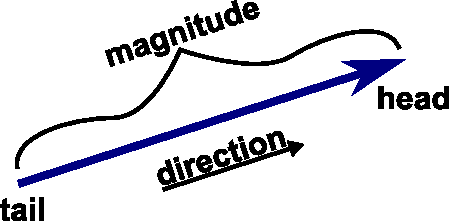
Example: Physical forces such as gravity, velocity, and displacement are commonly represented as vectors.
Vectors vs. Points and Vector Coordinates
Vectors can be described by their coordinates in space. If a vector v is positioned so its tail is at the origin and its head is at the point (a, b, c), then v = <a, b, c>.
Vector between two points: If Q = (a, b, c) and P = (d, e, f), then the vector from P to Q is PQ = <a - d, b - e, c - f>.
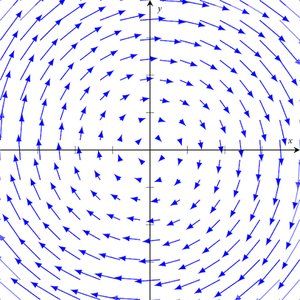
Application: In vector fields, it is important to consider both points and vectors simultaneously.
Vector Operations
Addition, Subtraction, and Scalar Multiplication
Vectors can be added, subtracted, and multiplied by scalars. These operations are defined component-wise in both two and three dimensions.
Vector Addition (in \(\mathbb{R}^2\)):
Vector Subtraction (in \(\mathbb{R}^2\)):
Scalar Multiplication (in \(\mathbb{R}^2\)):
Vector Addition (in \(\mathbb{R}^3\)):
Vector Subtraction (in \(\mathbb{R}^3\)):
Scalar Multiplication (in \(\mathbb{R}^3\)):
Example: If and , then .
Magnitude (Length) of a Vector
The magnitude of a vector is the distance from its tail to its head, calculated using the Pythagorean theorem.
In \(\mathbb{R}^2\):
In \(\mathbb{R}^3\):
Example: For , .
Dot Product and Orthogonality
Dot Product
The dot product is a way to multiply two vectors, resulting in a scalar. It is closely related to the angle between the vectors.
Definition: For vectors and , , where is the angle between them.
Component Formula (in \(\mathbb{R}^3\)):
Orthogonality: Two vectors are orthogonal (perpendicular) if their dot product is zero.
Example: If and , then (so they are orthogonal).
Orthogonal Projections
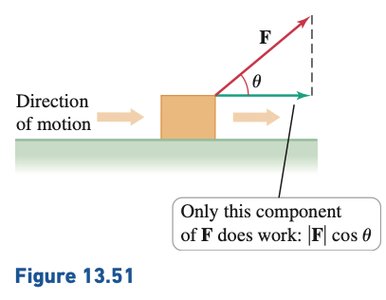
The orthogonal projection of one vector onto another represents the "shadow" that one vector casts onto another. It is useful in physics and engineering, especially for calculating work.
Projection Formula:
Direction :
Length =
using definition of dot product -->
=
Scalar Component:
Physical Interpretation (Work): The work done by a force F moving an object through a displacement d is , where is the angle between the force and the direction of motion.
Cross Product and Area
Definition and Properties
The cross product is an operation on two vectors in three-dimensional space, resulting in a vector that is orthogonal to both original vectors. The magnitude of the cross product equals the area of the parallelogram formed by the two vectors.
Magnitude:
Direction: Determined by the right-hand rule (orthogonal to both and ).
Component Formula: For and :
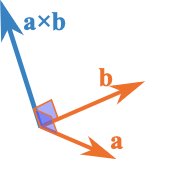
Right-Hand Rule: Point your fingers in the direction of , curl them toward ; your thumb points in the direction of .
Summary Table: Vector Operations
Operation | Formula | Result |
|---|---|---|
Addition | Vector | |
Subtraction | Vector | |
Scalar Multiplication | Vector | |
Dot Product = | Scalar | |
Cross Product = | Vector (orthogonal to both) |
Additional info: These concepts are foundational for later topics in multivariable calculus, including vector fields, line integrals, and theorems such as Green's, Stokes', and the Divergence Theorem.
