 Indietro
Volumes Using Cross-Sections: The Method of Slicing
Guida di studio - Note intelligenti
 Appunti personalizzati basati sui tuoi materiali, ampliati con definizioni chiave, esempi e contesto.
Volumes Using Cross-Sections
Introduction to the Method of Slicing
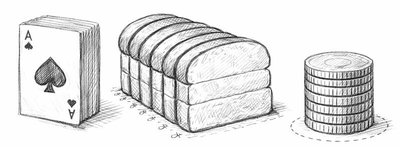
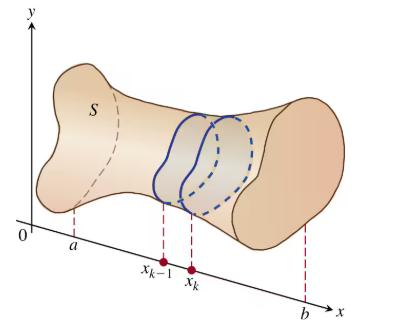
The method of slicing is a fundamental technique in calculus for finding the volume of a solid. By dividing a three-dimensional object into thin, parallel slices, we can approximate the total volume by summing the volumes of these slices. As the slices become infinitesimally thin, the sum approaches the exact volume, which can be calculated using integration.
Key Concept: Each slice is treated as a cylindrical solid whose volume is the area of the cross-section times its thickness.
Orientation: Slices can be taken perpendicular to either the x-axis or y-axis, depending on the problem's setup.
Understanding the Volume of a Slice
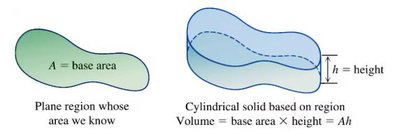
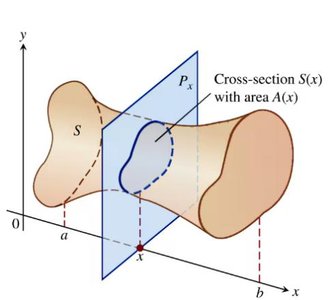
To find the volume of each slice, recall that the volume of a cylindrical solid is the area of its base multiplied by its height (thickness). For a slice perpendicular to the x-axis, the area of the cross-section at position x is denoted as A(x), and the thickness is Δx.
Volume of a slice:
Thickness:
Finding the Cross-Sectional Area
The function represents the area of the cross-section at position x. The shape of the cross-section depends on the boundaries defined by the problem. Common cross-sectional shapes and their area formulas include:
Shape | Area Formula |
|---|---|
Rectangle | |
Triangle | |
Square | |
Square (diagonal known) | |
Right Triangle | |
Circle | |
Equilateral Triangle | |
Washer |
When slicing perpendicular to the y-axis, rewrite all constraint functions in terms of y to find , and use as the thickness.
Summing Slices to Find Total Volume
The total volume is approximated by summing the volumes of all slices:
As the number of slices increases and their thickness approaches zero, this sum becomes an integral:
Definite Integral for Volume:
Step-by-Step Process for Finding Volume
Sketch the solid and a typical cross-section.
Find a formula for , the area of a typical cross-section.
Determine the limits of integration (from to ).
Integrate over the interval to find the volume.
Special Methods for Volumes of Revolution
Disk Method
The disk method is used when the cross-sections perpendicular to the axis of revolution are circles (disks). The radius is the distance from the axis of rotation to the curve.
Formula:
Washer Method
The washer method is used when the cross-sections are washers (rings), i.e., there is a hole in the middle. is the outer radius, and is the inner radius.
Formula:
Examples and Applications
Pyramid with Square Base: Find the volume by integrating the area of square cross-sections perpendicular to the altitude.
Curved Wedge from Cylinder: Use slicing to find the volume between two planes in a cylinder.
Region Revolved About x-axis: For , , revolve about the x-axis and use the disk method.
Sphere by Rotation: Rotate about the x-axis to find the volume of a sphere.
Region Revolved About Other Lines: Adjust the radius functions for rotations about lines other than the axes.
Additional info: For more complex solids, always express the area of the cross-section in terms of the variable of integration and carefully determine the limits based on the region's boundaries.
