Ch. 10 - Sequences and Infinite Series
Briggs - Calculus: Early Transcendentals 3rd Edition
Briggs3rd EditionCalculus: Early TranscendentalsISBN: 9780136847243Non è quello che usi tu?Cambia libro di testo
Capitolo 10, Problema 10.R.29

27–37. Evaluating series Evaluate the following infinite series or state that the series diverges.
∑ (from k = 0 to ∞)((1/3)ᵏ + (4/3)ᵏ)

Guida verificata passo dopo passo
1
Identify the given series as the sum of two separate infinite series: \( \sum_{k=0}^\infty \left( \left(\frac{1}{3}\right)^k + \left(\frac{4}{3}\right)^k \right) = \sum_{k=0}^\infty \left(\frac{1}{3}\right)^k + \sum_{k=0}^\infty \left(\frac{4}{3}\right)^k \).
Recognize that each series is a geometric series of the form \( \sum_{k=0}^\infty r^k \), where \( r \) is the common ratio.
Recall the convergence criterion for a geometric series: it converges if and only if \( |r| < 1 \). If it converges, the sum is given by \( \frac{1}{1-r} \).
Check the common ratios: for the first series, \( r = \frac{1}{3} \), which satisfies \( |r| < 1 \), so it converges; for the second series, \( r = \frac{4}{3} \), which does not satisfy \( |r| < 1 \), so it diverges.
Conclude that since the second series diverges, the entire original series diverges and does not have a finite sum.

Risposta video verificata per un problema simile:

Questa soluzione video è stata consigliata dai nostri tutor come utile per risolvere questo problema.
Durata del video:
2m

Concetti chiave

Ecco i concetti essenziali che devi comprendere per rispondere correttamente alla domanda.

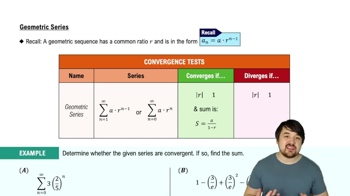
Infinite Geometric Series

An infinite geometric series is a sum of terms where each term is obtained by multiplying the previous term by a constant ratio. It converges if the absolute value of the ratio is less than 1, and its sum can be found using the formula S = a / (1 - r), where a is the first term and r is the common ratio.
Video consigliato:
Percorso guidato
06:00
Geometric Series

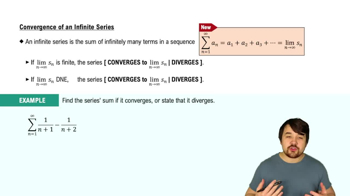
Convergence and Divergence of Series

A series converges if the sum of its terms approaches a finite limit as the number of terms increases indefinitely. If the terms do not approach zero or the sum grows without bound, the series diverges. Determining convergence is essential before evaluating the sum.
Video consigliato:
Percorso guidato
06:52
Convergence of an Infinite Series

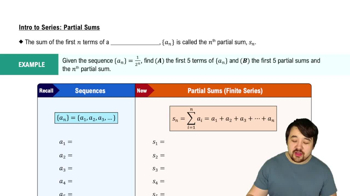
Sum of a Series with Multiple Terms

When a series is composed of sums of multiple sequences, the sum of the series is the sum of the individual series, provided each converges. This allows breaking down complex series into simpler parts that can be evaluated separately and then combined.
Video consigliato:
Percorso guidato
06:45
Intro to Series: Partial Sums