Ch. 10 - Sequences and Infinite Series
Briggs - Calculus: Early Transcendentals 3rd Edition
Briggs3rd EditionCalculus: Early TranscendentalsISBN: 9780136847243Non è quello che usi tu?Cambia libro di testo
Capitolo 10, Problema 10.3.87b

87. Explain why or why not
Determine whether the following statements are true and give an explanation or counterexample.


b. If ∑ (k = 1 to ∞) aₖ diverges, then ∑ (k = 10 to ∞) aₖ diverges.

Guida verificata passo dopo passo
1
Understand the problem: We are asked to determine if the statement "If \( \sum_{k=1}^{\infty} a_k \) diverges, then \( \sum_{k=10}^{\infty} a_k \) also diverges" is true or false.
Recall the definition of series convergence and divergence: A series \( \sum_{k=m}^{\infty} a_k \) converges if the sequence of partial sums \( S_n = \sum_{k=m}^n a_k \) approaches a finite limit as \( n \to \infty \). Otherwise, it diverges.
Analyze the relationship between the two series: The series starting at \( k=10 \) is essentially the tail of the series starting at \( k=1 \). The original series can be written as \( \sum_{k=1}^{\infty} a_k = \sum_{k=1}^{9} a_k + \sum_{k=10}^{\infty} a_k \).
Consider the impact of the finite sum \( \sum_{k=1}^{9} a_k \): Since this is a finite sum, it does not affect convergence or divergence of the infinite series. Therefore, the convergence or divergence of \( \sum_{k=10}^{\infty} a_k \) determines the behavior of the tail.
Conclude based on the above: If the entire series \( \sum_{k=1}^{\infty} a_k \) diverges, then its tail \( \sum_{k=10}^{\infty} a_k \) must also diverge, because adding or removing a finite number of terms does not change the divergence property.

Risposta video verificata per un problema simile:

Questa soluzione video è stata consigliata dai nostri tutor come utile per risolvere questo problema.
Durata del video:
1m

Concetti chiave

Ecco i concetti essenziali che devi comprendere per rispondere correttamente alla domanda.

Infinite Series and Convergence

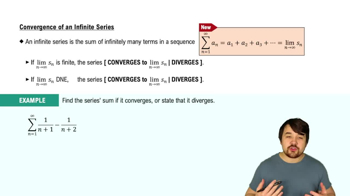
An infinite series is the sum of infinitely many terms from a sequence. A series converges if its partial sums approach a finite limit; otherwise, it diverges. Understanding convergence is essential to analyze whether changing the starting index affects the series' behavior.
Video consigliato:
Percorso guidato
06:52
Convergence of an Infinite Series

Effect of Changing the Index of Summation

Shifting the starting index of a series changes only a finite number of terms. Since convergence depends on the tail behavior of the series, adding or removing finitely many terms does not affect whether the series converges or diverges.
Video consigliato:
Percorso guidato
06:35
Changing Geometries

Counterexamples in Series Analysis

Counterexamples demonstrate when a general statement is false. To test if a series starting at k=10 diverges when the series from k=1 diverges, one can consider series where initial terms affect convergence, highlighting the importance of examining specific cases.
Video consigliato:
Percorso guidato
06:00
Geometric Series
Pratica correlata
Domanda del libro di testo

Explain why or why not Determine whether the following statements are true and give an explanation or counterexample.


b. (2n)! / (2n − 1)! = 2n

61
views

Domanda del libro di testo

Explain why or why not

Determine whether the following statements are true and give an explanation or counterexample.


b.If a sequence of positive numbers converges, then the sequence is decreasing.

60
views
Domanda del libro di testo

27–34. Working with sequences Several terms of a sequence {aₙ}ₙ₌₁∞ are given.

b. Find a recurrence relation that generates the sequence (supply the initial value of the index and the first term of the sequence).


{1, 3, 9, 27, 81, ......}

52
views
Domanda del libro di testo

Suppose the sequence {aₙ}⁽∞⁾ₙ₌₀ is defined by the recurrence relation

aₙ₊₁ = ⅓aₙ + 6;a₀ = 3.


b.Explain why {aₙ}⁽∞⁾ₙ₌₀ converges and find the limit.

36
views
Domanda del libro di testo

57–60. Heights of bouncing balls A ball is thrown upward to a height of hₒ meters. After each bounce, the ball rebounds to a fraction r of its previous height. Let hₙ be the height after the nth bounce. Consider the following values of hₒ and r.


b. Find an explicit formula for the nth term of the sequence {hₙ}.


h₀ = 20,r = 0.5

82
views
Domanda del libro di testo

39–40. {Use of Tech} Lower and upper bounds of a series

For each convergent series and given value of n, use Theorem 10.13 to complete the following.


b. Find an upper bound for the remainder Rₙ.


39. ∑ (k = 1 to ∞) 1 / k⁷ ; n = 2

120
views