
Ch. 10 - Sequences and Infinite Series
Briggs - Calculus: Early Transcendentals 3rd Edition
Briggs3rd EditionCalculus: Early TranscendentalsISBN: 9780136847243Non è quello che usi tu?Cambia libro di testo
Capitolo 10, Problema 10.2.93b

Suppose the sequence {aₙ}⁽∞⁾ₙ₌₀ is defined by the recurrence relation
aₙ₊₁ = ⅓aₙ + 6;a₀ = 3.


b.Explain why {aₙ}⁽∞⁾ₙ₌₀ converges and find the limit.

Guida verificata passo dopo passo
1
Recognize that the sequence \( \{a_n\} \) is defined by a linear recurrence relation of the form \( a_{n+1} = r a_n + c \), where \( r = \frac{1}{3} \) and \( c = 6 \). Since \( |r| = \frac{1}{3} < 1 \), the sequence is a contraction and will converge to a fixed point.
To find the limit \( L \) of the sequence, assume it exists and satisfies the recurrence relation in the limit, so \( L = \frac{1}{3} L + 6 \). This is because as \( n \to \infty \), \( a_n \to L \) and \( a_{n+1} \to L \).
Solve the equation for \( L \): \( L = \frac{1}{3} L + 6 \). Rearranging gives \( L - \frac{1}{3} L = 6 \), which simplifies to \( \frac{2}{3} L = 6 \).
Multiply both sides by \( \frac{3}{2} \) to isolate \( L \), yielding \( L = 6 \times \frac{3}{2} \).
Interpret the result: since the sequence converges to \( L \), this value is the fixed point of the recurrence relation and represents the long-term behavior of \( \{a_n\} \).

Risposta video verificata per un problema simile:

Questa soluzione video è stata consigliata dai nostri tutor come utile per risolvere questo problema.
Durata del video:
1m

Concetti chiave

Ecco i concetti essenziali che devi comprendere per rispondere correttamente alla domanda.

Recurrence Relations

A recurrence relation defines each term of a sequence based on previous terms. Understanding how to manipulate and solve these relations is essential to analyze the behavior of sequences, such as finding explicit formulas or limits.
Video consigliato:
Percorso guidato
04:16
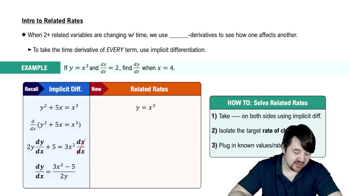
Intro To Related Rates

Convergence of Sequences

A sequence converges if its terms approach a specific finite value as the index goes to infinity. Determining convergence involves analyzing the long-term behavior of the sequence, often by examining the recurrence relation or using limit properties.
Video consigliato:
8:22
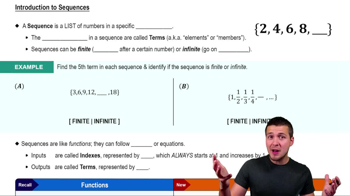
Introduction to Sequences

Finding Limits of Linear Recurrence Sequences

For linear recurrence relations like aₙ₊₁ = r aₙ + c with |r| < 1, the sequence converges to the fixed point L = c / (1 - r). This limit is found by setting aₙ₊₁ = aₙ = L and solving the resulting equation.
Video consigliato:
05:21
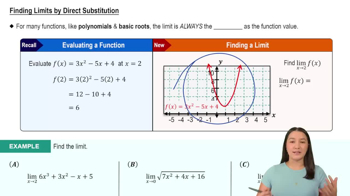
Finding Limits by Direct Substitution
Pratica correlata
Domanda del libro di testo

67–70. Formulas for sequences of partial sums Consider the following infinite series.


b.Find a formula for the nth partial sum Sₙ of the infinite series. Use this formula to find the next four partial sums S₅, S₆, S₇, S₈ of the infinite series.


∑⁽∞⁾ₖ₌₁2⁄[(2k − 1)(2k + 1)]

90
views
Domanda del libro di testo

41–44. {Use of Tech} Remainders and estimates Consider the following convergent series.


b. Find how many terms are needed to ensure that the remainder is less than 10⁻³.


43. ∑ (k = 1 to ∞) 1 / 3ᵏ

134
views
Domanda del libro di testo

Explain why or why not Determine whether the following statements are true and give an explanation or counterexample.


b. (2n)! / (2n − 1)! = 2n

61
views
Domanda del libro di testo

27–34. Working with sequences Several terms of a sequence {aₙ}ₙ₌₁∞ are given.

b. Find a recurrence relation that generates the sequence (supply the initial value of the index and the first term of the sequence).


{1, 3, 9, 27, 81, ......}

52
views
Domanda del libro di testo

87. Explain why or why not

Determine whether the following statements are true and give an explanation or counterexample.


b. If ∑ (k = 1 to ∞) aₖ diverges, then ∑ (k = 10 to ∞) aₖ diverges.

46
views
Domanda del libro di testo

39–40. {Use of Tech} Lower and upper bounds of a series

For each convergent series and given value of n, use Theorem 10.13 to complete the following.


b. Find an upper bound for the remainder Rₙ.


39. ∑ (k = 1 to ∞) 1 / k⁷ ; n = 2

120
views