
Ch. 3 - Derivatives
Briggs - Calculus: Early Transcendentals 3rd Edition
Briggs3rd EditionCalculus: Early TranscendentalsISBN: 9780136847243Non è quello che usi tu?Cambia libro di testo
Capitolo 3, Problema 3.8.14b

13-26 Implicit differentiation Carry out the following steps.
b. Find the slope of the curve at the given point.
x = e^y; (2, ln 2)

Guida verificata passo dopo passo
1
Start by recognizing that the equation given is in implicit form: \( x = e^y \). This means that \( y \) is not isolated on one side of the equation.
To find the derivative \( \frac{dy}{dx} \), apply implicit differentiation to both sides of the equation with respect to \( x \). Differentiate \( x \) to get 1, and differentiate \( e^y \) using the chain rule to get \( e^y \cdot \frac{dy}{dx} \).
Set up the equation from the differentiation: \( 1 = e^y \cdot \frac{dy}{dx} \).
Solve for \( \frac{dy}{dx} \) by isolating it on one side of the equation: \( \frac{dy}{dx} = \frac{1}{e^y} \).
Substitute the given point \((2, \ln 2)\) into the expression for \( \frac{dy}{dx} \). Since \( y = \ln 2 \), calculate \( e^{\ln 2} \) which simplifies to 2, and find the slope at this point.

Risposta video verificata per un problema simile:

Questa soluzione video è stata consigliata dai nostri tutor come utile per risolvere questo problema.
Durata del video:
4m

Concetti chiave

Ecco i concetti essenziali che devi comprendere per rispondere correttamente alla domanda.

Implicit Differentiation

Implicit differentiation is a technique used to differentiate equations where the dependent and independent variables are not explicitly separated. Instead of solving for one variable in terms of the other, we differentiate both sides of the equation with respect to the independent variable, applying the chain rule as necessary. This method is particularly useful for curves defined by equations that cannot be easily rearranged.
Video consigliato:
Percorso guidato
05:14
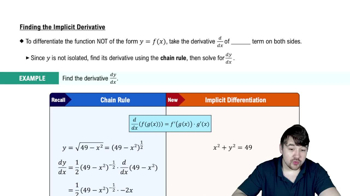
Finding The Implicit Derivative

Slope of a Curve

The slope of a curve at a given point represents the rate of change of the function at that point, which is mathematically defined as the derivative of the function. For a curve defined implicitly, the slope can be found by evaluating the derivative obtained through implicit differentiation. The slope is often denoted as 'dy/dx' and indicates how steep the curve is at the specified coordinates.
Video consigliato:
11:41
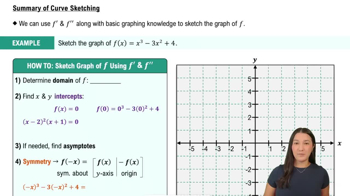
Summary of Curve Sketching

Exponential and Natural Logarithm Functions

Exponential functions, such as e^y, and natural logarithm functions, like ln(x), are fundamental in calculus. The function e^y is the inverse of ln(y), and they exhibit unique properties, such as the derivative of e^y being e^y dy/dx. Understanding these functions is crucial for evaluating expressions and derivatives involving exponential growth or decay, especially when working with implicit relationships.
Video consigliato:
05:18
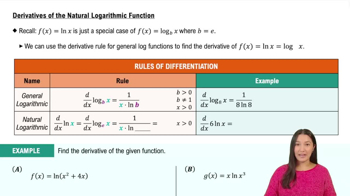
Derivative of the Natural Logarithmic Function
Pratica correlata
Domanda del libro di testo

{Use of Tech} Bungee jumper A woman attached to a bungee cord jumps from a bridge that is 30 m above a river. Her height in meters above the river t seconds after the jump is y(t) = 15(1+e^−t cos t), for t ≥ 0.

b. Use a graphing utility to determine when she is moving downward and when she is moving upward during the first 10 s.  

256
views
Domanda del libro di testo

An object oscillates along a vertical line, and its position in centimeters is given by y(t) = 30(sint - 1), where t ≥ 0 is measured in seconds and y is positive in the upward direction.

Find the velocity of the oscillator, v(t) =y′(t).

274
views
Domanda del libro di testo

The Chain Rule for second derivatives

b. Use the formula in part (a) to calculate d2dx2(sin(3x4+5x2+2))\(\frac{d^2}{dx^2}\[\left\)(\(\sin\]\left\)(3x^4+5x^2+2\(\right\))\(\right\)).

408
views
Domanda del libro di testo

109-112 {Use of Tech} Calculating limits The following limits are the derivatives of a composite function g at a point a.

b. Use the Chain Rule to find each limit. Verify your answer by using a calculator.

limx→04+sin(x)−2x{\(\displaystyle\)\(\lim\)_{x\(\to\)0}}\(\frac{\sqrt{4+\sin\left(x\right)}\)-2}{x}

263
views
Domanda del libro di testo

Tracking a dive A biologist standing at the bottom of an 80-foot vertical cliff watches a peregrine falcon dive from the top of the cliff at a 45° angle from the horizontal (see figure). <IMAGE>


b. What is the rate of change of θ with respect to the bird’s height when it is 60 ft above the ground?

141
views
Domanda del libro di testo

{Use of Tech} Fuel economy Suppose you own a fuel-efficient hybrid automobile with a monitor on the dashboard that displays the mileage and gas consumption. The number of miles you can drive with g gallons of gas remaining in the tank on a particular stretch of highway is given by m(g) = 50g−25.8g²+12.5g³−1.6g⁴, for 0≤g≤4.

b. Graph and interpret the gas mileage m(g)/g. 

241
views