
Ch. 3 - Derivatives
Briggs - Calculus: Early Transcendentals 3rd Edition
Briggs3rd EditionCalculus: Early TranscendentalsISBN: 9780136847243Non è quello che usi tu?Cambia libro di testo
Capitolo 3, Problema 3.7.108b

The Chain Rule for second derivatives
b. Use the formula in part (a) to calculate d2dx2(sin(3x4+5x2+2))\(\frac{d^2}{dx^2}\[\left\)(\(\sin\]\left\)(3x^4+5x^2+2\(\right\))\(\right\)).

Guida verificata passo dopo passo
1
Step 1: Identify the function and its inner function. Here, the outer function is \( \sin(u) \) and the inner function is \( u = 3x^4 + 5x^2 + 2 \).
Step 2: Compute the first derivative using the chain rule. The derivative of \( \sin(u) \) with respect to \( u \) is \( \cos(u) \), and the derivative of \( u \) with respect to \( x \) is \( 12x^3 + 10x \). Therefore, the first derivative is \( \frac{d}{dx} \left( \sin(u) \right) = \cos(u) \cdot (12x^3 + 10x) \).
Step 3: Apply the product rule to differentiate the first derivative. The first derivative is a product of two functions: \( \cos(u) \) and \( 12x^3 + 10x \). Use the product rule: \( (fg)' = f'g + fg' \).
Step 4: Differentiate \( \cos(u) \) with respect to \( x \) using the chain rule. The derivative of \( \cos(u) \) is \( -\sin(u) \cdot (12x^3 + 10x) \).
Step 5: Differentiate \( 12x^3 + 10x \) with respect to \( x \), which is \( 36x^2 + 10 \). Combine these results using the product rule to find the second derivative.

Risposta video verificata per un problema simile:

Questa soluzione video è stata consigliata dai nostri tutor come utile per risolvere questo problema.
Durata del video:
7m

Concetti chiave

Ecco i concetti essenziali che devi comprendere per rispondere correttamente alla domanda.

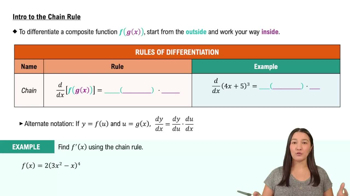
Chain Rule

The Chain Rule is a fundamental theorem in calculus used to differentiate composite functions. It states that if a function y is composed of two functions u and x, then the derivative of y with respect to x can be found by multiplying the derivative of y with respect to u by the derivative of u with respect to x. This rule is essential for calculating derivatives of functions that are nested within one another.
Video consigliato:
05:02
Intro to the Chain Rule

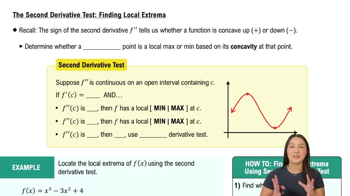
Second Derivative

The second derivative of a function is the derivative of the derivative, providing information about the curvature of the function's graph. It indicates how the rate of change of the function is itself changing. In practical terms, the second derivative can reveal whether a function is concave up or concave down, which is useful for understanding the behavior of the function and identifying points of inflection.
Video consigliato:
06:02
The Second Derivative Test: Finding Local Extrema

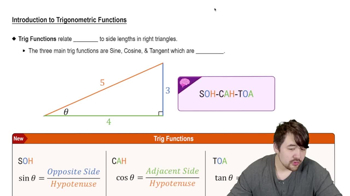
Trigonometric Functions

Trigonometric functions, such as sine, cosine, and tangent, are fundamental in calculus, especially when dealing with periodic phenomena. The sine function, in particular, is crucial when applying the Chain Rule, as it often appears in composite functions. Understanding the properties and derivatives of trigonometric functions is essential for solving problems involving their rates of change and for applying rules like the Chain Rule effectively.
Video consigliato:
Percorso guidato
6:04
Introduction to Trigonometric Functions
Pratica correlata
Domanda del libro di testo

{Use of Tech} Bungee jumper A woman attached to a bungee cord jumps from a bridge that is 30 m above a river. Her height in meters above the river t seconds after the jump is y(t) = 15(1+e^−t cos t), for t ≥ 0.

b. Use a graphing utility to determine when she is moving downward and when she is moving upward during the first 10 s.  

256
views
Domanda del libro di testo

13-26 Implicit differentiation Carry out the following steps.

b. Find the slope of the curve at the given point.

x = e^y; (2, ln 2)

189
views
Domanda del libro di testo

109-112 {Use of Tech} Calculating limits The following limits are the derivatives of a composite function g at a point a.

b. Use the Chain Rule to find each limit. Verify your answer by using a calculator.

limx→04+sin(x)−2x{\(\displaystyle\)\(\lim\)_{x\(\to\)0}}\(\frac{\sqrt{4+\sin\left(x\right)}\)-2}{x}

263
views
Domanda del libro di testo

Throwing a stone Suppose a stone is thrown vertically upward from the edge of a cliff on Earth with an initial velocity of 32 ft/s from a height of 48 ft above the ground. The height (in feet) of the stone above the ground t seconds after it is thrown is s(t) = -16t²+32t+48.

b. When does the stone reach its highest point?

184
views
Domanda del libro di testo

Product Rule for three functions Assume f, g, and h are differentiable at x.

b. Use the formula in (a) to find d/dx(e^x(x−1)(x+3))

418
views
Domanda del libro di testo

Tracking a dive A biologist standing at the bottom of an 80-foot vertical cliff watches a peregrine falcon dive from the top of the cliff at a 45° angle from the horizontal (see figure). <IMAGE>


b. What is the rate of change of θ with respect to the bird’s height when it is 60 ft above the ground?

141
views