

At all times, the length of the long leg of a right triangle is 3 times the length x of the short leg of the triangle. If the area of the triangle changes with respect to time t, find equations relating the area A to x and dA/dt to dx/dt.
Ch. 3 - Derivatives
Briggs3rd EditionCalculus: Early TranscendentalsISBN: 9780136847243Non è quello che usi tu?Cambia libro di testo
Capitolo 3, Problema 3.1.14
A projectile is fired vertically upward into the air; its position (in feet) above the ground after t seconds is given by the function s (t). For the following functions, use limits to determine the instantaneous velocity of the projectile at t = a seconds for the given value of a.
s(t) = -16t2 + 128t + 192; a = 2
Guida verificata passo dopo passo1
Step 1: Understand that the instantaneous velocity of the projectile at time t = a is given by the derivative of the position function s(t) evaluated at t = a. This is because the derivative of a position function with respect to time gives the velocity function.
Step 2: The position function is s(t) = -16t^2 + 128t + 192. To find the instantaneous velocity, we need to find the derivative of s(t) with respect to t, which is denoted as s'(t).
Step 3: Differentiate the function s(t) = -16t^2 + 128t + 192. Use the power rule for differentiation: if f(t) = at^n, then f'(t) = n*at^(n-1). Apply this rule to each term in s(t).
Step 4: After differentiating, you will obtain s'(t) = -32t + 128. This is the velocity function, which gives the velocity of the projectile at any time t.
Step 5: Evaluate the velocity function s'(t) at t = a, where a = 2. Substitute t = 2 into s'(t) to find the instantaneous velocity at that specific time.

Risposta video verificata per un problema simile:
Questa soluzione video è stata consigliata dai nostri tutor come utile per risolvere questo problema.
Durata del video:
4mConcetti chiave
Ecco i concetti essenziali che devi comprendere per rispondere correttamente alla domanda.
Limits
Limits are fundamental in calculus, representing the value that a function approaches as the input approaches a certain point. In the context of instantaneous velocity, limits help us find the derivative of a function at a specific point, which is the slope of the tangent line to the curve at that point. This concept is crucial for understanding how functions behave near particular values.
Video consigliato:
One-Sided Limits
Derivatives
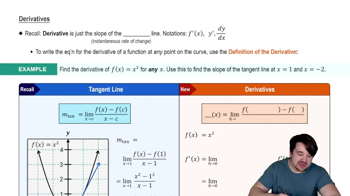
The derivative of a function measures how the function's output changes as its input changes, essentially providing the rate of change at any given point. For the position function s(t) of the projectile, the derivative s'(t) gives the instantaneous velocity. This concept is key to solving problems involving motion, as it allows us to determine how fast an object is moving at any moment.
Video consigliato:
Percorso guidato
Derivatives
Projectile Motion
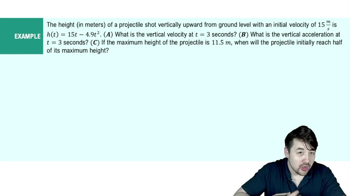
Projectile motion describes the motion of an object that is launched into the air and is subject to gravitational acceleration. The position function s(t) = -16t² + 128t + 192 models the height of the projectile over time, where the coefficients represent the effects of gravity and initial velocity. Understanding this concept is essential for analyzing the behavior of the projectile and applying calculus to find its instantaneous velocity.
Video consigliato:
Percorso guidato
Derivatives Applied To Acceleration Example 2
Pratica correlata
Domanda del libro di testo
281
views
Domanda del libro di testo
15–48. Derivatives Find the derivative of the following functions.
y = 10^x(In 10^x-1)
207
views
Domanda del libro di testo
Calculate the derivative of the following functions. In some cases, it is useful to use the properties of logarithms to simplify the functions before computing f'(x).
y = (cos x) In cos²x
206
views
Domanda del libro di testo
47–56. Derivatives of inverse functions at a point Consider the following functions. In each case, without finding the inverse, evaluate the derivative of the inverse at the given point.
f(x)=tan x; (1,π/4)
148
views
Domanda del libro di testo
Find y'' for the following functions.
y = ex sin x
297
views
Domanda del libro di testo
Calculate the derivative of the following functions. In some cases, it is useful to use the properties of logarithms to simplify the functions before computing f'(x).
y = 4 log₃(x²−1)
205
views
