Ch. 3 - Derivatives
Briggs - Calculus: Early Transcendentals 3rd Edition
Briggs3rd EditionCalculus: Early TranscendentalsISBN: 9780136847243Non è quello che usi tu?Cambia libro di testo
Capitolo 3, Problema 3.11.8

At all times, the length of the long leg of a right triangle is 3 times the length x of the short leg of the triangle. If the area of the triangle changes with respect to time t, find equations relating the area A to x and dA/dt to dx/dt.

Guida verificata passo dopo passo
1
Start by expressing the relationship between the lengths of the legs of the triangle. Let the short leg be x, then the long leg is 3x.
The area A of a right triangle is given by the formula: A = (1/2) * base * height. Here, the base is x and the height is 3x, so A = (1/2) * x * 3x.
Simplify the expression for the area: A = (3/2) * x^2.
To find the relationship between dA/dt and dx/dt, use the chain rule for differentiation. Differentiate A with respect to t: dA/dt = d/dt[(3/2) * x^2].
Apply the chain rule: dA/dt = (3/2) * 2x * (dx/dt), which simplifies to dA/dt = 3x * (dx/dt). This equation relates the rate of change of the area to the rate of change of the short leg.

Risposta video verificata per un problema simile:

Questa soluzione video è stata consigliata dai nostri tutor come utile per risolvere questo problema.
Durata del video:
2m

Concetti chiave

Ecco i concetti essenziali che devi comprendere per rispondere correttamente alla domanda.

Area of a Right Triangle

The area A of a right triangle can be calculated using the formula A = (1/2) * base * height. In this case, the base can be considered the short leg (x) and the height the long leg, which is 3x. Therefore, the area can be expressed as A = (1/2) * x * (3x) = (3/2)x^2.
Video consigliato:
Percorso guidato
05:59
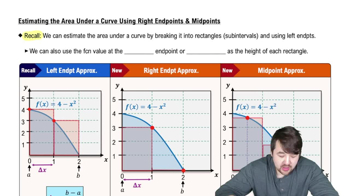
Estimating the Area Under a Curve with Right Endpoints & Midpoint

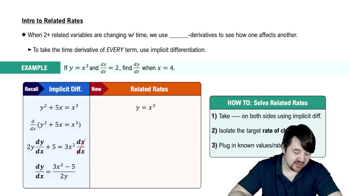
Related Rates

Related rates involve finding the relationship between the rates at which two or more quantities change. In this problem, we need to relate the rate of change of the area (dA/dt) to the rate of change of the short leg (dx/dt). This is typically done using implicit differentiation with respect to time.
Video consigliato:
Percorso guidato
04:16
Intro To Related Rates

Chain Rule

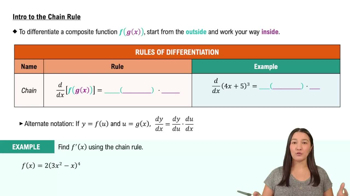
The chain rule is a fundamental principle in calculus used to differentiate composite functions. When applying the chain rule in this context, we differentiate the area A with respect to time t, leading to dA/dt = (dA/dx)(dx/dt). This allows us to express how the area changes as the length of the short leg changes.
Video consigliato:
05:02
Intro to the Chain Rule
Pratica correlata
Domanda del libro di testo

75–86. Logarithmic differentiation Use logarithmic differentiation to evaluate f'(x).

f(x) = x^In x

189
views

Domanda del libro di testo

{Use of Tech} Difference quotients Suppose f is differentiable for all x and consider the function D(x) = f(x+0.01)-f(x) / 0.01 For the following functions, graph D on the given interval, and explain why the graph appears as it does. What is the relationship between the functions f and D?

f(x) = sin x on [−π,π]

268
views
Domanda del libro di testo

Calculate the derivative of the following functions. In some cases, it is useful to use the properties of logarithms to simplify the functions before computing f'(x).


y = (cos x) In cos²x

206
views
Domanda del libro di testo

47–56. Derivatives of inverse functions at a point Consider the following functions. In each case, without finding the inverse, evaluate the derivative of the inverse at the given point.

f(x)=tan x; (1,π/4)

148
views
Domanda del libro di testo

A projectile is fired vertically upward into the air; its position (in feet) above the ground after t seconds is given by the function s (t). For the following functions, use limits to determine the instantaneous velocity of the projectile at t = a seconds for the given value of a.

s(t) = -16t2 + 128t + 192; a = 2

275
views
Domanda del libro di testo

Calculate the derivative of the following functions. In some cases, it is useful to use the properties of logarithms to simplify the functions before computing f'(x).


y = 4 log₃(x²−1)

205
views