Ch. 3 - Derivatives
Briggs - Calculus: Early Transcendentals 3rd Edition
Briggs3rd EditionCalculus: Early TranscendentalsISBN: 9780136847243Non è quello che usi tu?Cambia libro di testo
Capitolo 3, Problema 3.11.5c

A rectangular swimming pool 10 ft wide by 20 ft long and of uniform depth is being filled with water.
c. At what rate is the water level rising if the pool is filled at a rate of 10ft³/min?

Guida verificata passo dopo passo
1
First, identify the variables involved in the problem. Let h be the height of the water level in the pool, which is changing over time.
The volume V of the water in the pool can be expressed as V = length × width × height, or V = 20 × 10 × h. This simplifies to V = 200h.
Since the pool is being filled at a rate of 10 ft³/min, this is the rate of change of the volume with respect to time, denoted as dV/dt = 10 ft³/min.
To find the rate at which the water level is rising, we need to find dh/dt. Use the relationship between the rates: dV/dt = 200 × dh/dt.
Solve for dh/dt by dividing both sides of the equation by 200: dh/dt = (dV/dt) / 200. Substitute dV/dt = 10 ft³/min into the equation to find dh/dt.

Risposta video verificata per un problema simile:

Questa soluzione video è stata consigliata dai nostri tutor come utile per risolvere questo problema.
Durata del video:
3m

Concetti chiave

Ecco i concetti essenziali che devi comprendere per rispondere correttamente alla domanda.

Volume of a Rectangular Prism

The volume of a rectangular prism, such as a swimming pool, is calculated using the formula V = length × width × height. In this case, the pool's dimensions are given, and understanding this formula is essential to relate the volume of water being added to the change in water level.
Video consigliato:
08:29
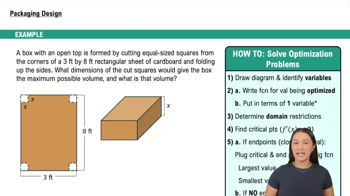
Example 5: Packaging Design

Related Rates

Related rates involve finding the rate at which one quantity changes in relation to another. In this problem, we need to determine how fast the water level (height) is rising as the volume of water (10 ft³/min) is added, which requires applying the concept of derivatives to relate the rates of change.
Video consigliato:
Percorso guidato
04:16
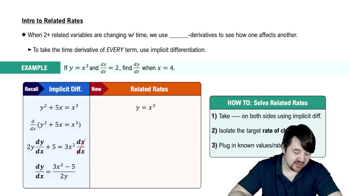
Intro To Related Rates

Differentiation

Differentiation is a fundamental concept in calculus that deals with finding the rate of change of a function. In this context, we will differentiate the volume formula with respect to time to find the rate at which the height of the water is increasing as the pool is filled.
Video consigliato:
Percorso guidato
05:53
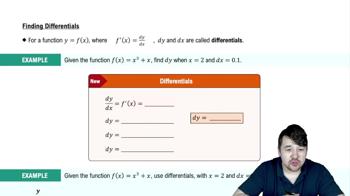
Finding Differentials
Pratica correlata
Domanda del libro di testo

62–65. {Use of Tech} Graphing f and f'

c. Verify that the zeros of f' correspond to points at which f has a horizontal tangent line.

f(x)=(x²−1)sin^−1 x on [−1,1]

150
views

Domanda del libro di testo

{Use of Tech} Spring oscillations A spring hangs from the ceiling at equilibrium with a mass attached to its end. Suppose you pull downward on the mass and release it 10 inches below its equilibrium position with an upward push. The distance x (in inches) of the mass from its equilibrium position after t seconds is given by the function x(t) = 10sin t−10cos t, where x is positive when the mass is above the equilibrium position. <IMAGE>

c. At what times is the velocity of the mass zero?

283
views
Domanda del libro di testo

Derivatives using tables Let h(x)=f(g(x))h(x)=f(g(x)) and p(x)=g(f(x))p(x)=g(f(x)). Use the table to compute the following derivatives.

<IMAGE>

c. p′(4)p^{\(\prime\)}\(\left\)(4\(\right\))

279
views
Domanda del libro di testo

Throwing a stone Suppose a stone is thrown vertically upward from the edge of a cliff on Earth with an initial velocity of 32 ft/s from a height of 48 ft above the ground. The height (in feet) of the stone above the ground t seconds after it is thrown is s(t) = -16t²+32t+48.

c. What is the height of the stone at the highest point?

234
views
Domanda del libro di testo

Derivatives using tables Let h(x)=f(g(x))h(x)=f(g(x)) and p(x)=g(f(x))p(x)=g(f(x)). Use the table to compute the following derivatives.

<IMAGE>

d. p′(2)p^{\(\prime\)}\(\left\)(2\(\right\))

233
views
Domanda del libro di testo

Witch of Agnesi Let y(x²+4)=8 (see figure). <IMAGE>

c. Solve the equation y(x²+4)=8 for y to find an explicit expression for y and then calculate dy/dx.

250
views