


Ch. 3 - Derivatives
Briggs - Calculus: Early Transcendentals 3rd Edition
Briggs3rd EditionCalculus: Early TranscendentalsISBN: 9780136847243Non è quello che usi tu?Cambia libro di testo
Capitolo 3, Problema 3.96c

Computing the derivative of f(x) = e^-x
c. Use parts (a) and (b) to find the derivative of f(x) = e^-x.

Guida verificata passo dopo passo
1
Step 1: Recall the derivative of the exponential function. The derivative of \( e^x \) with respect to \( x \) is \( e^x \).
Step 2: Apply the chain rule for differentiation. The chain rule states that if you have a composite function \( f(g(x)) \), its derivative is \( f'(g(x)) \cdot g'(x) \).
Step 3: Identify the inner function \( g(x) = -x \) and the outer function \( f(u) = e^u \) where \( u = g(x) \).
Step 4: Differentiate the inner function \( g(x) = -x \). The derivative \( g'(x) \) is \( -1 \).
Step 5: Combine the results using the chain rule. The derivative of \( f(x) = e^{-x} \) is \( e^{-x} \cdot (-1) \).

Risposta video verificata per un problema simile:

Questa soluzione video è stata consigliata dai nostri tutor come utile per risolvere questo problema.
Durata del video:
4m

Concetti chiave

Ecco i concetti essenziali che devi comprendere per rispondere correttamente alla domanda.

Derivative

The derivative of a function measures how the function's output value changes as its input value changes. It is defined as the limit of the average rate of change of the function over an interval as the interval approaches zero. In calculus, the derivative is often denoted as f'(x) or df/dx, and it provides critical information about the function's behavior, such as its slope and points of tangency.
Video consigliato:

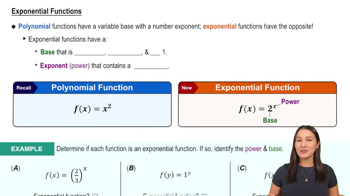
Exponential Functions

Exponential functions are mathematical functions of the form f(x) = a * e^(bx), where 'e' is the base of natural logarithms, approximately equal to 2.71828. The function f(x) = e^-x is a specific case where the base 'e' is raised to the power of a negative variable, resulting in a function that decreases rapidly as x increases. Understanding the properties of exponential functions is essential for computing their derivatives.
Video consigliato:
6:13
Exponential Functions

Chain Rule

The chain rule is a fundamental technique in calculus used to differentiate composite functions. It states that if a function y = f(g(x)) is composed of two functions, the derivative can be found by multiplying the derivative of the outer function f with the derivative of the inner function g. This rule is particularly useful when dealing with functions like e^-x, where the exponent itself is a function of x.
Video consigliato:
05:02
Intro to the Chain Rule
Pratica correlata
Domanda del libro di testo

{Use of Tech} Spring runoff The flow of a small stream is monitored for 90 days between May 1 and August 1. The total water that flows past a gauging station is given by v(t) = <matrix 2x2> where V is measured in cubic feet and t is measured in days, with t=0 corresponding to May 1.

c. Describe the flow of the stream over the 3-month period. Specifically, when is the flow rate a maximum?

218
views
Domanda del libro di testo

Another way to approximate derivatives is to use the centered difference quotient: f' (a) ≈ f(a+h) - f(a- h) / 2h. Again, consider f(x) = √x.

c. Explain why it is not necessary to use negative values of h in the table of part (b).

361
views
Domanda del libro di testo

Highway travel A state patrol station is located on a straight north-south freeway. A patrol car leaves the station at 9:00 A.M. heading north with position function s = f(t) that gives its location in miles t hours after 9:00 A.M. (see figure). Assume s is positive when the car is north of the patrol station. <IMAGE>

c. Find the average velocity of the car over the interval [1.75, 2.25]. Estimate the velocity of the car at 11:00 A.M. and determine the direction in which the patrol car is moving.

239
views
Domanda del libro di testo

62–65. {Use of Tech} Graphing f and f'

c. Verify that the zeros of f' correspond to points at which f has a horizontal tangent line.

f(x)=e^−x tan^−1 x on [0,∞)

145
views
Domanda del libro di testo

City urbanization City planners model the size of their city using the function A(t) = - 1/50t² + 2t +20, for 0 ≤ t ≤ 50, where A is measured in square miles and t is the number of years after 2010.

c. Suppose the population density of the city remains constant from year to year at 1000 people mi². Determine the growth rate of the population in 2030.

297
views
Domanda del libro di testo

Vertical tangent lines If a function f is continuous at a and lim x→a| f′(x)|=∞, then the curve y=f(x) has a vertical tangent line at a, and the equation of the tangent line is x=a. If a is an endpoint of a domain, then the appropriate one-sided derivative (Exercises 71–72) is used. Use this information to answer the following questions.

73. {Use of Tech} Graph the following functions and determine the location of the vertical tangent lines.

c. f(x) = √|x-4|

239
views